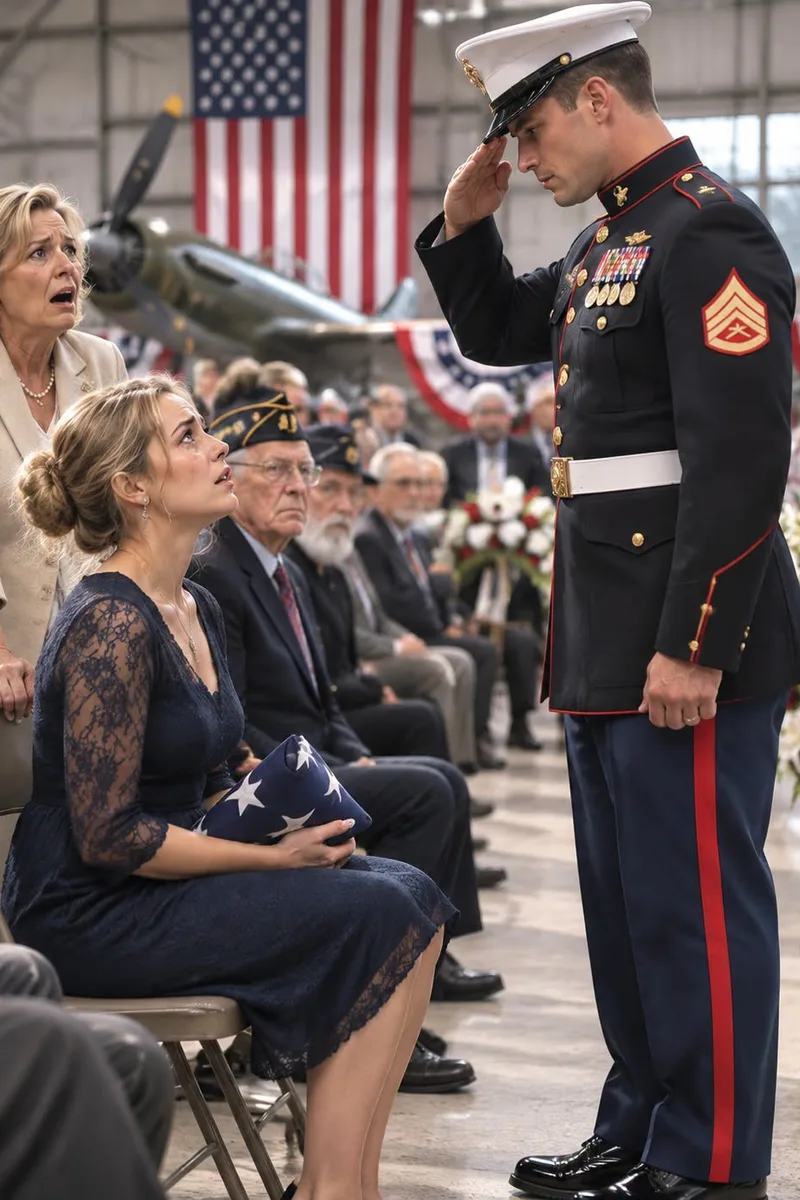
 When a Navy Officer Saluted Me at My Father's Ceremony, My Stepmother's Story Collapsed
Chapter 2
The Question in the Parking Lot
Mercer unfolded a short letter under the awning, where the rain had begun to strike the concrete in soft, irregular taps. The message confirmed a date for a formal handover and asked me to attend a preparation session before my return to Norfolk. None of it changed the assignment I'd already accepted. The reason he had traveled in person was practical: a scheduling conflict had narrowed the window, and he needed my answer before Monday. I read the page carefully, then told him I would be there. He seemed relieved that we could settle it without a telephone chain.
"I didn't mean to put you on display," he said as I folded the letter. "Someone told me you'd be seated with the family near the front. I looked there first." I almost smiled. "That would have been a reasonable guess." He hesitated, glancing through the doors at the chairs being stacked. "I heard a strange thing when I came in. A volunteer said the honoree's daughter had left the service and might not want to be approached. I thought they had confused you with someone else." I told him they had not confused my identity, only my circumstances. His face tightened, but he did not ask me to tell him family history I had no desire to share.
"You don't need to defend my career tonight," I said. "My father does need to hear it from me." Mercer agreed. He offered to confirm any ordinary public facts if asked, but reminded me that parts of the assignment remained restricted. That was the distinction Evelyn had exploited: silence about my work was not silence about whether I served. I had accepted the limitations because they protected people and responsibilities beyond this little town. I had not expected those same limitations to give my stepmother room to invent a discharge.
When Mercer left, I found Dad waiting under the covered side entrance. He held the plaque awkwardly, as if it had become heavier after the applause. Evelyn stood several feet behind him, her arms folded. "Can we go home?" she asked. "It's been a very long evening." Dad didn't answer. He looked at me instead. "I want to understand what just happened." The rain blew sideways across the steps. I suggested we talk in the diner across the road, where he and I used to eat pancakes when I was young. Evelyn announced that she was exhausted and wanted her own car. Dad handed her the keys without argument.
"You can't seriously leave me standing here," she said. Her complaint was not about transportation; she knew he could drive with me and she could take the car. Dad seemed to realize that too. "Go ahead," he said. "I'll meet you at home." The sentence was quiet, and no one applauded. Evelyn looked at me as though I had engineered a humiliation. I hadn't. I had merely asked my father for a conversation, and for once he had agreed without requiring her permission. She walked to the parking lot with quick steps, leaving the two of us beneath the awning.
The diner had closed its kitchen but Miss Donna was still counting the register. She recognized us through the glass and unlocked the door. "I can give you coffee," she said. "No food unless you want yesterday's pie." Dad asked for the pie. We sat in the booth beside the window, the one where he'd once taught me to make change from a five-dollar bill. The familiar vinyl seat made the conversation feel both easier and more dangerous. There was nowhere formal to hide, no microphone to rescue either of us with a change of subject.
"Are you a commander?" Dad asked. I nodded. "Yes." He set down his fork. "When did that happen?" I told him the date and the place, both facts I could share. He stared at the coffee. "I would have come." I believed he meant it. I also remembered the messages I'd sent about earlier milestones that had gone unanswered until Evelyn replied on his behalf. "I sent you an invitation," I said. "I never got an answer." He frowned, then looked suddenly tired. "Evelyn handles the mail when we're busy." "That shouldn't mean she decides which letters from your daughter reach you."
Dad's expression changed. He opened his mouth, closed it, then said, "She told me you'd taken time off after some trouble." The word trouble rested between us like an object neither wanted to touch. I asked whether he'd ever heard that from me. He shook his head. "I thought you didn't want to talk about it." "I didn't want to talk about my assignment," I replied. "There's a difference." He was silent long enough for Miss Donna to return with a pot of coffee and retreat again when she saw our faces.
I told Dad about the morning at the diner, the men at the gas station, and what Evelyn had said beside the seating chart. I did not ask him to accept every interpretation I attached to those facts. I wanted him to hear what I'd actually witnessed. He listened without interrupting. Finally he said, "I should have called you." It was not yet an apology for all the years, but it was the first sentence that located responsibility where it belonged. I said, "Yes. You should have." It hurt him. I watched the hurt settle and stayed in the booth anyway.
He looked toward the empty street. "I thought giving Evelyn the arrangements was how I kept the peace." I remembered my childhood home before she came, cluttered and loud and occasionally tense, but never organized around avoiding one person's displeasure. "You kept her peace," I said. "You didn't ask what it cost anyone else." He took a long breath. "I didn't understand it had become this." I believed that too, though his ignorance had required a great deal of looking away. Understanding could begin tonight. Repair would require more than tonight.
I offered him a concrete first step: call my number directly, ask what he wanted to know, and accept that some work details would remain private. He agreed. I also asked him not to confront Evelyn with a version of this conversation that made me the aggressor. "If you want to speak to her, speak about what you saw and what you allowed," I said. "Don't tell her I sent you." He looked embarrassed, then nodded. We stayed until Miss Donna finished cleaning the counter. When we stood to leave, Dad picked up his plaque and looked at it as though its meaning had changed.
Outside, he asked if I would come to breakfast at the house. I hesitated. My return flight was tomorrow, and the last thing I wanted was to spend my final hours being told to make peace for the sake of appearances. I said I would come if we could speak without Evelyn managing the conversation. Dad promised to ask her to give us time. It sounded easy in the quiet street. We both knew it would be tested as soon as we opened his front door.
The End









