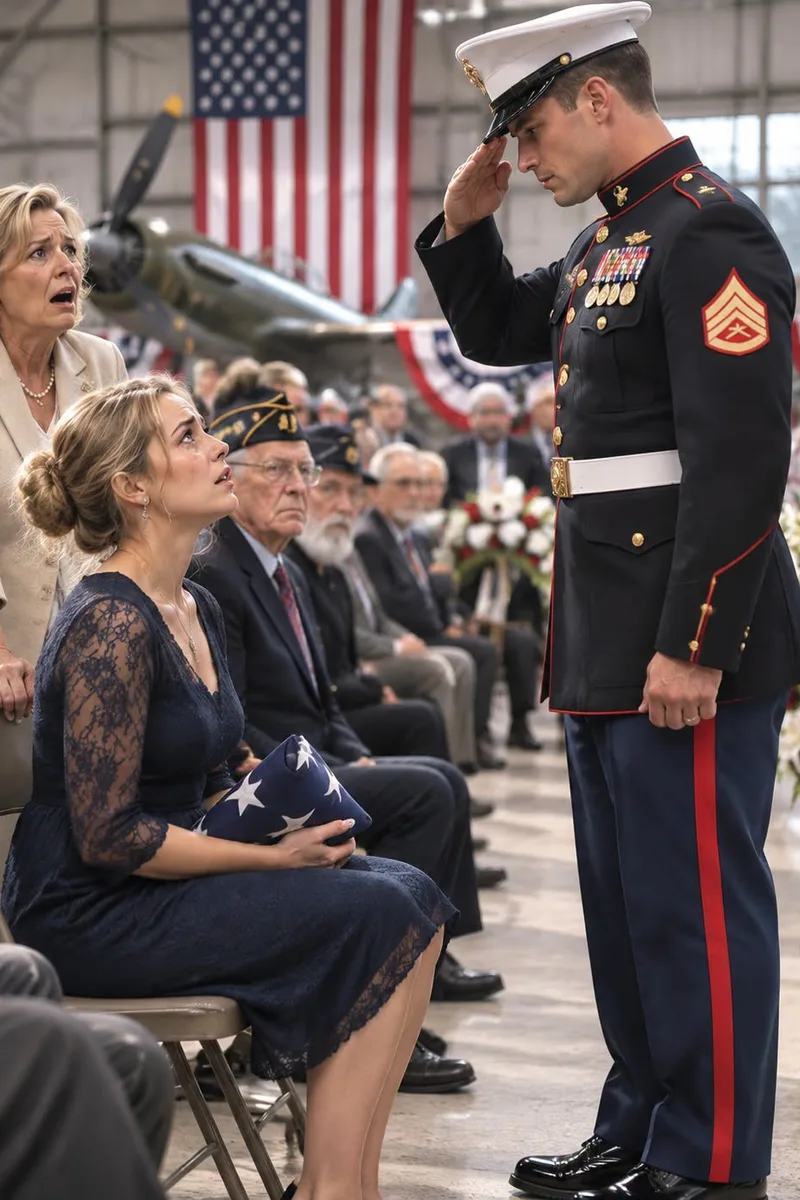
 When a Navy Officer Saluted Me at My Father's Ceremony, My Stepmother's Story Collapsed
Chapter 4
The Distance Between Two Calls
Dad drove me toward Norfolk beneath a sky that had cleared to a brittle blue. We had agreed to stop at the airport, but he wanted to take a longer route past the waterfront where we used to watch working boats return. The detour added only twenty minutes. He asked about my apartment and whether I still ran in the mornings. I answered. It felt strangely intimate to discuss ordinary details after years of messages that had passed through Evelyn.
At the waterfront parking area he turned off the engine. A tug moved slowly along the channel, pushing a barge against the current. Dad watched it for a while, then said, "I didn't want to think Evelyn was lying." He looked at me. "She has been good to me in ways I don't know how to repay." I said I understood gratitude. I also understood the difference between being cared for and being controlled. "Both things can be true," I told him. "She can help you and hurt me. You don't have to erase one to admit the other."
He told me something I hadn't known. After my mother died, he had avoided opening bills and managing appointments because each small task reminded him that the house was missing the person who used to make it work. Evelyn had stepped into that disorder with great competence. She'd organized his medication, helped him reconnect with veterans' groups, and made sure he ate regular meals. "She gave me my days back," he said. "I was afraid if I challenged her, I'd lose everything she'd built." I had no reason to doubt his account. It gave his silence a history without making it harmless.
"You didn't lose me all at once," I said. "I stopped calling as often because I rarely reached you. Then I stopped sharing news because the replies sounded like they came from Evelyn. Eventually I decided you preferred it that way." He gripped the steering wheel. "I never preferred that." I looked out at the tug, nearly past the breakwater. "I couldn't know what you preferred when you didn't tell me." He accepted that without defending himself. It was the most honest moment we'd had since I arrived.
At the terminal he carried my duffel despite my protests. I hugged him and felt how much older he had become. Before he left, he asked whether there was a time he could call without interfering with work. I gave him Sunday evenings, with the understanding that I might sometimes be unavailable and would return the call when I could. He took out his phone and entered the reminder himself. I watched him do it because the act was small and specific. It made a better promise than saying we'd never drift apart again.
The preparation session in Norfolk was as unglamorous as most important work. There were briefing slides, safety requirements, travel questions, and a long discussion about managing teams during a transition. I listened, took notes, and gave the answers I was authorized to give. The officer who'd replaced Mercer in one part of the process asked how my weekend had been. "Complicated," I said. She nodded as if that were a complete military category. We returned to the agenda. It was a relief to be treated as a colleague rather than the subject of a rumor.
On Wednesday, Miss Donna called. She apologized for interrupting but said a local veterans' association member had asked whether the officer's salute meant I'd received a special medal. I almost laughed. The town had moved from inventing my failure to inventing an achievement. Both versions treated me as a story people could complete without consulting the person living it. "It was a professional courtesy," I said. "There isn't any announcement to make." Donna repeated the words carefully. Then she asked whether I'd like her to correct the rumor that I had quit. I said yes, with the simple truth that I remained in the Navy. Nothing more.
Dad called on Sunday evening, exactly as we'd agreed. He asked about the week, told me that he'd fixed a leaky pipe, and described a veterans' outreach meeting that had gone better than expected. Then he said Evelyn was unhappy about the mail. "She thinks I'm implying she can't be trusted." I waited to hear what he'd said. "I told her I wanted to open anything addressed to me. She said that was insulting. I said it was still what I wanted." His voice shook slightly as he told me. "It shouldn't be so difficult to ask for my own letters."
I asked how he'd felt afterward. He said relieved and frightened, a combination I recognized from difficult professional decisions. He worried that Evelyn would feel unappreciated, and he also worried that she'd continue telling neighbors I was no longer serving. I told him he couldn't control what she felt, but he could correct statements made in his presence. "You don't need to turn every dinner into a trial," I said. "You do need to stop leaving the room when someone lies about me." He was quiet for a long moment, then said he'd try.
The following week brought a test neither of us had anticipated. A committee member sent Dad a draft newsletter praising the ceremony. It included a paragraph about the visiting officer and described me as a former sailor who had overcome personal difficulties to attend. Dad forwarded it to me with a note: I haven't approved this. What should I ask them to change? I felt an immediate surge of anger at the phrase personal difficulties. It was the old rumor dressed in the language of kindness. I wrote back with a single factual correction: Clare Hale is currently serving as a commander in the United States Navy. No additional details are necessary.
Dad sent the correction to the committee himself. He copied me on the response. The editor apologized and removed the false paragraph. The newsletter went out without any dramatic announcement, and I found myself disproportionately moved by that boring little exchange. Dad hadn't asked Evelyn to handle it. He hadn't told me to ignore it. He had seen an inaccurate statement, checked with the person concerned, and acted. Trust sometimes returned as a paper trail, not as an embrace.
That evening, Evelyn called my phone directly. For a moment I stared at her name, remembering the way she had spoken to strangers at the ceremony. I answered because ignoring her would not tell me what she wanted. "You've turned him against me," she said without greeting. I asked what she meant. "He corrected the committee. He questions how I manage the mail. He acts like I'm a stranger in my own home." I told her that he was making decisions about his own correspondence and reputation. She answered, "You don't know what it takes to keep that man functioning."
I could hear fear beneath her accusation, and I refused to use it as permission to forget what she'd done. "I know you've helped Dad," I said. "I also know you told people I'd left the service when I hadn't. Those facts don't cancel each other." She asked whether I wanted her to apologize in front of the entire town. I said I wanted her to stop spreading false information and correct it when she had the chance. She was silent. Then she said, "You always were difficult to please." I ended the call politely and wrote down what we'd discussed. The phone rang again almost immediately. This time it was Dad. He'd heard enough of Evelyn's side to know there had been a confrontation, and he wanted to ask me what happened instead of assuming he knew.
The End









