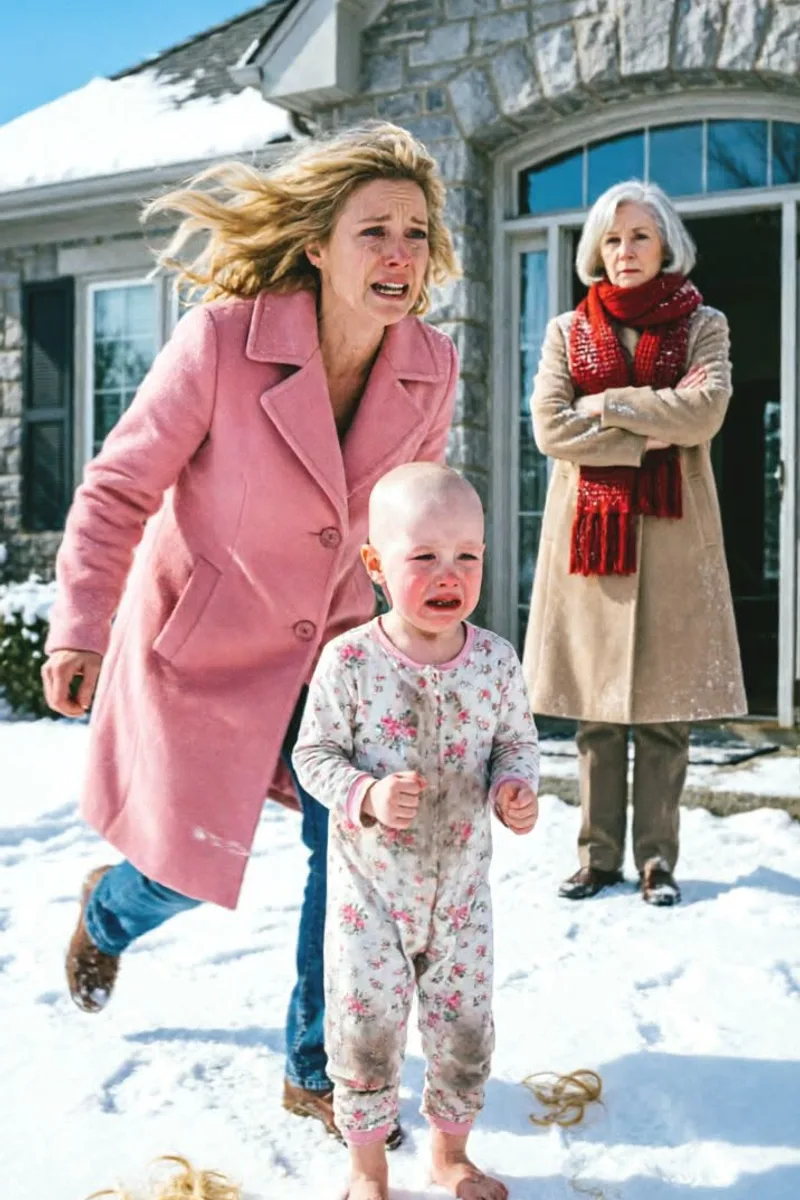
 When My In-Laws Shaved My Three-Year-Old Daughter's Head and Demanded an Apology, a Forgotten Camera Revealed the Truth
Chapter 9
The Father He Was Learning to Be
By the time spring arrived, the snow had melted from the courtyard and Daisy's hair had grown into a soft, uneven halo. She liked rubbing the short curls with her fingertips. Sometimes she wore her purple headband, sometimes she forgot it on the floor. The change wasn't only in her appearance.
She had stopped asking whether Beatrice could enter our apartment every night, though the question still returned when she was tired or upset. The clinician said progress could be uneven. I kept following the guidance and tried not to turn each good night into proof that the frightening ones were over.
Mitchell had kept the agreed visitation schedule for several months. He attended parenting sessions, participated in appropriate medical updates, and stopped asking me to communicate with his parents on his behalf. When Raymond called him repeatedly after one hearing, Mitchell told me he'd ended the conversation rather than debate Daisy's safety.
I appreciated the action, but I asked whether he'd seek help if the pressure continued. He said he would. I wanted him to learn that setting a boundary wasn't a dramatic act done once. It was a responsibility that might have to be repeated on difficult days.
One afternoon Daisy returned from a visit holding a small drawing of two houses. One had yellow curtains and a purple rabbit in the window. The other had a tree outside. She told me the second belonged to Daddy. "Can I like both?" she asked. I knelt beside her and said of course.
She didn't have to choose which parent felt happier because of her drawing. She looked relieved, then asked whether we could put it on the refrigerator beside her snowman. I taped it there. A child could understand two places without being asked to take responsibility for the distance between them.
Mitchell requested a discussion about longer-term arrangements. We met with counsel and reviewed what had worked, what remained uncertain, and how Daisy had responded to contact. I said I wanted to remain living separately. The decision wasn't intended to punish him. It reflected the trust that had been broken and the time needed to decide how we could cooperate as parents.
He looked sad, then asked whether there was anything he could do to change my mind. I told him the goal of behaving responsibly could not be a guaranteed return to marriage. Daisy needed a reliable father whether or not I ever lived with him again.
He asked if we might attend counseling for ourselves as well as for parenting. I agreed to a consultation with a clear purpose: understand what had happened and whether our communication could become healthier. At the first appointment he described the way his parents had controlled conflict in his childhood.
I told the counselor that his explanation made sense to me but did not excuse his response to Daisy's suffering. The counselor asked Mitchell what he'd do if his mother apologized without acknowledging harm. He said he would not permit contact simply because the word sorry had been spoken. I needed to hear him say it, though the future would show whether he meant it.
My own work had begun to settle into a new rhythm. The remote project went well, and my manager offered me a role that involved planning rather than constant travel. I considered it carefully, talking with Mom about childcare and with Rachel about the practical implications of our arrangements. I accepted after the details worked. I didn't feel as if I were choosing between being a mother and having a career. I felt like someone learning to shape both around real needs rather than the demands of a household where everyone else had the final say.
Brenda's involvement with the bracelet was addressed through a process that required her to account for taking and using it. I learned that she'd borrowed against the jewelry to cover a debt and then lied when Beatrice discovered it was missing. She had not expected Daisy to be accused so harshly, according to the account she later gave, but she also had not stepped forward while the punishment unfolded.
I was angry with her in a way I couldn't easily describe. Her dishonesty had helped create the conditions for the abuse, but Beatrice and Raymond were responsible for what they did. I refused to collapse three people's choices into one convenient villain.
Beatrice sent another letter, this time acknowledging that the haircut and cold balcony had been wrong. She said she had been frightened that something precious from her mother was gone and had acted cruelly. I did not respond immediately. The words were more specific than before, but a letter did not make Daisy safe with her. Rachel reviewed the message and advised that any contact questions should remain within the applicable process. I agreed. I could recognize an admission without inviting Beatrice back into our home or asking Daisy to reward it with affection.
Raymond had not offered a comparable admission. His communications continued to describe the slap as a reaction to disrespect. That told me what I needed to know about contact with him. I was no longer interested in convincing him that his authority ended where another person's body began. The relevant professionals and procedures could address consequences. I would maintain the boundaries required for safety. Daisy did not need to hear his name at dinner, and I didn't need to keep repeating it to justify my decisions.
At preschool Daisy joined a group project planting seeds in paper cups. She brought home one that looked empty and announced it was a flower waiting to happen. We placed it beside Bean and checked the soil each morning. One day she became frustrated when nothing appeared and pushed the cup away. I told her growing things took time. She looked at my hair, then touched her own curls. "Like this?" she asked. "A little like that," I said. She carried the cup back to the window and asked whether we could water it together.
That evening I looked at the two-house drawing on the refrigerator. I still missed the marriage I had believed Mitchell and I shared before the incident. I missed the easy routines and the confidence that we would face every frightening thing together.
I also knew that my memory had edited out the times I'd been told to keep the peace. I couldn't build the future by forgetting what had happened or by making Daisy's recovery evidence that the marriage was fine. The work ahead was quieter: keep her safe, accept reliable help, and let Mitchell's choices stand or fail on their own.
The End









