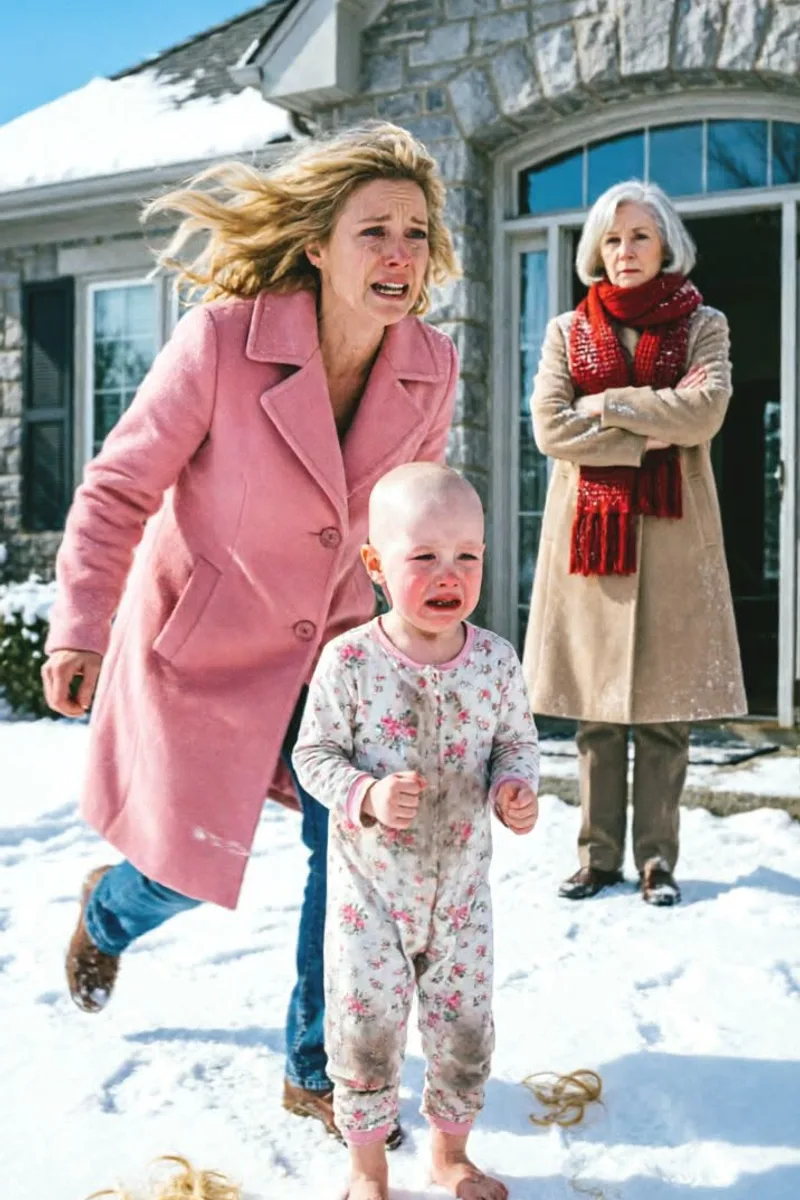
 When My In-Laws Shaved My Three-Year-Old Daughter's Head and Demanded an Apology, a Forgotten Camera Revealed the Truth
Chapter 4
The Bracelet Without an Owner
The investigator called on a gray afternoon while Daisy was napping. She said she had interviewed members of the household and wanted to clarify a few details about the old living-room camera. I answered where it had been installed, who had known about it, and why I had accessed it from Nebraska.
I had not remotely operated it to watch people in private rooms; it faced the common living area and had been put there when we used a nanny. The investigator thanked me for the specifics. She did not promise that the recording alone established theft. I appreciated her refusal to tell me only what I wanted to hear.
Brenda had told the investigators she found the bracelet under a sofa cushion and put it into her bag for safekeeping. But the clip showed her opening a pouch before she approached the sofa, not retrieving jewelry from beneath it. I couldn't see the bedroom drawer in the footage, and I didn't pretend that I could. I supplied the original file and waited while the officer reviewed it against other evidence. I wanted the truth to be reliable enough that no one could claim I'd manufactured it because I was angry with my husband's family.
Rachel suggested I keep a written timeline of new contacts and concerns rather than reviewing the video each night. I had begun waking with an urge to check the recording as though another viewing might protect Daisy from everything I'd failed to see while I was away.
The lawyer said preserving evidence was useful; reliving it repeatedly might not be. I wrote the file's date and location on my ledger and put my phone away. Daisy was still sleeping in the next room. When she woke, she would want apple slices, not a mother who had spent the entire afternoon looking at Brenda's handbag.
Mitchell requested another structured conversation. This time he came prepared with questions about Daisy's medical follow-up, her routines, and the parenting resources Rachel had identified. I was suspicious of how quickly his tone had changed. He admitted that he'd been speaking with a counselor and that his first instinct had been to call his parents whenever something went wrong.
He said he was beginning to understand why that had left me alone. I asked what he'd do if Beatrice told him I was lying. He hesitated. "I would listen to what the evidence says," he answered. It wasn't as strong as I wanted, but he didn't tell me to apologize.
That same week, Daisy's pediatrician referred us to a clinician experienced in helping young children after frightening events. At our first appointment the clinician explained that Daisy might express fear through play, sleep changes, or questions, and that we shouldn't press her to repeat the incident. She invited Daisy to choose toys while we spoke.
Daisy selected a small bear and wrapped it in a blanket. She said the bear had a cold head. The clinician looked toward me, not as a warning but as a reminder to let Daisy tell the story at her own pace. I sat on the floor and waited.
Brenda began sending messages to my old number through mutual relatives, insisting she had done nothing wrong and that I was making her look like a criminal. One relative suggested I answer her to keep peace in the family. I forwarded the message to Rachel and asked that further contact go through appropriate channels.
I could understand someone being frightened by an investigation. I did not owe that person an opportunity to persuade me to take the blame. I blocked the relatives who refused to respect that boundary and told the others I would share updates only when there was something they genuinely needed to know.
The investigator eventually confirmed that Brenda had taken the bracelet from the apartment after appearing in the camera clip. A separate financial record suggested she had later used it as collateral for a short-term loan. The exact route from Beatrice's drawer to Brenda's hands remained part of the investigation, but the evidence made it impossible to maintain that Daisy was responsible for the missing jewelry.
I felt an immediate rush of relief followed by anger so strong I had to sit down. My daughter's hair had been taken from her over an accusation that should never have justified punishment even if it had been true.
I asked whether Beatrice had received this information. The investigator said the relevant parties would be contacted through the normal process, but she couldn't give me a running account of every interview. I thanked her and called Rachel. She reminded me that the matter of the bracelet and the harm to Daisy were separate questions. Even if Brenda's conduct was proved, it would not excuse Beatrice shaving a child or Raymond striking me. I knew that intellectually. Emotionally, I wanted to hold up the report and demand that everyone see how unnecessary the suffering had been.
Instead I took Daisy to the library. She chose a book about a girl who planted seeds in winter and waited for spring. We sat in a sunny corner while she pointed out the pictures. When the girl in the book became worried that nothing would grow, Daisy touched her own hat.
"My hair is taking a long time," she said. I told her that bodies grew at their own pace, and that we could choose comfortable hats or go without one whenever she wanted. She considered that, then removed the hat for the rest of the story. I tried not to cry at the smallness and courage of the gesture.
Mitchell learned the investigator's findings before I saw him again. His next message said he believed Daisy had been wrongly accused and that he was ashamed he hadn't protected her. I read the words carefully. He had not needed proof that Daisy was innocent before rejecting the abuse. I told Rachel I wanted him to say that distinction aloud in our next meeting. She said it was reasonable to ask him to address the choices he'd made, not only the facts newly revealed about Brenda. We scheduled a discussion with clear time limits.
At Tessa's house that evening, Daisy helped stir pancake batter for dinner. She spilled some on the counter, then froze and looked at me. I picked up a cloth and handed her another. "Spills are for cleaning," I told her. "They're not a reason to hurt anyone." She wiped one spot with exaggerated care, then returned to stirring. I realized how much of our future would be built in moments like that, when a child tested whether an ordinary mistake could be met without humiliation. The bracelet mattered to the record. Daisy's confidence mattered to every day that followed.
The End









