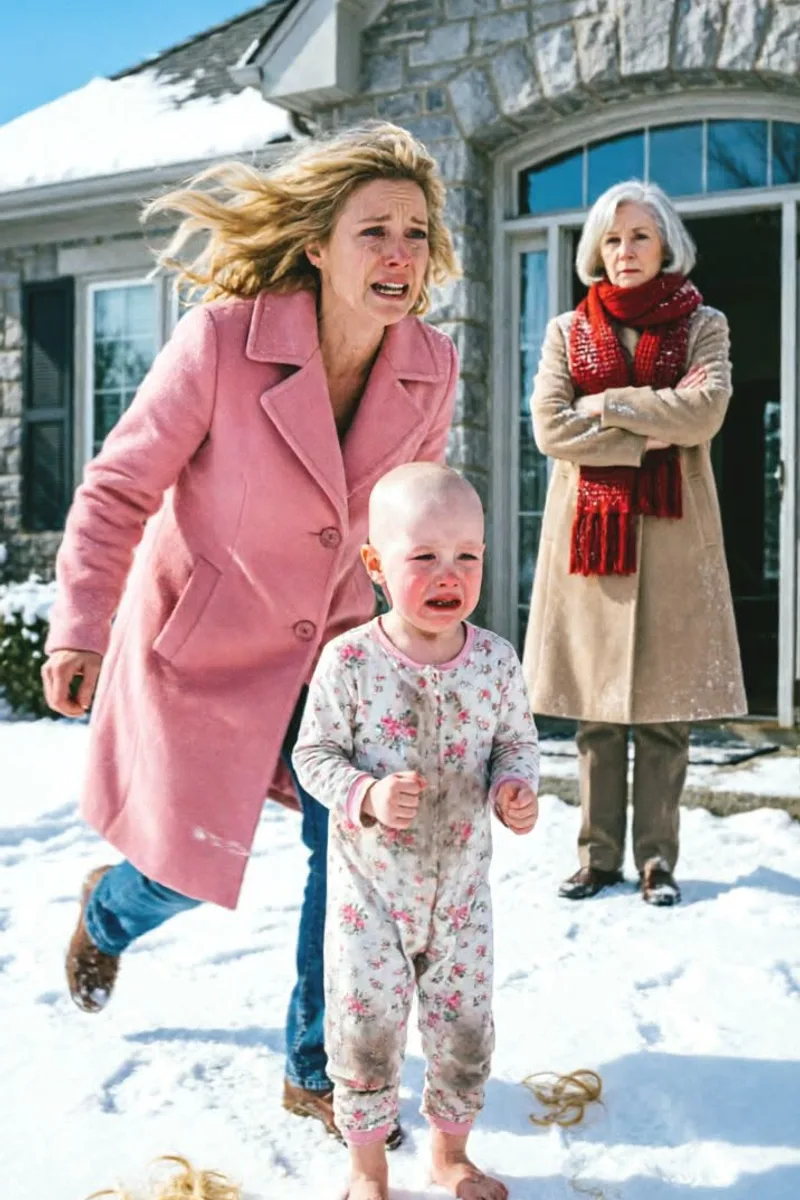
 When My In-Laws Shaved My Three-Year-Old Daughter's Head and Demanded an Apology, a Forgotten Camera Revealed the Truth
Chapter 3
The Question Mitchell Avoided
Mitchell arrived at Rachel's office wearing the coat I'd bought him for our anniversary. I noticed that before I noticed his expression, and I hated how a familiar detail could reach me even when I was angry. We had agreed to meet in a structured setting with counsel present.
Daisy was with Tessa, making a paper snowman at the kitchen table. Mitchell sat across from me and said he wanted this to stop being a family argument. Rachel asked him to explain what he thought had happened. He said his mother had been upset about the bracelet and that Daisy probably didn't understand what she'd done.
I placed the medical report on the table. I told him that Daisy had been left on an exposed balcony in thin pajamas in January, that her head had been shaved against her will, and that his father had hit me while I was holding her. Mitchell glanced at the report without touching it.
"Dad shouldn't have done that," he said. I waited for the rest. He asked whether I had frightened his parents by threatening to call the police. I looked at him until he lowered his eyes. The question he kept avoiding was whether Daisy felt safe with them.
Rachel summarized the video evidence and explained that it had been preserved for the appropriate process. Mitchell asked to see it. We played a copy on a tablet. Brenda appeared with the pouch; the bracelet caught the light; she closed her handbag. Mitchell leaned forward and watched the sequence a second time.
"Mom said Brenda had found it," he said. I asked why, if they'd found the bracelet, Daisy had been punished. He couldn't answer. His first instinct was to call Beatrice from the office. Rachel asked him not to interrupt the meeting or interfere with any investigation. He put down his phone.
I had imagined this moment in the hotel room: Mitchell would see the clip, become horrified, and ask how to help our daughter. Instead he looked as though someone had removed the explanations he had been using to keep the people he loved from being in conflict. He asked whether Brenda might have misunderstood something. I said she might have; that was why we were asking questions. But he had not needed the recording to know that shaving Daisy's head and leaving her in the cold were wrong. He looked away. That was the truth I needed him to face.
He told me he'd grown up in a household where arguing with his father made everything worse. His mother called a child's disobedience dangerous; his father believed a loud voice was the only way to get respect. Mitchell had learned to keep the peace by agreeing with them. I listened, then told him I understood why he'd become frightened of conflict. I didn't understand why he'd expected a three-year-old to pay for that fear. He flinched, but he didn't argue. For once he heard the sentence instead of trying to rephrase it as an attack on his parents.
Rachel explained that any immediate care and contact arrangements needed to put Daisy's safety first, with attention to the existing legal situation. Mitchell could ask questions about her health and participate through appropriate channels. The parents who had hurt her could not simply demand access because they were grandparents.
We would need professional guidance and, if necessary, court direction. Mitchell asked whether he might apologize to Daisy. I said not through a surprise visit and not in a way that required her to reassure him. He nodded reluctantly. It was the first time he'd accepted a condition without looking for a loophole.
After the meeting, I sat in my car shaking. Tessa called to say Daisy had eaten lunch and wanted to show me her drawing. I drove home slowly. Daisy met me at the door holding a paper snowman with a blue hat. She had drawn a smaller figure beside it and said it was me.
The figures had enormous hands, reaching toward each other. I put the drawing on the refrigerator and asked whether she'd like to go outside to make a real snowman. She said only if she could wear two hats. We found another one, and she laughed when it slipped over her eyes.
That night Mitchell sent a message through Rachel saying he was prepared to participate in parenting guidance and a mediated discussion about safety. He had also told Beatrice and Raymond that they were not to contact me directly. I appreciated the step without mistaking it for a complete change. The first message he'd sent after the assault had demanded an apology from me. Now he was beginning to accept that his job as a father was not to keep his parents comfortable. I needed to see whether he could hold that position when they were angry with him.
A child-welfare worker arranged a meeting with me and Daisy in a setting designed for young children. I asked what the process would involve and tried to prepare Daisy without telling her what to say. She could describe how she felt and what she remembered in her own words. I reminded myself that adults weren't supposed to make a child perform certainty for them. If she remembered something differently than I did, I would listen. I could keep records without turning her into my witness at every family conversation.
I began looking for a longer-term place to live. Tessa's house was safe, but I didn't want Daisy to feel as though we'd been forced into permanent hiding. My job could accommodate a temporary change of schedule while I resolved the immediate arrangements. The first apartment I visited had a bright kitchen and a small playground nearby.
I asked about locks, parking, and the route to Daisy's pediatrician. The agent looked surprised by my attention to such ordinary details. I had once looked for a beautiful place to bring my family together. Now I wanted a door I knew I could close.
Before bed Daisy asked whether Daddy knew she hadn't taken Grandma's bracelet. I told her we had found information showing another adult had it and that grown-ups were working to understand what happened. She considered that, then asked whether Daddy would be mad at Grandma.
I said grown-ups were responsible for their choices and feelings; she didn't need to manage them. Daisy tucked her rabbit into the crook of her elbow. "Good," she said. "Because I don't want anyone mad." I kissed the soft edge of her hat and wished I could give her a world where being safe never required anybody to become angry.
The End









