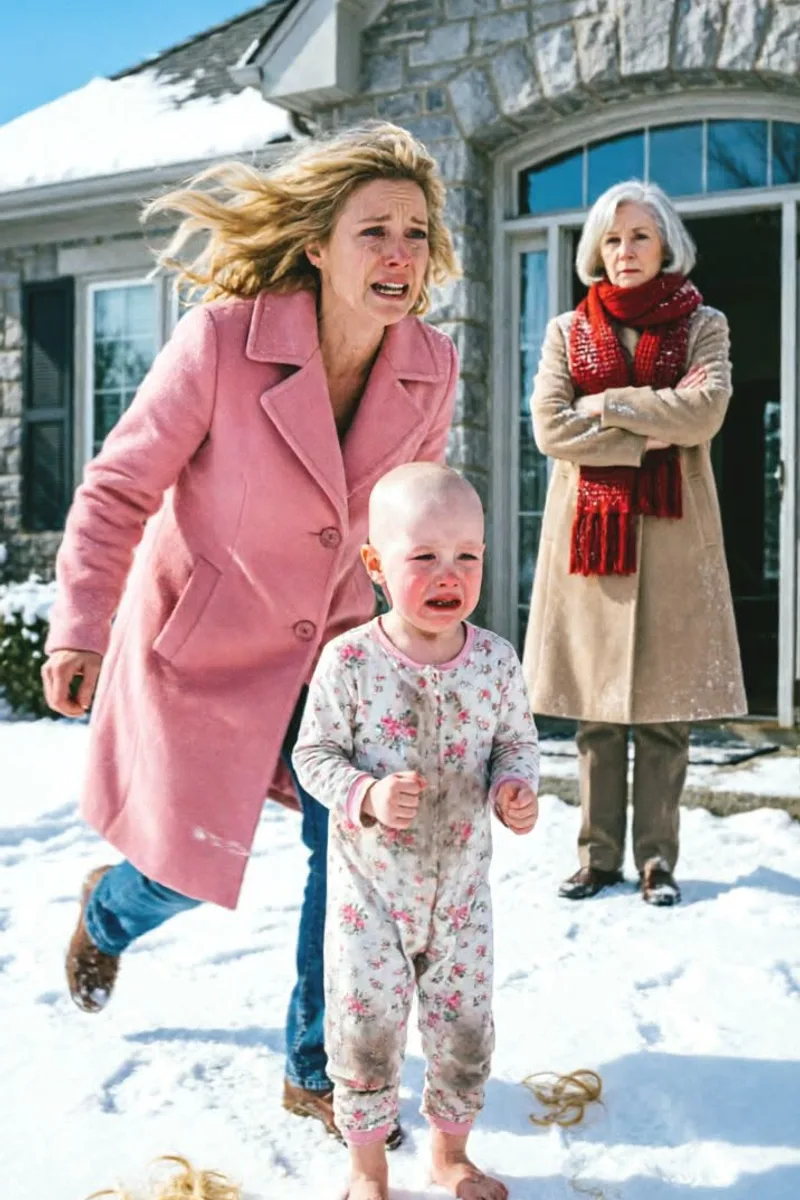
 When My In-Laws Shaved My Three-Year-Old Daughter's Head and Demanded an Apology, a Forgotten Camera Revealed the Truth
Chapter 1
The Woman in the Recording
Brenda crossed the living room carrying a narrow velvet pouch. I recognized the pattern immediately: wine-colored fabric with a gold cord, the kind Beatrice used to store her mother's bracelet. The video was silent except for the hum of the old camera's microphone and a television in another room.
Brenda stopped beside the sofa, opened the pouch, and held something yellow and bright between two fingers. The recording was grainy, but I could make out the heavy links and small oval clasp I'd seen Beatrice admire at family dinners. My hands shook so badly that I put the phone down on the hotel desk.
Daisy slept in the bed behind me, her stuffed rabbit tucked under her chin. We were near Omaha, hours from the apartment in Minneapolis where her grandmother had shaved her head and her grandfather had slapped me. I wanted to wake her and tell her she had been right, that somebody else had taken the bracelet. But a three-year-old should not have to stay awake for proof of her innocence. She needed warmth and sleep. I turned the screen away from the bed and watched the rest of the clip with headphones on.
Brenda slipped the bracelet into her own handbag. A minute later, Beatrice entered the frame holding a folded towel. She said something the camera could not capture clearly. Brenda nodded, smiled, and moved the handbag farther behind her chair.
The footage did not tell me whether Brenda had permission to handle the jewelry, or what had happened in Beatrice's bedroom before she appeared. It did tell me that at the time Daisy was being accused, another adult had the bracelet. I saved the original clip, recorded the device's date and time, and copied the file to a secure folder.
I called the hotel desk and asked for directions to the nearest emergency department that saw children. The clerk gave me two options and offered to call a taxi if I needed one. I said we had a car and asked her to write the addresses down. My face still hurt where Raymond had hit me. Daisy's scalp was red in patches, and I couldn't know how long she had stood in January cold before I found her. The safest next decision was medical care, not confronting Brenda through a screen.
At the hospital, a nurse brought a warm blanket and asked Daisy whether she wanted to sit beside me or on my lap. Daisy climbed onto me. The nurse spoke slowly and didn't touch her head without warning. I described what I had seen when I returned from Kansas City, including the cold balcony, the shaved hair, and Raymond striking me while I held her.
It was difficult to say everything in a room where people might take notes. I said it anyway. A clinician examined Daisy and documented the scalp irritation and concerns about exposure to the cold. Another clinician examined my swollen lip and shoulder.
The hospital's social worker met us before discharge. She explained that because Daisy was a child, the concerns could require a report to protective authorities and appropriate follow-up. I told her I wanted that report made and asked what information I should keep. She recommended preserving photographs, medical records, messages, and the original camera file without editing it. She also asked about immediate safety. I showed her Mitchell's text telling me to apologize to his parents. The social worker read it and looked at Daisy, who was coloring a house with a purple roof.
"Does he know where you are?" she asked. I said no. I had blocked his number after he dismissed what happened, but I had not yet decided how to communicate necessary facts about our daughter. She told me a lawyer familiar with our home state's rules could help plan those steps.
I didn't want to hide Daisy from every responsible conversation forever. I wanted to keep her away from adults who had hurt her while I found a lawful, safe path forward. It mattered to say those things separately. Fear made everything feel like one enormous decision; the social worker helped me see smaller ones.
I didn't sleep much that night. Daisy woke once and asked whether her hair would grow back. I held her in the dark and said it would, slowly, and that no one was allowed to shave it as a punishment. "Even if Grandma says so?" she asked. "Even then," I said. She pressed her cheek against mine, careful of my bruised lip, and fell asleep again. I stared at the ceiling, angrier at the fear in that question than at the pain in my face.
The next morning I spoke with an attorney in Minneapolis recommended through a colleague. Her name was Rachel Moreno. She listened while I explained the trip, the assault, the family arrangement, and the video. She did not promise that one recording would resolve everything.
She asked where Daisy ordinarily lived, who exercised parental care, whether there were custody orders, and whether there had been earlier incidents. I told her there were no custody orders and that Mitchell and I were still married. She explained that interstate travel and parenting disputes could have legal consequences, so we needed to make a safe plan promptly instead of improvising for weeks.
Rachel suggested I make a clear written account while details were fresh, preserve the medical documents, and discuss reporting to the appropriate authorities in Minnesota. She would coordinate the legal questions without exposing our location unnecessarily. I asked whether I should send the clip to Mitchell. She said it might become important evidence, but we should preserve the original and think carefully about how it was disclosed. He had already minimized the abuse before seeing any recording. I wanted him to know the truth; I also wanted to stop behaving as if proof would automatically make him protect us.
By lunchtime Daisy was asking for the chocolate teddy bears I'd promised to bring home from Kansas City. I found a small shop near the hotel that sold them in a blue wrapper. She chose one, took a bite, and left fingerprints on the paper.
For ten minutes we were simply a mother and daughter choosing a treat. Then my phone showed a message from Mitchell through an email address I had not blocked. He said his parents had been worried all night and that I needed to stop making them look bad. There was still no question about Daisy's head.
I forwarded the message to Rachel and did not answer immediately. In the camera clip Brenda's handbag had held the bracelet that supposedly justified my daughter's punishment. In the hospital record there was a description of the child's injuries and the violence I'd experienced. Those facts mattered, but another fact mattered just as much: Mitchell had chosen his parents' comfort before his daughter's safety. I couldn't repair that choice for him. I could decide what evidence to preserve and who was allowed near Daisy while the adults faced what they had done.
The End









