 Dad Said It Wouldn't Hurt... But It Does: A Second Grader's Whispered Secret That Shook a Teacher to Her Core
Chapter 81
The Legislative Chambers
The morning sun reflected off the neoclassical limestone dome of the State Capitol in Lansing, casting long, deliberate shadows across the granite steps. Inside Hearing Room 302, the air hummed with the muted cadence of public service: rustling papers, the click of stenotype keys, and the low murmurs of legislative aides sorting informational packets.
Valerie Kincaid sat at the witness table, her hands folded neatly over a slim leather binder. To her right sat Nurse Eleanor Miller, clinical and composed in her navy blazer, a silver caduceus pin gleaming on her lapel. Behind them in the public gallery sat a delegation from Greendale: Principal Arthur Harris, Clara Vance holding Lila’s hand, Martha Campbell-Vance with Noah, and Maria Alvarez, whose dark eyes watched the committee members with steady, unblinking clarity.
At the center of the elevated dais, Senator Christine Holloway adjusted her reading glasses and tapped her gavel twice.
"The Committee on Health, Human Services, and Judiciary will now come to order," Senator Holloway announced. "We are here this morning to take expert and community testimony on Senate Bill 510, informally titled the Room 204 Foundation Bill, which establishes a state-funded network of dedicated pediatric forensic nurse specialists across all public elementary districts. The committee welcomes Valerie Kincaid, recipient of the State Educator Shield of Honor, and Eleanor Miller, Registered Nurse and Certified Pediatric Forensic Examiner."
Valerie leaned toward the gooseneck microphone. The red light clicked to life.
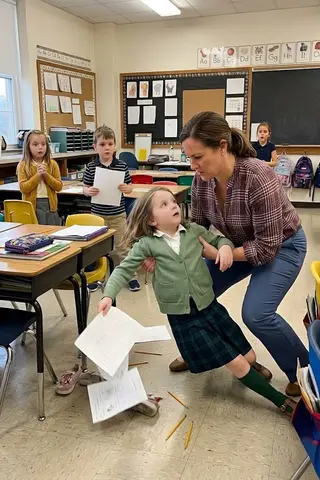
"Madam Chair, members of the committee," Valerie began, her voice carrying the quiet, unwavering clarity that had grounded second graders through four difficult years. "Four years ago, an eight-year-old child collapsed on the linoleum floor of my classroom. She had been wrapped in industrial packing cardboard and duct tape, locked in darkness, and systematically starved. Before that collapse, she had spent an entire month in my room giving me subtle, polite answers, terrified that the slightest complaint would bring about her execution."
The chamber went deathly still. Several junior legislative staffers stopped typing.
"In that moment, our school learned an irrevocable truth," Valerie continued. "Abused children do not carry placards. They do not raise their hands to announce their terror. They survive by becoming invisible, by adopting the guise of absolute obedience, and by enduring pain in silence because they believe silence is the only barrier keeping them alive. That girl was Lila Vance Mercer. Today, she is an honor roll fourth grader sitting in your gallery."
A murmur rippled through the spectators as committee members turned their heads toward the gallery, where Lila offered a serene, solemn nod.
"When Lila was rescued," Valerie said, "we made a pact. We vowed that Room 204 would never again rely on catastrophe to trigger protection. With Nurse Eleanor Miller, we forged what has become known as the Crestview Vigil Protocol—a systematic, trauma-informed baseline of early observation, non-punitive physical check-ins, and mandatory clinical forensic intervention before a child reaches the point of collapse."
Eleanor leaned forward, speaking with seasoned clinical authority. "Distinguished members, in the three years since we formalized this framework, Crestview and its regional partner districts have evaluated over forty children flagged for subtle physical or behavioral trauma indicators. In every case where domestic torture or severe felony battery was taking place—whether hidden beneath winter coats, disguised as clumsy playground spills, or masked by terrified hyper-compliance—our multi-agency net acted within twenty-four hours. Zero fatalities. Zero delayed reports. And an eighty-five percent reduction in permanent orthopedic or neurological disability."
Eleanor held up a series of anonymized radiological scans—clean, black-and-white plates showing rib fractures, spiral contusions, and soft-tissue trauma caught at early healing stages.
"Child protection is not an administrative courtesy," Eleanor concluded. "It is an acute clinical discipline. SB 510 provides every public school with the statutory backing, funding, and licensed forensic personnel needed to intervene before the morgue becomes the reporting agency."
Senator Holloway removed her glasses, her eyes moist. "Ms. Kincaid, Nurse Miller... in my twenty-two years on this committee, I have rarely heard testimony that blends such profound compassion with such rigorous institutional design. Does the committee have questions?"
Representative Donald Vance, known as a staunch fiscal conservative, pressed his microphone button. "Ms. Kincaid, the projected appropriation for full-time forensic nurses across eight hundred elementary districts is substantial. What is your response to the argument that existing school nurses and local social services are already tasked with this work?"
Valerie looked directly into the representative’s eyes. "A general practice school nurse is asked to administer insulin, dispense asthma inhalers, and bandage scraped knees for six hundred children a day. They are not trained to discern between a common playground bruise and circumferential finger-pressure marks inflicted by an enraged adult. And child protective caseworkers are overwhelmed with active crises; they cannot live in the hallways where children walk every morning. If we consider a child's life worth less than the cost of an early-warning specialist, then our society's moral budget has already failed."
A spontaneous burst of applause echoed from the gallery. Senator Holloway tapped her gavel once, not to silence the room, but to seal the moment.
"The testimony is concluded," Holloway said softly. "The committee will proceed immediately to a roll-call vote."
***
The End









