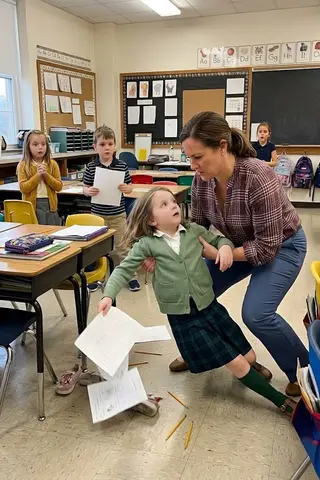
 Dad Said It Wouldn't Hurt... But It Does: A Second Grader's Whispered Secret That Shook a Teacher to Her Core
Chapter 38
The Voice on the Record
Two weeks later, Valerie and Eleanor sat at a polished mahogany witness table in the grand hearing chamber of the State Capitol.
The room was vast, flanked by marble pillars and towering oil paintings of historic governors. Above them, seated at an elevated dais, sat twelve state senators, their microphones gleaming under the intense glare of television broadcast cameras and reporters' notebooks. Clara Vance sat in the front row of the public gallery, holding Lila’s hand. Principal Harris sat beside them, his jaw set with quiet determination.
Senator Evelyn Vance adjusted her glasses and tapped her gavel. "The committee will now hear testimony on Senate Bill 402, the Student Safety and Educator Empowerment Act. We welcome Ms. Valerie Kincaid, educator at Crestview Elementary, and Nurse Eleanor Miller."
Eleanor delivered her opening remarks with surgical, clinical brilliance, outlining the stark medical realities of masked trauma, child malnutrition, and the catastrophic physical toll of delayed intervention. She detailed the vital necessity of lower nurse-to-student ratios, citing statistics that made several senators lean forward in grave concern.
Then, Senator Vance turned her attention to Valerie. "Ms. Kincaid. The floor is yours."
Valerie adjusted her microphone. For a split second, the sheer scale of the room and the clicking of press cameras made her throat constrict. But then she looked out into the gallery and caught Lila’s eye. Lila gave her a bright, confident nod—the exact same nod Valerie had given Lila on her first day back to school.
Valerie looked up at the senators and began to speak.
"Members of the committee," Valerie said, her voice ringing out steady, clear, and resonant across the chamber. "On the twenty-fourth of October of last year, a seven-year-old girl walked into my classroom. She had perfect attendance. She sat quietly at her desk. She never broke a rule, never raised her voice, and never asked for help. Under the standards of many traditional evaluations, she appeared to be an ideal, obedient student."
The room fell into an absolute, breathless hush.
"Underneath her clothing," Valerie continued, her voice tightening with quiet fury and profound grief, "she was encased in a suffocating cage of corrugated cardboard, bonded to her skin with heavy duct tape. Her father had bound her so tightly that her lungs were failing and her skin was dying from infection. He told her that if she cried, he would throw her into the river. He told her that pain was love."
A collective murmur rolled through the gallery. One senator on the dais removed his glasses, pressing his fingers to the bridge of his nose.
"She survived because she collapsed in my room," Valerie said. "She survived because our school nurse had the clinical skill to cut her free, and because our community refused to turn away. But how many children do not collapse in front of a teacher? How many children sit in our classrooms every single day, silently starving, hiding cracked bones beneath winter coats, or packing rolls into their shoes because their refrigerators at home have been empty for weeks?"
Valerie leaned toward the microphone, her eyes locking onto the committee chair.
"We teach our children reading, science, and mathematics. But our first and most sacred duty as educators is to ensure they survive long enough to grow up. Child safety cannot be a matter of luck, or the instinct of an individual teacher who happens to look twice. It must be an institutional fortress. We must give our teachers the training to see through the masks of trauma, and we must give our schools the medical and social resources to lift families out of despair before children are broken."
Valerie paused, looking across the marble room. "Every child who enters a public school classroom is placing their life in our hands. If we do not protect them, nothing else we teach them will ever matter."
For three seconds, the hearing room remained frozen in absolute silence.
Then, breaking all standard legislative decorum, applause erupted from the public gallery. Clara Vance stood, clapping through tears. Principal Harris followed. Within moments, the entire gallery was on its feet, and several senators on the dais joined the ovation.
Valerie let out a long, trembling breath. The voice that had once been whispered in the terrified shadows of Room 204 had now shaken the highest halls of the state.
***
The End









