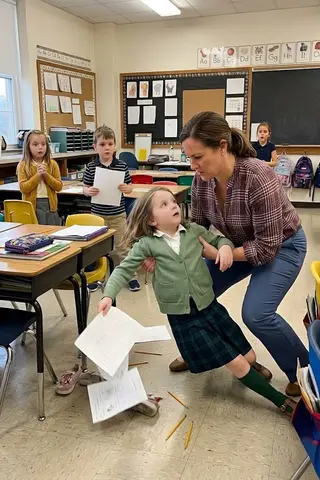
 Dad Said It Wouldn't Hurt... But It Does: A Second Grader's Whispered Secret That Shook a Teacher to Her Core
Chapter 80
The Seeds of the Fourth Year
The final weeks of February melted into the crisp, expectant mornings of early March. The snowbanks along the playground perimeter receded into clean, damp earth, and the first crocuses began pushing their purple tips through the mulch beneath the Reading Arbor.
Inside Room 204, the rhythm of education had reached that glorious mid-spring harmony where children no longer merely followed instructions, but inhabited the room as their sovereign domain of learning and joy.
Noah Campbell was now reading at third-grade fluency. During reading circles, his voice was clear, lively, and filled with dramatic inflection. Elena Alvarez sat beside him, her hairline rib fractures completely healed, her laughter ringing out across the classroom during recess games of tag.
In the fourth-grade wing, Lila Vance Mercer was preparing for the regional science fair, her project on the acoustics of cetacean communication earning high praise from the district committee. Julian Cole and Maya Lin in Room 208 were collaborating on a historical presentation about the founding of the Greendale canal system.
On this particular Friday afternoon, Valerie stood at the classroom window during her planning period, watching the garden club clean out the cedar planter boxes around the arbor.
Principal Harris walked into Room 204, accompanied by Dr. Kenneth Rawlings of Oakridge and a woman Valerie recognized immediately: Rachel Bailey, the first-grade teacher from Millbrook Elementary who had famously utilized the Crestview Protocol to save young Toby a year earlier.
"Valerie," Harris said with an expansive smile. "We have visitors from the State Department of Education."
Dr. Rawlings stepped forward, shaking Valerie’s hand with profound respect. "Ms. Kincaid, we’ve just concluded the quarterly evaluation of the multi-district trauma consortium. Over the past twelve months, the implementation of Statute 402 across our seven collaborating districts has documented an eighty-five percent increase in early-stage domestic violence interventions, with zero child fatalities reported in our jurisdiction."
"That is extraordinary news, Dr. Rawlings," Valerie said, her voice filled with deep gratitude.
"It gets better," Rachel Bailey added, her eyes shining. "The Governor’s office has officially introduced the 'Room 204 Foundation Bill' to the state legislature. If passed, it will make trauma-informed forensic nurse partnerships mandatory in every elementary school in the state, funded by a dedicated child welfare endowment. They want you and Eleanor to deliver the keynote address at the legislative hearing next month."
Valerie looked out the window. Down below, Lila was kneeling beside Elena by the Reading Arbor, showing her how to plant sunflower seeds in the dark, freshly turned soil. Noah was carrying a small green watering can, pouring water over the earth with careful, steady hands.
They were children who had known the darkest depths of human cruelty—children who had been bound, beaten, starved, and terrorized. Yet here they stood in the clear March sunlight, planting seeds for a summer they now had the right to see.
"We will be there, Rachel," Valerie said quietly. "We will tell them what happened in this room. And we will remind them that a child’s whisper must always be louder than the loudest silence."
Principal Harris looked at the bulletin board by the door, where Elena’s drawing of the arbor hung proudly beside Noah’s picture of the yellow house and Lila’s framed poem from two years ago.
"The fourth year is approaching, Valerie," Harris said softly. "New rosters will come. New children will walk through that door carrying things we cannot see."
Valerie turned back to the room, adjusting a box of pristine, unbroken crayons on the reading table. A serene, unshakable smile touched her lips.
"Let them come, Arthur," Valerie said. "The room is ready. The anchors are set. And the door will always be open."
The End









