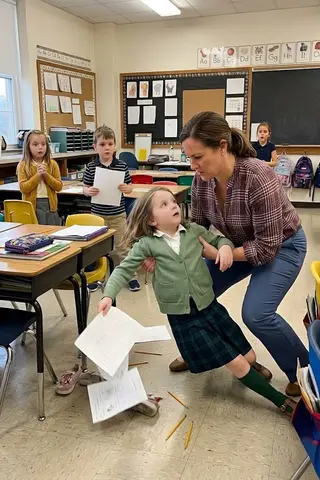
 Dad Said It Wouldn't Hurt... But It Does: A Second Grader's Whispered Secret That Shook a Teacher to Her Core
Chapter 33
Whispers in the Cafeteria
By the first week of November, the Crestview cafeteria was buzzing with the lively chatter of the midday rush. Trays clattered against stainless steel counters, the smell of pizza and steamed corn hung in the humid air, and monitors blew their plastic whistles to maintain order.
Valerie took her turn on cafeteria duty alongside Nurse Eleanor. While most teachers treated the thirty-minute lunch block as a chance to catch up on grading, Valerie and Eleanor viewed the lunchroom as an invaluable canvas of behavioral observation. A child’s relationship with food, personal boundaries, and physical touch was often laid bare in the noisy chaos of the cafeteria.
"Table four, second-grade row," Eleanor murmured, taking a subtle step beside Valerie near the milk cooler. "Watch the little girl with the pink barrettes. The transfer student who arrived on Monday."
Valerie shifted her gaze. Her roster had gained another student that week: Maya Lin, a seven-year-old girl with delicate features and wide, watchful brown eyes. Maya’s school file indicated she had recently entered the county foster care system following her mother’s sudden hospitalization, and she was currently placed under kinship guardianship with her elderly maternal grandmother, Mrs. Evelyn Lin.
Maya sat at the far end of the long folding bench. Unlike the other children who tore into their lunch bags with loud enthusiasm, Maya worked with robotic, silent precision.
She opened a paper sack, but instead of eating, she began looking anxiously from left to right. Her shoulders were hunched, her chin tucked into her chest. She took a single dinner roll from the cafeteria tray, wrapped it tightly in a brown napkin, and slipped it deep into the front pouch of her denim overalls. Then, glancing around again to ensure the cafeteria monitors were looking elsewhere, she took half of an uneaten peanut butter sandwich from her tray and slid it down the side of her shoe, concealing it beneath the cuff of her jeans.
Valerie felt an ache in her core. Food hoarding was a classic, desperate symptom of early developmental neglect or housing insecurity.
"She isn't eating a bite," Valerie observed quietly. "She's stashing it for later."
"And look at her hands," Eleanor added, her clinical instincts sharp. "Every time another student reaches across the table to grab a carton of chocolate milk, she withdraws her hands into her sleeves and leans back. She treats food as a scarce, contestable resource that can be ripped away at any second."
Just then, a boisterous boy sitting two seats down accidentally bumped Maya's tray while reaching for a bag of chips. Maya let out a sharp, choked gasp, instantly throwing her entire torso across her food tray, covering her carton of milk and half-eaten apple with her forearms like a soldier shielding a grenade.
The cafeteria noise continued around her, but Maya remained frozen in that defensive posture, trembling violently, her eyes darting like a trapped sparrow's.
Valerie immediately began walking toward the table, her steps calm, measured, and devoid of urgency. The art of intervening with a traumatized child lay entirely in the absence of alarm.
***
The End









