 Dad Said It Wouldn't Hurt... But It Does: A Second Grader's Whispered Secret That Shook a Teacher to Her Core
Chapter 23
The Oakridge Seminar
On the last Friday of July, the central auditorium of the Oakridge Regional High School was filled to capacity with more than four hundred elementary school teachers, nurses, counselors, and school resource officers. The atmosphere was charged with quiet anticipation. Recent news reports regarding systemic failures had left many in the room defensive, while others looked visibly burdened by the sheer weight of responsibility.
Valerie stood backstage alongside Eleanor Miller. Eleanor adjusted her spectacles, her hands trembling slightly against her presentation binder.
"I’ve spent thirty-four years taking temperatures and bandaging scraped elbows, Valerie," Eleanor whispered, her voice tight. "I never imagined I’d be standing on a stage telling four hundred strangers how to spot child torture."
Valerie reached out and placed her hand over Eleanor's. "You aren't telling them how to be detectives, Eleanor. You’re telling them how to listen when a child cannot speak. Just speak from the heart of Room 204."
When Superintendent Rawlings introduced them, the applause was respectful but subdued. Valerie stepped up to the podium, looking out at the rows of educators who carried the futures of countless families on their shoulders.
Instead of displaying clinical statistics on the overhead projector, Valerie began with a simple physical prop. She reached into a cardboard box and lifted a plain, unsharpened No. 2 yellow pencil.
"In early October of last year," Valerie spoke clearly into the microphone, her voice resonating through the auditorium, "a seven-year-old girl dropped this pencil on the floor of my classroom."
She paused, letting the silence settle over the room.
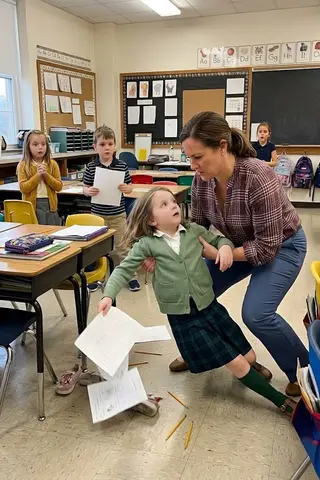
"She did not bend her knees to retrieve it. She did not reach down. Instead, she stared at that pencil on the linoleum with an expression of sheer, paralyzing horror. To an untrained eye, or to a teacher hurried by standardized reading goals, she might have looked distracted, stubborn, or disobedient. But she was paralyzed because beneath three layers of heavy winter clothing, her torso was encased in corrugated cardboard wrapped in three layers of industrial duct tape."
A collective, audible gasp rippled across the auditorium. Several teachers in the front rows covered their mouths.
"Abuse rarely announces itself with screams and dramatic bruises on the playground," Valerie continued, her voice gaining steady power. "Abuse hides in the quietest corners of your classrooms. It hides in the child who refuses to take off a winter coat when the radiator is hissing. It hides in the child who uses the bathroom only when the hallway is completely empty because they cannot sit down without tearing their skin. It hides in the student whose posture never relaxes, whose eyes constantly track your hands, and who apologizes for existing."
Eleanor stepped up beside her, clicking to a slide showing anonymous, schematic illustrations of atypical physical indicators: linear abrasions, uniform pressure marks, symmetrical bruising, and the psychological concept of 'frozen watchfulness.'
"Our mandate as educators is not to prove guilt," Eleanor told the audience firmly. "Our mandate is reasonable suspicion and prompt documentation. If your gut clenches when you look at a child, do not second-guess yourself into inaction. You do not wait for permission to protect a life. You pick up the phone, you call protective services, and you do not let the child walk back out that door into danger."
When the presentation concluded forty minutes later, the entire auditorium stood up as one. The standing ovation was not one of celebratory triumph, but of somber, unified resolve.
***
The End









