 Dad Said It Wouldn't Hurt... But It Does: A Second Grader's Whispered Secret That Shook a Teacher to Her Core
Chapter 1
The Weight of Seven Years
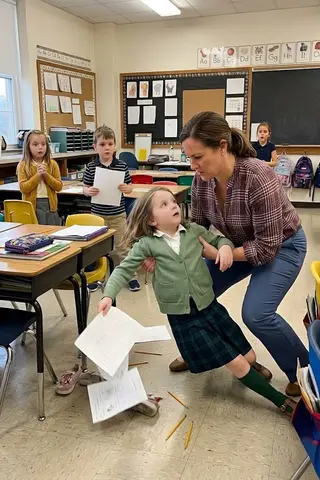
The fluorescent hum of Room 204 was the background music to Valerie Kincaid’s life for twelve years. It was a familiar frequency, buzzing quietly above the scuff marks on the tile floor and the faint scent of old crayons, damp wool, and apple juice. On this particular Thursday in early October, the gray Pennsylvania morning pressed against the tall classroom windows like a heavy, wet veil. Outside, the oak leaves were turning brittle and brown, dropping one by one onto the asphalt playground. Inside, twenty-two second graders were settling into their morning routine with the restless energy typical of seven-year-olds. Chairs scraped against the floorboards, pencils clicked against plastic pencil boxes, and small, high-pitched voices bickered over the best color of glitter glue.
Valerie stood near her oak desk, holding a stack of double-sided math worksheets that smelled faintly of the copy machine toner. Her eyes scanned the rows automatically, tracking movement, behavior, and mood. Teaching second grade required a specific kind of hyper-vigilance. You had to know who skipped breakfast, who stayed up too late playing video games, and whose parents were going through a bitter custody battle before the children even unzipped their backpacks.
That was how she spotted Lila Mercer.
Lila sat alone in the third row by the bank of windows. She wasn't making noise. In fact, she was standing out precisely because she was making no noise at all. While the boy next to her, a chatterbox named Leo, was enthusiastically stabbing his eraser into his desk, Lila sat completely still. Her pale blue cardigan was buttoned with absolute precision—every button slipped meticulously into its corresponding hole, right down to the hem. Her hands were folded on top of her laminated desk mat, resting palms down, knuckles slightly pink.
Valerie paused, her thumb flicking the edge of the math worksheets.
She knew Lila. Every teacher on the elementary school wing knew Lila. She was the textbook definition of a "good girl." She never ran in the hallways, never raised her voice, never cried when she didn't get the purple crayon, and turned in every assignment on time, neat and legible. Adults loved children like Lila because they required zero emotional labor. They blended into the background like pleasant wallpaper.
Yet, as Valerie watched closer, something felt profoundly wrong.
Lila wasn't just sitting quietly; she was holding herself together. Literally. Her small shoulders were locked tight, pulled back and rigid. Her knees were pressed hard against one another underneath the metal frame of the desk. When a sudden gust of wind rattled the windowpanes, making the glass shudder, Lila flinched—not with a normal startle, but with a sharp, controlled wince that rippled down her entire spine. Her face tightened into a grimace for half a second before her expression wiped clean, replaced by that hauntingly practiced, polite neutrality.
Valerie felt a cold prickle at the back of her neck.
That isn't normal posture, Valerie thought, her grip tightening on the papers. That is the posture of someone guarding an injury.
The End









