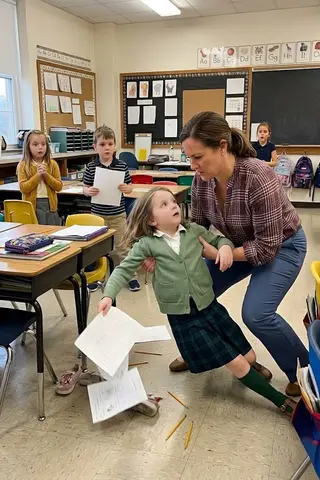
 Dad Said It Wouldn't Hurt... But It Does: A Second Grader's Whispered Secret That Shook a Teacher to Her Core
Chapter 21
Ripples Across the County
The silence of summer break descended upon Crestview Elementary with an almost eerie tranquility. The polished terrazzo floors of the long corridors reflected the golden afternoon sunlight through vacant double doors. In Room 204, the air was warm, smelling faintly of citrus cleaning solution and floor wax. Valerie Kincaid stood over her desk, smoothing out the worn edges of the newspaper clipping Clara had tucked into Lila’s farewell card.
The headline from the *Oakridge Gazette* was stark: *State Department of Education Opens Review into Oakridge Elementary Following Reports of Overlooked Student Trauma*. The article detailed how a six-year-old child had endured months of severe neglect before an outside relative intervened, prompting county officials to question why warning signs had slipped past school staff. Toward the bottom of the column, the reporter noted that county prosecutors were pointing to the recent resolution in Crestview as the gold standard for classroom vigilance.
Before Valerie could fold the clipping back into her leather planner, the classroom phone rang, shattering the summer quiet.
"Valerie? Are you still packing up?" Principal Harris’s voice sounded over the line, carrying an unusual blend of urgency and warmth.
"Just finishing the supply inventory, Arthur. What is it?"
"If you have twenty minutes, I’d appreciate you coming down to my office. We have a visitor—Superintendent Rawlings from the Oakridge School District. He drove down here personally after reading the district attorney's summary of the Mercer case."
Ten minutes later, Valerie sat in the familiar leather chair across from Principal Harris. Sitting beside her was Dr. Kenneth Rawlings, a silver-haired man whose expression bore the visible exhaustion of an administrator under intense public scrutiny. On the mahogany coffee table between them sat Eleanor Miller’s medical triage records and Valerie’s classroom observation log—redacted to protect Lila’s identity, but clear in their devastating precision.
"Ms. Kincaid," Superintendent Rawlings began, his voice raspy and sincere, "I won't mince words. We failed a child in our district. The signs were there—the withdrawal, the sudden drop in attendance, the defensive posture—and our staff simply marked it down as behavioral stubbornness or seasonal illness. When I read the court transcripts of your testimony and Eleanor’s documentation, I realized our educators are fundamentally unequipped to see what sits right in front of them."
Valerie felt a heavy knot form in her chest. "It isn't about blaming teachers, Dr. Rawlings. We are trained to teach literacy, math, and social studies. Nobody gives us a syllabus on how to recognize a child bound in physical restraint or living under terror."
"Which is precisely why I’m here," Rawlings replied, leaning forward. "Our county board has authorized an emergency professional development symposium for all primary school teachers and nurses across four districts in late July. We want you and Nurse Miller to lead the keynote workshop. We don't want legal theory from state lawyers. We want the two people who walked into a classroom, trusted their instincts, and saved a seven-year-old girl’s life."
Valerie glanced at Principal Harris, who nodded encouragingly. "You said it yourself at the board meeting, Valerie," Harris said gently. "Vigilance is not optional. You have a chance to turn what happened to Lila into a permanent shield for thousands of children."
Looking at the weathered newspaper clipping in her lap, Valerie closed her eyes for a brief moment. She remembered Lila's trembling whisper from that cold morning in October: *Dad said it wouldn't hurt... but it does.*
"I’ll do it," Valerie said softly. "On one condition. We don't turn Lila into a spectacle. We teach them how to look at every child who sits quietly in the corner, holding their breath."
***
The End









