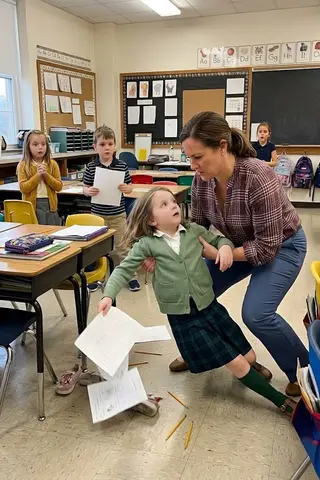
 Dad Said It Wouldn't Hurt... But It Does: A Second Grader's Whispered Secret That Shook a Teacher to Her Core
Chapter 41
The First Cohort
The first Monday of February brought a sharp, crystalline frost that turned the playground asphalt silver and coated the classroom windows in delicate ferns of ice. Before the morning bell, Crestview Elementary’s media center buzzed with the low murmur of thirty visiting educators. They had arrived from three neighboring rural districts, clutching spiral notebooks and hot mugs of coffee, their eyes reflecting a blend of weariness, curiosity, and cautious hope.
Valerie stood at the front podium alongside Thomas Henderson and Nurse Eleanor Miller. Projected behind them on the digital display was a simple photograph of Room 204’s sunlit reading corner, accompanied by a single sentence: *Safety is not the absence of danger; it is the presence of an unbreakable connection.*
Principal Arthur Harris opened the session with brief, grounded remarks before stepping back to yield the floor to Valerie.
"Every child who enters your classroom brings an entire invisible world with them," Valerie began, her voice steady and resonant in the quiet library. "Some bring warmth, secure routines, and the confidence of being cherished. Others bring the terrifying weight of adult secrets—secrets they believe they must carry alone in order to survive. When a child is trapped in terror, they do not announce it with words. They announce it with silence, with excessive compliance, with strange posture, or with an oversized jacket worn in sweltering heat."
In the third row, a young woman with dark hair tied back in a hurried ponytail leaned forward. Her badge identified her as Rachel Bailey, a first-grade teacher from Millbrook, an underfunded school thirty miles south. Her fingers gripped her pen so tightly that her knuckles were pale.
Thomas took over, speaking to the practical mechanics of classroom design. He explained how predictability in seating, physical transparency, and low-stimulus calming zones allowed hypervigilant nervous systems to rest. "A child who spends every ounce of mental energy scanning the perimeter for an incoming threat cannot process long division or phonics. We cannot teach the mind until we have anchored the body."
When the orientation concluded, the visiting teachers divided into small observation groups. Valerie led four teachers, including Rachel Bailey, down the polished hallway toward Room 204.
As the second graders filed in from the morning line, Valerie initiated the quiet, rhythmic ritual she had practiced for years. She stood at the threshold, meeting each child at eye level. She offered a gentle smile, an open palm, and a warm greeting tailored to each student.
"Good morning, Maya. Your braids look beautiful today."
"Good morning, Julian. I see your space shuttle book tucked in your backpack—let’s make sure we find time for you to share chapter three during silent reading."
Julian grinned, hanging his neatly fitted navy winter coat on his assigned wooden peg. There was no hesitation in his movements, no flinching as he reached upward, no protective hunch over his ribs. He carried himself with the natural, unburdened fluidity of a healthy, thriving eight-year-old boy.
Behind Valerie, Rachel Bailey watched with an expression bordering on heartache. As the students began their morning handwriting exercises, Rachel stepped closer to Valerie’s desk and spoke in a trembling whisper. "Ms. Kincaid... how do you know the difference between a child who is just quiet, and a child who is slowly drowning?"
Valerie turned to face her, seeing in the young teacher's eyes the exact panic and intuition she herself had felt on that fateful October morning with Lila Mercer.
"You look for what they are trying so desperately to hide," Valerie whispered back gently. "And during our planning period today, Rachel, you and I are going to sit down, and you are going to tell me about the child who brought you here."
***
The End









