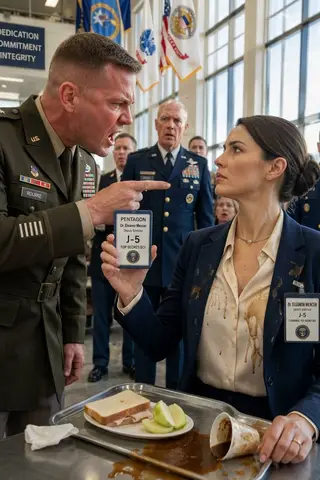
 THE PENTAGON CAFETERIA DISASTER: Arrogant Marine Shoves High-Ranking Female Official With Top-Secret Clearance
Chapter 9
Vindication at the Army-Navy Club
The grand ballroom of the Army-Navy Club in downtown Washington was a masterclass in timeless elegance—crystal chandeliers casting a warm amber glow over polished mahogany tables, walls adorned with historical portraits of legendary commanders, and the soft murmur of diplomats, cabinet members, and flag officers mingling over vintage wine and hors d'oeuvres.
Tonight was a celebration of resilience, strategic brilliance, and institutional reform. The successful adoption of our Indo-Pacific logistics framework had just been officially signed into law by the Secretary of Defense earlier that afternoon, closing critical national security vulnerabilities that had languished in bureaucratic limbo for years.
I stood near the tall arched windows overlooking downtown D.C., wearing a sleek, tailored midnight-blue evening gown that felt a million miles away from the coffee-stained white blouse of a week ago. Holding a glass of sparkling water, I watched the room interact with a quiet sense of satisfaction.
"You clean up remarkably well for someone who survived a combat zone in the Pentagon cafeteria," a warm, familiar voice murmured beside me.
I turned to see General Arthur Vance smiling gently, his dress uniform immaculate, adorned with his signature rows of service ribbons and stars. Beside him stood the Secretary of Defense, holding out a hand in warm greeting.
"Dr. Vance," the Secretary said, shaking my hand with genuine enthusiasm. "I want to personally thank you for your extraordinary work on the Indo-Pacific framework. Your insights last week didn't just save our supply lines—they fundamentally shifted how this administration approaches strategic risk management."
"Thank you, Mr. Secretary," I replied graciously. "It takes a collaborative team to turn data into action. Though I have to admit, having the Chairman of the Joint Chiefs as an enthusiastic hype man certainly helped grease the bureaucratic wheels."
The Secretary laughed heartily, glancing at General Vance. "Well, Arthur has always had a knack for recognizing talent—and an absolute zero-tolerance policy for anyone foolish enough to get in your way."
"Speaking of which," General Vance added with a sly grin, raising his glass in a silent toast, "I hear the fallout from your little cafeteria adventure has resulted in a thirty percent drop in arbitrary civilian harassment complaints across all three major D.C. defense installations. Turns out, a very public reminder about basic professionalism was precisely what the joint services needed."
"Maybe we should issue commemorative coffee mugs to all incoming personnel," I suggested, my eyes sparkling with amusement. "Printed with the golden rule: Check your clearance, not your manners."
The Secretary nearly choked on his champagne, laughing so hard that several nearby admirals turned their heads in curiosity. "Consider that patent pending, Doctor."
As the evening progressed, the formal dinner was served, followed by toasts, warm handshakes, and deep, productive conversations about the future of national security architecture. Every single flag officer in the room—from the naval commanders to the Air Force generals—approached our table at some point during the night to offer their profound respect, gratitude, and collegial warmth.
The memory of Gunnery Sergeant Blake Rourke, his arrogant smirk, and the burning sting of hot coffee had completely faded into the background, eclipsed by the undeniable reality of success, validation, and systemic change.
The End









