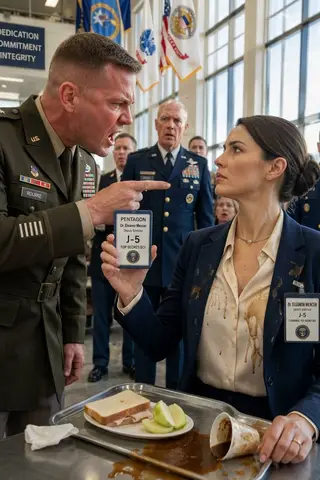
 THE PENTAGON CAFETERIA DISASTER: Arrogant Marine Shoves High-Ranking Female Official With Top-Secret Clearance
Chapter 3
The Arrival of the Four-Star Brass
The cafeteria air seemed to drop ten degrees as Gunnery Sergeant Blake Rourke snapped around to face the interruption. Standing less than three feet behind him was General Arthur Vance, the Chairman of the Joint Chiefs of Staff. Flanking him were two lieutenant generals and the Pentagon’s Director of Security Operations. The gold stars on General Vance’s shoulders caught the fluorescent overhead lighting, gleaming with an authority that commanded absolute silence from everyone within fifty yards.
Rourke’s face, which had been flushed with angry crimson just seconds earlier, turned an ashen, ghostly white. His jaw worked silently for a split second, his lips parting and closing like a fish gasping for water, before he managed to bark out a rigid military greeting.
"General Vance, sir!" Rourke bellowed, his voice cracking slightly on the final syllable as his right hand shot up into a sharp, trembling salute. "Gunnery Sergeant Rourke reporting, sir! Area secure, all unauthorized personnel being—"
General Vance did not return the salute. He didn't even look at Rourke's outstretched hand. Instead, the Chairman’s sharp, weathered eyes swept past the Marine’s broad shoulders, locked directly onto me standing beside the ruined tray of coffee and sandwiches, and surveyed the dark brown stain splashed across my white silk blouse. A muscle twitched along the general’s jawline—not in amusement, but in cold, controlled fury.
"At ease, Gunnery Sergeant," General Vance said, his voice dropping into a low, rumbling register that sent a visible shiver down Rourke’s spine. "Though I use the term 'ease' loosely, considering you appear to have declared war on an unprovoked breakfast tray."
Rourke swallowed hard, his Adam's apple bobbing violently. "Sir, I—this civilian—she wandered past the designated security perimeter near the eastern windows, sir. Refused to identify herself, showed aggressive non-compliance, and disrupted the command staff protocol. I was merely executing protocol to clear the sector."
The silence that followed was heavy enough to suffocate. The surrounding officers didn't move a muscle. The young Army captain who had snickered earlier was now staring straight down at his table, desperately wishing he could melt into the linoleum floor.
General Vance took two slow, measured steps forward, coming to a halt right beside Rourke. The Chairman stood slightly shorter than the bulky Marine, but the sheer gravitational pull of his presence made him look ten feet tall. He didn't look at Rourke; he kept his eyes fixed entirely on me, his expression softening from military ice into a look of deep, professional respect.
"Dr. Alana Vance," the Chairman said clearly, his voice carrying effortlessly across the entire cafeteria. "I apologize for the delay. We were wondering why you hadn't arrived on the fourth-floor briefing deck yet."
The name hung in the air like a thunderclap.
Dr. Alana Vance.
Not a civilian wanderer. Not a confused consultant. Not a contractor looking for a bathroom. But Dr. Alana Vance—the premier senior cyber-defense strategist and special advisor to the National Security Council, the woman whose name was whispered with absolute reverence in intelligence circles across Washington, and incidentally, the general's niece, though very few people in the Pentagon knew or dared to weaponize that familial connection. More importantly, I was the lead architect of the classified defense architecture review currently sitting inside the locked briefcase resting on my chair.
Rourke’s brain appeared to short-circuit entirely. His eyes bulged as he slowly turned his head to look from General Vance to me, and back to General Vance again, his mouth hanging open in silent horror. The color drained completely from his cheeks, leaving him looking like a corpse in a pressed uniform.
"D-Dr. Vance?" Rourke stammered, his military bearing cracking down the middle like cheap glass. "Ma'am... I—I didn't know... there was no indication—"
"Gunnery Sergeant," I interrupted, stepping forward and looking down at the coffee still dripping from the edge of my ruined blouse. "You made it abundantly clear that you don't read indications. Or situations. Or basic human decency."
General Vance turned his head slowly, fixing his steel-gray eyes on the trembling Marine. The weight of those eyes had broken generals and sent policy chiefs scrambling for early retirement.
"Gunnery Sergeant Rourke," the Chairman said softly, every word enunciated with surgical precision. "You were assigned to perimeter hospitality and general corridor oversight in the east wing. You were explicitly instructed to maintain order and assist visiting delegates. Instead, I am told by three separate flag officers watching from the balcony that you physically assaulted a senior national security advisor, destroyed her personal property, and subjected her to public harassment because you mistook her for someone disposable."
"Sir, it was a misunderstanding—I thought—" Rourke tried to interject, his voice trembling uncontrollably.
"You didn't think, Gunnery Sergeant," General Vance cut him off, his voice rising just enough to snap like a whip. "That is precisely the problem. In this building, nobody is disposable. Every single person here—from the civilian analysts tracking logistics to the advisors shaping our defensive posture—is a vital part of national security. And you just demonstrated a catastrophic failure of judgment, discipline, and basic professionalism."
The Director of Security Operations stepped forward, pulling a small digital tablet from his inner pocket. He didn't say a word; he simply tapped the screen twice, logging an immediate incident report directly tied to Rourke’s service jacket.
"General," I said, breaking the heavy tension as I picked up my briefcase from the chair and slung the strap over my unspilled shoulder. "The fourth-floor briefing starts in ten minutes. I'd prefer not to be late. Though I suppose Gunnery Sergeant Rourke has already ensured I have a very memorable aesthetic for the presentation."
General Vance let out a single, dry, humorless chuckle. "Of course, Doctor. Let's get you cleaned up and into the secure room. The flag officers are waiting."
As the Chairman turned to lead me away toward the elevators, he threw one final, devastating glance over his shoulder at the paralyzed Marine.
"Gunnery Sergeant Rourke," General Vance said coldly. "Do not move an inch from this spot until the Provost Marshal arrives to take your statement. Your tour in the Pentagon is officially concluded."
The End









