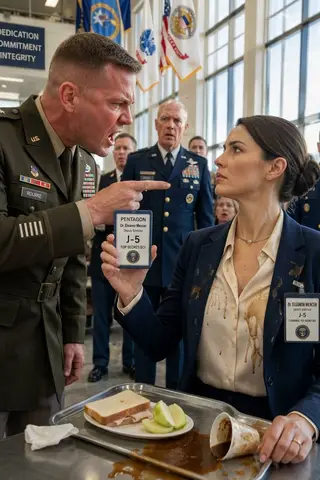
 THE PENTAGON CAFETERIA DISASTER: Arrogant Marine Shoves High-Ranking Female Official With Top-Secret Clearance
Chapter 1
The Coffee Spill Heard Around the Pentagon
The morning sun had barely cleared the concrete ramparts of the Pentagon as I walked through the east corridor, my mind racing through three different contingency budgets and an unredacted threat assessment sitting securely in my briefcase. I had traveled halfway across the country on less than four hours of sleep, carrying a mandate signed directly by the Office of the Secretary of Defense. My destination was a secure briefing room on the fourth floor where four flag officers were scheduled to review an operation that could shift the geopolitical balance of the entire Indo-Pacific region. But before I could touch a single classified document, I needed something basic: black coffee and a quiet corner to review my notes.
The Pentagon cafeteria at 07:30 hours is a chaotic ecosystem of ambition, caffeine addiction, and quiet hierarchy. Thousands of boots scuff against the polished floors, while senior analysts, junior officers, civilian contractors, and generals maneuver through the lines like chess pieces on a board. I grabbed a turkey sandwich, a bottle of water, and a paper cup of hot black coffee, sliding my tray along the metal rails. Seeking a momentary bubble of silence before the storm of briefings, I headed toward the eastern windows where the morning light hit the tables and the foot traffic thinned out. There were no ropes, no signs, no military police tape, and no indicators of any restriction. I set my tray down, pulled out my notebook, and prepared to take my first sip.
Then came the impact.
A heavy, calloused hand struck my right shoulder with enough kinetic force to send me staggering sideways. My tray tilted sharply, and the paper cup of scalding black coffee tipped over, emptying its entire contents directly down the front of my pristine white silk blouse. The heat hit my skin instantly, searing through the thin fabric and turning the white material into a transparent, stained mess. Dark brown streams ran down my front, dripping onto my skirt and splashing onto the polished linoleum floor. A few stray drops hit the back of my hand, leaving stinging red welts.
"Move, ma'am," a voice boomed behind me, intentionally loud, engineered to project dominance across the room. "This section is for command staff."
For one agonizing second, the universe seemed to pause. The hum of the espresso machine faded into the background. The nearby chatter died down. Then, from two tables away, a young Army captain let out a sharp, nervous snort of amusement. That tiny sound broke the spell. The Marine standing beside me puffed out his chest, smiling not because anything was actually funny, but because he had an audience, and he loved playing to the gallery.
I looked down at my ruined blouse, then at my tray—now holding only a squashed turkey sandwich, apple slices, and a dry bottle. Slowly, deliberately, I raised my eyes. They locked onto the name tape stitched tightly across the chest of the service uniform towering above me.
ROURKE.
Gunnery Sergeant Blake Rourke. He stood at least six-foot-two, with broad shoulders, heavily pressed sleeves, a razor-sharp jawline, and posture that practically screamed arrogant overcompensation. He looked like an actor cast as a hard-charging Marine in a low-budget recruitment film, someone who had spent his entire career confusing sheer volume and petty intimidation with actual authority. He had no idea who I was. He had no idea what kind of clearance code was embedded in the encrypted credentials resting in my blazer pocket. And he certainly had no idea that his entire career—built on years of glossed-over insubordination and unchecked bullying—was about to collide with a freight train named accountability. I picked up a napkin, pressed it calmly against my stained sleeve, and looked him dead in the eye.
"You just put your hands on the wrong civilian," I said, my voice dangerously quiet.
Rourke’s mouth curled into an ugly, dismissive smirk. "Civilian," he muttered, rolling the word around his tongue as if it were a foul taste. "That’s exactly the issue. You people wander in here thinking this building is a public museum."
Around us, the cafeteria was undergoing a profound transformation. The background noise vanished entirely. A Navy commander near the salad bar stopped chewing and turned his head slowly. An Air Force colonel lowered her tablet, her eyes narrowing as she assessed the scene. Near the windows, a four-star admiral slowly lowered his spoon, his gaze locking onto Gunnery Sergeant Rourke with an intensity that could melt steel. Rourke remained completely oblivious, blinded by his own ego, and stepped closer into my personal space, towering over me in a deliberate display of physical intimidation.
"You walked past a restricted area," Rourke barked, doubling down on his script.
I glanced past his broad shoulder once more. The floor was completely bare. There was no barrier, no warning, nothing. "I don’t see any restriction, Gunnery Sergeant."
"I gave you one," he snapped back, his voice rising again. "I told you this area was reserved."
"No. You told me this section was for command staff after I had already sat down."
"Same difference."
"No, Gunnery Sergeant," I said, stepping half an inch closer, letting him feel the absolute stillness of my posture. "It really isn't."
That was the exact moment I saw a flicker of genuine panic cross his eyes. It was gone in a fraction of a second, masked instantly by stubborn defiance, but it was there. He realized, on some primal level, that I wasn't backing down, and that the audience watching us wasn't looking at him with admiration anymore. They were looking at him with cold, clinical evaluation. Rourke crossed his arms, his jaw tightening until the muscle ticked. "You ignored a Marine on assigned detail. You refused to identify yourself. Now you’re going to pick up your tray, turn around, and find another place to eat before I have you escorted out by military police."
I calmly set the ruined napkin down on my tray, smoothing out the edge with deliberate slowness. "Gunnery Sergeant," I whispered, loud enough for everyone within ten feet to hear clearly, "let's talk about what happens next."
The End









