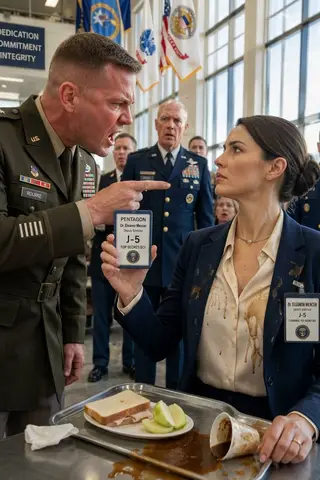
 THE PENTAGON CAFETERIA DISASTER: Arrogant Marine Shoves High-Ranking Female Official With Top-Secret Clearance
Chapter 6
The Fallout Downstairs
While the secure conference room on the fourth floor buzzed with high-level tactical debates, strategic adjustments, and emergency directives, the chaotic energy of the lower-level cafeteria had taken on an entirely different rhythm. Word of what had happened—how an arrogant, power-tripping Gunnery Sergeant had physically shoved the premier national security advisor in front of the Chairman of the Joint Chiefs—had spread like wildfire across the entire Pentagon complex.
Gunnery Sergeant Blake Rourke was still standing rigidly by the eastern windows, though the initial shock had given way to a cold, suffocating dread. The two military police officers dispatched by the Provost Marshal had arrived within minutes, taking up silent, imposing posts on either side of him. They didn't cuff him—he hadn't resisted physically, and his rank afforded him a shred of procedural dignity—but they made it abundantly clear that he was not permitted to leave, speak to anyone, or touch his phone.
"Gunnery Sergeant Rourke?"
A sharp, authoritative voice cut through the nervous murmurs of the few remaining cafeteria patrons who were shamelessly rubbernecking from neighboring tables.
Rourke snapped his head around. Standing before him was Lieutenant Colonel Marcus Vance—no relation to the General, but an internal affairs investigator known across the building as the ultimate career executioner for abusive misconduct. Colonel Vance’s face was carved from stone, his eyes cold and devoid of any human warmth.
"Colonel," Rourke choked out, attempting to maintain a salute, though his arm felt like it weighed a thousand pounds.
"Drop the hand, Gunnery Sergeant," Colonel Vance said flatly, pulling a digital clipboard from his side pocket. "You're officially relieved of all active duties, security details, and perimeter assignments effective immediately. Turn over your service sidearm, your access credentials, and your building pass to the military police."
Rourke’s breath caught in his throat. "Colonel, with all due respect, it was a minor incident—a misunderstanding over protocol! The civilian didn't identify herself, she walked into a restricted zone without authorization—"
Colonel Vance held up a single hand, silencing him instantly. "Gunnery Sergeant, I have personally reviewed three separate high-definition security feeds from the cafeteria cameras, alongside eyewitness statements from a Navy commander, an Air Force colonel, and the Director of Security Operations himself. There was no restricted zone. There was no warning posted. There was no identification failure—because you never asked for her credentials before you put your hands on her."
The blood rushed out of Rourke’s face a second time, leaving him looking ghastly pale under the fluorescent lights. "I... I didn't know who she was..."
"That," Colonel Vance interrupted, his voice dropping into a lethal, icy whisper, "is precisely the root of your entire professional failure. In the United States military, your authority is designed to protect and project strength, not to terrorize civilians or massage your own fragile ego because you wanted to feel important in front of an audience."
The two military police officers stepped closer, their hands resting naturally near their holsters.
"Hand over your gear, Gunnery Sergeant," Colonel Vance ordered. "You're going down to administrative processing for formal charges of assault, destruction of federal property, and gross abuse of authority. After that, your command will be reviewing your immediate court-martial eligibility and a one-way ticket out of active service."
Slowly, with trembling, clumsy fingers, Rourke unbuckled his duty belt. He unclipped his sidearm holster, detached his primary access badge, and laid them neatly onto the metal cafeteria tray that had started the entire disaster. The heavy thud of the equipment hitting the tray sounded like a gavel coming down in a courtroom.
As the military police officers stepped in to flank him on either side, guiding him away from the windows and toward the freight elevators that led down to the holding cells, Rourke cast one lingering, desperate look back at the spot where I had stood earlier. The floor was spotless now—custodial staff had already wiped away the last traces of spilled black coffee. There was no evidence left of what had happened, save for the permanent, unalterable destruction of a career built on arrogance.
Word of Rourke’s swift, merciless defenestration hit the fourth-floor briefing room just as we were wrapping up our final Q&A session. A quiet buzz of satisfaction hummed through the senior leadership as the Director of Security Operations leaned over and whispered the update into General Vance’s ear.
The Chairman gave a single, approving nod, then turned his gaze back to me with a warm, proud smile.
The End









