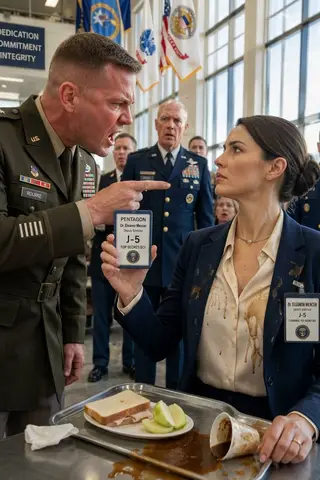
 THE PENTAGON CAFETERIA DISASTER: Arrogant Marine Shoves High-Ranking Female Official With Top-Secret Clearance
Chapter 7
The Cleanup and the Correction
With the fourth-floor briefing successfully adjourned, the flag officers and senior analysts began filing out of Conference Room 4-A, their minds buzzing with new directives, updated logistics frameworks, and a renewed sense of operational urgency. General Arthur Vance remained seated at the head of the mahogany table, motionရင်း for me to stay as I gathered my scattered notes and slid them back into my leather briefcase.
"Well, Alana," the General said, leaning back in his chair and letting out a long, exhausted breath that seemed to shed ten years of accumulated stress. "You absolutely crushed that presentation. The logistics director was already cornering me by the door asking if we can poach you from the National Security Council full-time."
I offered a tired, genuine smile, running a hand over the front of my ruined white blouse, where the coffee stain had now dried into a stiff, dark brown map across the silk. "I think my blouse took the brunt of the strategic damage today, Uncle Arthur. Though I have to admit, your security detail downstairs works with terrifying efficiency."
"We don't tolerate cancer in the ranks," General Vance said flatly, his expression hardening momentarily before softening back into familial warmth. "Men like Rourke coast on bluster for years until they finally run into someone who refuses to shrink. You didn't just expose a bad actor; you forced the entire command staff to look in the mirror and ensure our internal culture actually reflects the values we claim to defend."
"It shouldn't have taken a cup of coffee down my front to get that review," I noted wryly.
"True," the General conceded with a faint chuckle. "But sometimes friction is the only thing that exposes a fracture before it shatters the whole foundation. Now, come with me. You can't walk around the Pentagon looking like you survived a tactical espresso explosion."
He stood up, leading me out of the secure conference room and down a private corridor toward the executive office suite behind the Chairman's main chambers. Waiting on a pristine wooden valet stand just outside his private office was a crisp, brand-new, high-end white button-down service shirt, along with a fresh blazer and an official Pentagon guest-replacement badge.
"My executive assistant had her office pull your spare travel profile metrics from protocol records," General Vance explained, gesturing to the clothes. "Standard emergency issue for visiting senior advisors who run into... unexpected tactical friction in the lower corridors."
I looked at the clothes, then up at the General, feeling a sudden wave of genuine gratitude. "Thank you, Uncle Arthur. I suppose I should change before I face the press briefing in the main auditorium this afternoon."
"Take all the time you need," he said, turning back toward his office. "And Alana? Next time you visit the Pentagon, let me know when you arrive. I'll make sure the east corridor is clear of overzealous Gunnery Sergeants."
"Deal," I said, stepping into the private washroom to clean up and reclaim my day.
By the time I emerged ten minutes later, dressed in the crisp new shirt and fresh blazer, the lingering frustration of the morning had completely evaporated. The stain was gone. The bully was gone. And the most critical defense architecture review of the decade was officially moving forward with the full, unreserved backing of the nation's highest military leadership.
Little did I know, the fallout from the cafeteria incident was about to trigger an institutional house-cleaning across every single branch of the armed forces—starting from the top down.
The End









