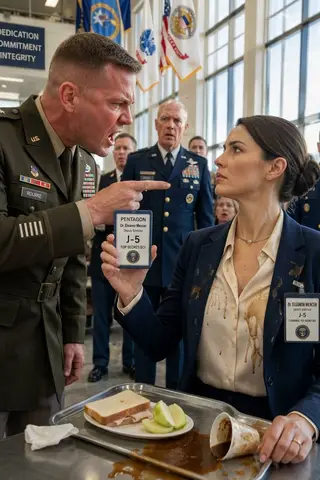
 THE PENTAGON CAFETERIA DISASTER: Arrogant Marine Shoves High-Ranking Female Official With Top-Secret Clearance
Chapter 2
The Anatomy of a Bully in Uniform
The silence in the Pentagon cafeteria had grown absolute. You could have heard a pin drop on the tile floor, save for the faint hum of the industrial refrigeration units near the back kitchen. Gunnery Sergeant Blake Rourke shifted his weight from one boot to the other, the polished leather squeaking slightly against the floor. My calm demeanor was clearly throwing off his internal calculus. In his world, civilians—especially women in business attire—were supposed to apologize, look flustered, gather their belongings, and scurry away in embarrassment. They were not supposed to stand their ground with cold, unblinking eyes while hot coffee dried into a stiff brown stain across their chest.
"You've got a lot of lip for someone standing in a place you shouldn't be," Rourke muttered, lowering his voice just enough to sound conspiratorial, though the entire room was still hanging on his every word. "I give you one order, and you want to debate me like we're in a college seminar. That attitude might work in whatever cozy contractor office sent you here, but it doesn't fly in my sector."
"I am not a contractor, Gunnery Sergeant," I replied evenly, not breaking eye contact for even a millisecond.
He scoffed, letting out a sharp breath through his nose. "Right. Then what? A think tank analyst? Some policy wonk who thinks she can rewrite naval logistics from an air-conditioned office in crystal city?"
"Incorrect again."
"Consultant?" he pressed, his frustration mounting as he tried to pin a label on me that would justify his condescension. "Auditor? Some congressional staffer looking for a photo op?"
"None of the above."
Rourke leaned down, invading my space once more, trying to use his height and physical mass to re-establish dominance. "Lady, I don’t care if you write national security policy, manage multi-billion-dollar defense budgets, or brief half the United States Senate twice a week. In this corridor, on my watch detail, my word is operational protocol. You crossed an invisible line when you ignored my initial posture, and now you're making a scene because your feelings got hurt over a little spilled coffee."
A little spilled coffee. I looked down at the large, dark stain soaking through my white silk blouse, radiating a damp, sticky warmth against my skin. It ruined an expensive designer top, but more importantly, it was physical evidence of his unprovoked assault. Yes, an assault. Shoving a federal official—regardless of whether he knew my rank yet—with enough force to cause physical displacement and property damage fell comfortably under several articles of misconduct.
"Let's review your sequence of events, Gunnery Sergeant," I said, my voice remaining level, carrying a chilling professional cadence that usually made junior officers break out in a cold sweat. "First, you observed me sitting at a table with no posted restrictions. Second, instead of making a polite request or directing me properly, you physically struck my shoulder with enough force to knock me sideways. Third, you destroyed my personal property and caused a safety hazard with hot liquid. Fourth, you fabricated an imaginary restriction to cover your own lack of situational awareness."
Rourke's face flushed a deep, mottled crimson. The veins along his thick neck began to bulge. For a Marine of his seniority, being publicly corrected by a civilian woman—and dissecting his tactical errors like a drill instructor tearing apart a boot recruit—was nothing short of blasphemy.
"You watch your tone with me," he snarled, his finger coming up to jab aggressively in my direction. "You're walking a very dangerous line of obstruction and failure to comply with military authority. I can have military police down here cuffing your wrists and tossing you into a holding cell before you can even finish explaining who you think you are."
"Try it," I said softly.
The simplicity of my response seemed to stun him. He blinked twice, his mouth opening slightly as if his brain was struggling to process a command line error. Across the room, the four-star admiral near the window finally pushed his chair back. The metallic scrape of the chair legs against the floor sounded like thunder in the dead silence of the cafeteria. The admiral stood up, smoothing down his service coat adorned with rows of ribbons and stars, and began walking slowly toward our table. Behind him, the Navy commander and the Air Force colonel rose in unison, forming a quiet, formidable procession that cut straight through the center of the cafeteria.
Rourke finally sensed a shift in the air behind him. He didn't turn around immediately, too focused on maintaining his aggressive posture toward me, but I watched his peripheral vision catch the movement of polished brass and gold braid drawing closer.
"You think you're untouchable because you managed to get a badge past the gate guards," Rourke sneered, leaning in closer, his voice dripping with venom. "Well, let me tell you something about this building—rank and reputation are everything. And right now, your reputation in this room is zero."
"My reputation," I said, lifting my chin just a fraction higher as the footsteps drew within ten feet of our table, "is actually quite secure. Can the same be said for yours, Gunnery Sergeant Rourke?"
Before he could fire back another threat, a deep, resonant voice cut through the air behind him like a knife through silk.
"Gunnery Sergeant."
The word wasn't shouted. It didn't need to be. It carried the effortless, crushing weight of absolute command—a voice that had directed combat operations across three continents and signed off on directives that shaped global military strategy.
Rourke froze. The aggressive posture dissolved instantly, replaced by the rigid, involuntary muscle memory of a lifetime spent under the strict hierarchy of the United States Marine Corps. He snapped his heels together, straightening his spine into a textbook position of attention, and whipped around to face the source of the voice, his face completely pale.
The End









