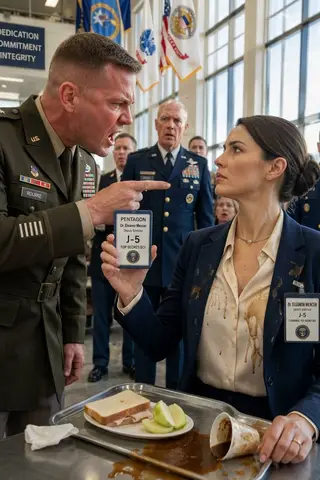
 THE PENTAGON CAFETERIA DISASTER: Arrogant Marine Shoves High-Ranking Female Official With Top-Secret Clearance
Chapter 5
Inside the Inner Sanctum
The heavy double doors of Conference Room 4-A swung open smoothly, revealing a sprawling, soundproofed command theater bathed in the cool, bluish glow of high-definition tactical displays. Around the massive, custom-built mahogany oval table sat four flag officers and a dozen senior intelligence analysts, all of whom had been murmuring quietly among themselves. The moment General Arthur Vance and I walked through the threshold, total silence descended upon the room.
Every single head turned toward the entrance. Every eye scanned the room—first catching the gold-braided stars of the Chairman, and then dropping immediately to my stained white blouse and the dark, jagged coffee mark marring my professional attire. A collective, unspoken wave of tension rippled through the brass. Word of the cafeteria incident had clearly beaten us upstairs, transmitted via the invisible, lightning-fast grapevine of Pentagon aides, staffers, and digital messaging apps.
General Vance walked briskly to the head of the table, pulling out his leather-bound chair but remaining standing. He cleared his throat, his authoritative baritone cutting through the hum of the secure servers lining the back walls.
"Be seated, gentlemen," the Chairman commanded quietly.
The officers and analysts dropped back into their seats with synchronized precision. General Vance turned his gaze directly toward me, gesturing gracefully to the primary presentation terminal at the center of the table.
"Before we begin our formal review of the Indo-Pacific logistics architecture," General Vance announced, his eyes sweeping across the assembly with deliberate intensity, "I want to take thirty seconds to formally introduce our lead briefer, Dr. Alana Vance. As many of you may have already heard through informal channels downstairs, Dr. Vance experienced a rather... aggressive introduction to our building's hospitality this morning courtesy of a now-former Gunnery Sergeant who fundamentally misunderstood the concept of operational clearance."
A few suppressed coughs and tight-lipped smiles rippled around the table. The three-star admiral seated to my left—a weathered logistics veteran with four decades of service—gave me a subtle, respectful nod of solidarity.
"Despite having her morning disrupted and her professional attire severely compromised," General Vance continued, his tone dry as bone, "Dr. Vance is here to deliver a briefing that will dictate our strategic posture for the next fiscal year. I suggest everyone give her their absolute, undivided attention. Doctor, the floor is yours."
"Thank you, General," I said smoothly, stepping up to the console and tapping the glass interface to awaken the primary overhead holoscreen.
With a soft hum, a massive, multi-layered interactive map of the Pacific theater materialized in glowing blue and amber light above the center of the table. Supply lines, naval deployment vectors, contested shipping lanes, and cyber-defense nodes glowed in intricate detail. The coffee stain on my blouse was completely forgotten as I locked into the professional zone, my voice steady, clear, and razor-sharp.
"Good morning, General, Admirals, Directors," I began, my laser pointer cutting a sharp red line across the holographic archipelago on display. "For the past six months, my team has been conducting an exhaustive vulnerability assessment of our regional logistics nodes. What we found should alarm every single person in this room."
For the next forty-five minutes, the room was suspended in absolute rapt attention. I walked them through encrypted data packets, compromised supply chain routes, and critical choke points that left vulnerabilities wide open to foreign intelligence operations. I didn't rely on generic corporate speak or recycled policy buzzwords; I gave them hard numbers, irrefutable data points, and actionable solutions that cut straight to the core of our defense posture.
As I spoke, I watched the faces of the flag officers shift from casual professional interest to deep, sober realization. The young Army captain who had snickered in the cafeteria earlier—now sitting quietly in the back row as a technical scribe—was staring at the screen and at me with wide, horrified eyes, finally grasping the monumental gap between the petty playground bullying downstairs and the terrifying gravity of actual national security operations happening right above.
When I finally tapped the console to conclude the presentation, the holoscreen dissolved into a static standby display. The room remained completely silent for three full seconds—the gold standard of military approval in a high-level strategic review.
Then, the three-star admiral to my left slowly raised his hands and started a deliberate, echoing round of applause. Within a second, the entire table joined in, filling the secure conference room with a thunderous ovation of pure professional respect.
General Vance smiled faintly, resting his hands on the edge of the mahogany table. "Thank you, Dr. Vance. That was, without question, the most thorough and sobering assessment this command has received in a decade. Now, let's open the floor for Q&A—starting with how we fix the massive blind spots you just so brilliantly laid bare."
The End









