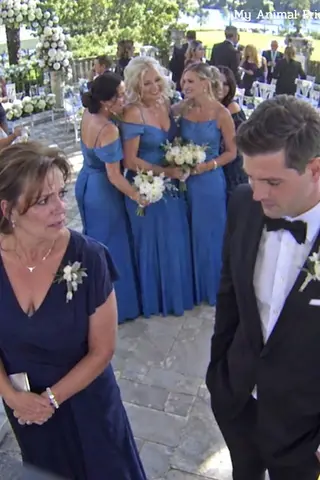
 My Son’s Bride Banned Me From Wearing Blue Because It Was "For Family Only"
Chapter 9
The Cleansing Season
Healing is not a movie montage; it is a slow, quiet reconstruction of a house that was nearly leveled by a storm.
Over the next six months, the fallout from that Saturday afternoon settled like dust after an earthquake.
Thomas Bradley worked with ruthless efficiency. Faced with undeniable forensic evidence of unauthorized charges and the threat of a public federal trial, Robert and Patricia Mitchell settled out of court. They were forced to liquidate Robert’s remaining corporate holdings to repay every single penny of Grant’s savings, settle the maxed-out credit card debts in full, and pay a substantial financial penalty for defamation.
The Lake Forest Country Club quietly stripped Patricia of her membership. The charity boards she once ruled with an iron fist replaced her within weeks. Stripped of their manufactured wealth and social standing, Robert and Patricia put their Lake Forest mansion up for foreclosure sale and moved into a modest two-bedroom rental condo forty miles south, completely ostracized by the very community they had sacrificed their souls to impress.
Vanessa moved to Arizona to live with an older cousin, starting over under a maiden name at a junior marketing firm, far away from the wreckage of the life she had tried to construct on lies.
And Grant?
Grant moved into a sun-filled, historic brick loft in downtown Chicago, five minutes from his engineering firm’s headquarters.
He spent his weekends restoring old wooden furniture, running along the lakefront trail, and cooking dinners in his spacious kitchen. He went to therapy every Tuesday evening, methodically unlearning the quiet guilt that had made him an easy target for narcissistic people. He learned that being kind did not mean being a doormat. He learned that setting a boundary was not an act of aggression; it was an act of survival.
Every Sunday afternoon, without fail, Grant’s truck pulled into my driveway.
He helped me repaint the front porch. He climbed up on the roof and replaced the worn shingles that had leaked during spring storms. We drank coffee at the kitchen table, talking about his bridge projects, about books, about life, without a single shadow hanging over our heads.
One brisk October afternoon, nearly a year after the wedding, Grant walked into my kitchen carrying a small white box from a local bakery.
Behind him walked a young woman.
Her name was Elena. She was an architect who worked with Grant’s firm on city infrastructure projects. She had dark, curly hair, warm hazel eyes, and a laugh that sounded like music playing through an open window. She wore a chunky knitted sweater, worn jeans, and sneakers with paint smudges on the toes.
"Mrs. Mitchell," Elena smiled warmly, stepping forward and extending both hands to clasp mine. "Grant has told me so much about you. I brought lemon shortbread—he told me it was your absolute favorite."
I looked at Elena. I looked at the way she stood—unpretentious, grounded, comfortable in her own skin. Then I looked at my son.
Grant wasn't walking on eggshells. He wasn't glancing nervously around the room, worried about what she might say or think. His shoulders were relaxed, his posture open, his eyes glowing with a calm, radiant happiness I hadn't seen since he was a little boy.
"It’s Joan, sweetheart," I smiled, pulling her into a warm embrace. "Just Joan. Come in, the kettle is already boiling."
The End









