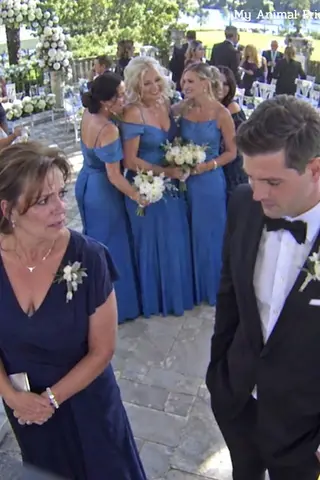
 My Son’s Bride Banned Me From Wearing Blue Because It Was "For Family Only"
Chapter 16
The Public Honor
By the time the golden leaves of October returned to the Chicago riverfront, the city’s grand downtown infrastructure project was nearing completion. The central centerpiece was the historic Wabash Avenue double-leaf bascule bridge—an engineering marvel originally constructed in the 1930s that had fallen into dangerous disrepair over decades of municipal neglect. Under Grant’s meticulous leadership, the bridge had been completely rehabilitated two months ahead of schedule and three million dollars under budget.
The city organized a massive civic dedication ceremony. Hundreds of city officials, union ironworkers, local business owners, and journalists gathered on the polished wooden promenade beside the river. A wide crimson ribbon was stretched between the two towering limestone bridge houses, fluttering beneath an azure autumn sky.
I sat in the front row of the VIP platform, dressed in a tailored navy-blue wool coat that Elena had helped me choose. Beside me sat Elena, her hand resting warmly in mine, and David Sterling, Grant’s senior partner, whose broad chest was practically bursting with professional pride.
The Mayor stepped up to the podium, adjusting his glasses as the microphone picked up his booming voice. "In an era where public works are too often plagued by cost overruns and compromises, Sterling Civil Engineering gave us a leader of extraordinary caliber. A man who understands that an iron bridge isn't just steel and rivets; it is the physical trust a city places in the hands of its builders. It is my distinct honor to present the Chicago Civic Leadership Medal to our Lead Project Engineer, Mr. Grant Mitchell."
The applause that erupted from the crowd was deafening. The union workers in their hardhats whistled and banged their heavy wrenches against the steel railings, creating a thunderous rhythm of genuine respect.
Grant stepped up to the podium, looking sharp and commanding in his charcoal suit. He accepted the heavy bronze medal, shook the Mayor’s hand, and then looked out over the sea of cameras and spectators. He didn't boast about engineering tolerances or structural load algorithms.
"A bridge stands," Grant began, his voice echoing clearly across the water, "because someone was willing to dig deep into the riverbed, through the mud and cold darkness, to anchor the caissons into bedrock where nobody can see them. For the first twenty-four years of my life, my mother was that bedrock. She worked twelve-hour shifts cleaning municipal clinics and scrubbing floors so that I could hold an engineering pencil. Everything I know about structural integrity, I learned by watching her refuse to break under the weight of an unfair world."
He stepped away from the microphone, walked straight down the steps of the platform, and placed the heavy bronze medal around my neck.
That evening, the ceremony was broadcast on every local news station across northern Illinois. Forty miles away, in her cramped, dusty rental apartment above a suburban strip mall, Patricia Mitchell turned on her television to find her former social circle watching the very man she had tried to ruin being heralded as the city's finest builder, while the woman she called an "outsider" sat crowned in honor before the entire state.
The End









