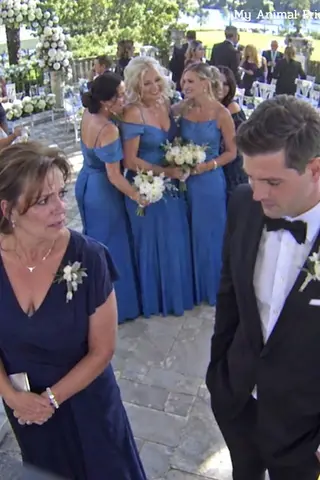
 My Son’s Bride Banned Me From Wearing Blue Because It Was "For Family Only"
Chapter 43
The Architecture of Grace
The high desert air of Flagstaff was thin, dry, and cold, carrying the sharp scent of ponderosa pine and red dust. We landed at the small regional airport on a Tuesday morning—Grant, Elena, and myself. We had left the children in the loving, capable care of Uncle David and Claire back at the lakehouse, knowing that this journey required our full, undivided presence.
The Coconino Women’s Haven was a sturdy, three-story building constructed of heavy red sandstone and fired brick, standing beneath the towering volcanic peaks of the San Francisco Mountains. It was old, worn, and scarred by decades of harsh mountain winters, but as Grant walked along the perimeter walls, his trained eye immediately recognized the honest craftsmanship of the masonry.
The heavy double doors opened, and Vanessa stepped out onto the wide stone porch.
She was thirty-two years old now, but she looked ten years older than the radiant, spoiled girl who had stood beneath the country club chandelier demanding a royal blue dress code. She wore a faded flannel work shirt with the sleeves rolled up to her elbows, dark canvas utility pants, and scuffed hiking boots. Her face was completely free of cosmetics, her skin weathered by the dry mountain sun, her blonde hair cut into a sensible, no-nonsense bob.
When she saw Grant standing in the gravel courtyard with his laser measuring tripod, she froze. Her breath hitched, her fingers instinctively curling into the fabric of her apron. She looked at Grant, then her eyes moved to Elena, and finally, they rested on me.
A profound, suffocating silence hung between us for several seconds. The memories of that horrific Saturday—the broken glass, the screaming in the hallway, the cruel laughter outside the bridal suite—flashed between us like summer lightning.
Vanessa swallowed hard, her chest heaving as tears welled up in her hazel eyes. She didn't offer a theatrical plea for forgiveness. She didn't fall to her knees or burst into performative sobs. She simply bowed her head, her hands trembling by her sides, and spoke in a voice that was raw, humble, and completely stripped of pride.
"Thank you for coming," she whispered. "I didn't think... I didn't dare hope you would come yourselves."
Elena stepped forward first. She extended her hand, not with cold politeness, but with the quiet, professional grace of an architect who judged people by their present integrity rather than their past debris. "Show us the foundation, Vanessa. We have work to do."
For the next eight hours, Grant and Elena disappeared into the subterranean guts of the old hospital. Grant set up ultrasonic density sensors against the sandstone foundation footings, while Elena mapped the structural load paths of the heavy timber roof trusses. They drilled small core samples from the basement mortar, testing the compressive strength with a portable hydraulic gauge Grant had checked as baggage.
I stayed on the main floor, helping Vanessa and two other shelter staff members prepare a massive pot of vegetable lentil soup for the evening meal. Watching Vanessa move through the shelter was a revelation. She knew the name of every child in the facility. When a frightened young mother arrived at the intake desk with a black eye, holding a shivering toddler wrapped in a threadbare coat, Vanessa didn't flinch or look away with disgust. She knelt on the worn linoleum, took the toddler’s cold shoes off, wrapped his feet in warm woolen socks, and spoke to the mother with a soothing, tender respect that made my eyes burn with tears.
She had not merely paid back the money; she had allowed herself to be completely broken down and rebuilt from the dust.
At five o’clock in the evening, Grant climbed out of the basement access hatch, covered in gray sandstone dust, his notebook filled with dense mathematical calculations.
"The developer’s engineering report is a total fabrication," Grant announced, washing his hands under the utility sink. "They claimed the foundation had suffered severe moisture degradation and structural shear failure. It’s completely false. This sandstone was quarried locally from Moenkopi bedrock. The compressive strength is nearly four thousand pounds per square inch—twice the density of modern commercial concrete. This building is safer than the high-rise hotels they’re building down in the valley."
A collective gasp of joyous disbelief rippled through the shelter kitchen.
"Will the judge believe it, Grant?" Vanessa asked, her knuckles white as she gripped the edge of the prep table.
"He won't just believe it," Grant said, his voice ringing with cold, professional authority. "I am submitting a certified, seal-stamped forensic structural affidavit to the district court tomorrow morning. And Thomas Bradley has already filed an emergency notice of appearance on behalf of the shelter. By Friday afternoon, that developer will be facing a formal grand jury referral for submitting fraudulent engineering documents under penalty of perjury."
The End









