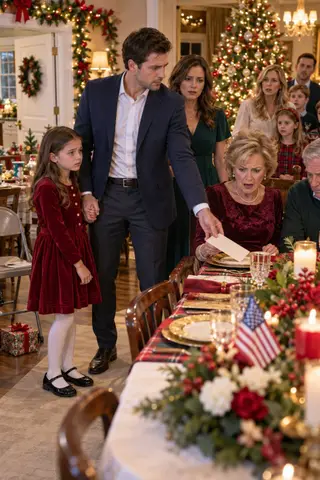
 Confronting toxic family on Christmas: The shocking envelope drop that instantly ended a generational nightmare!
Chapter 33
The Echo of the Twins
The past rarely vanishes completely; sometimes it sends out a faint, distorted echo, testing whether the walls you built are truly made of stone.
In mid-February, Leah competed in the regional high school art showcase held at the state university’s satellite campus in the valley. Her entry—a massive, intricate relief woodcut carved from seasoned black walnut depicting a pair of weathered hands sheltering a blooming sunflower—had taken first place in the printmaking division.
The exhibition hall was crowded with hundreds of students, art teachers, and families milling through the aisles. Nah and I stood a dozen feet away, watching with quiet pride as Leah explained her printmaking technique to a university professor who was visibly impressed by her structural line control.
As the crowd shifted, I noticed a teenage boy standing near the perimeter of the booth, clutching a paper program with white-knuckled intensity.
He was about fourteen years old, tall and painfully thin, with pale blonde hair that looked hurriedly combed. He wore a faded, oversized winter jacket that was clearly second-hand, and his posture carried that familiar, agonizing stiffness of an outsider bracing for an inevitable reprimand.
It was Liam—Chloe’s son. My nephew.
I hadn't seen him since Christmas dinner five years ago, when he was an eight-year-old boy in a matching designer reindeer sweater, completely insulated by his mother’s arrogant snobbery. Now, stripped of his trust funds and living through his parents’ bitter, impoverished divorce, he looked bewildered and raw.
Liam caught my eye. He froze, his Adam's apple bobbing nervously, looking like he wanted to bolt toward the exit doors.
Instead of scowling or walking away, I gave him a calm, measured nod.
Liam took a hesitant breath and stepped slowly into the booth, his sneakers scuffing against the polished floorboards.
Leah turned around from her conversation with the professor. When her eyes landed on Liam, her expression shifted into quiet surprise, but her posture remained entirely relaxed and open.
“Liam?” she asked softly.
The boy swallowed hard, holding out the exhibition program. “Hi, Leah. I… my art class from the valley middle school took a bus up here today. I saw your name on the winner’s placard.”
He stared down at the intricate walnut print hanging on the partition wall.
“It’s really amazing,” he mumbled, his voice cracking slightly with adolescent insecurity. “My mom… she told us terrible things about you guys. For years, she told us that you stole our college money and ruined our family.”
The bluntness of his confession hung in the air.
I tensed slightly, prepared to intervene if this was another orchestrated intrusion from Chloe. But looking closely at Liam’s trembling fingers and hollow cheeks, I saw no malice. I saw only a confused, neglected boy who was beginning to realize that the monsters his mother had painted were an illusion created to hide her own failures.
Leah stepped closer to him, her tone completely devoid of judgment.
“Your mom was hurt, Liam,” Leah said gently. “And when people are hurt and angry, they tell stories to make themselves feel less responsible. Nobody stole anything from you. The adults made choices, and the money was built on things that weren't real.”
Liam looked up at her, tears suddenly shimmering in his blue eyes.
“My dad lives in another state with his new girlfriend,” Liam whispered, his voice shaking with the pent-up anguish of a child who had been an afterthought in his parents' war. “My mom screams at us every single night because she has to work at the retail outlet. She says Noah and I ruined her youth. I… I remember that Christmas, Leah. I remember when they put you by the kitchen door. I didn't say anything because I was scared of Grandma.”
He wiped his sleeve across his nose, his shoulders dropping in profound shame. “I’m sorry. I should have given you my chair.”
The simple, unvarnished honesty of a fourteen-year-old boy pierced straight through five years of family trauma.
Leah smiled—a tender, luminous expression of pure grace. She reached out and rested her hand gently on her cousin’s thin shoulder.
“You were eight years old, Liam,” Leah said softly. “You didn't build that table, and you didn't decide where the chairs went. You don't have to carry your parents' choices on your back.”
She turned to her display table, picked up a small, beautifully printed proof of her sunflower woodcut on heavy mulberry paper, and handed it to him.
“Keep this,” she said. “Whenever your house feels loud and angry, look at the flower. Remember that you get to choose what kind of man you grow into. You don't have to be Chloe, and you don't have to be Richard. You just have to be Liam.”
Liam clutched the print against his chest as if it were a life preserver. He looked at Leah, then across to me, nodding with a choked, wordless gratitude before turning and walking quickly back toward his school group.
I stood beside my daughter, watching the boy disappear into the crowd.
Leah had not sought revenge. She had not used her triumph to mock the fallen. Instead, she had offered the son of her tormentor the one thing he had never received in his mother’s house: absolution, and the permission to break the cycle.
The End









