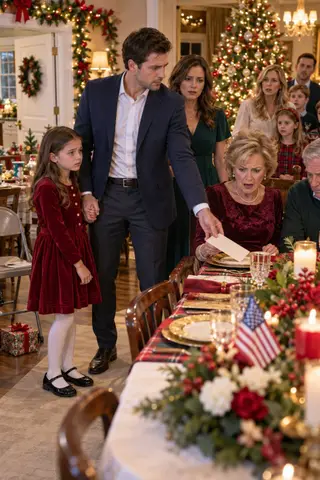
 Confronting toxic family on Christmas: The shocking envelope drop that instantly ended a generational nightmare!
Chapter 25
The Ghost at the Market
The final physical glimpse of Richard Miller occurred on a blistering Saturday morning in early August, amidst the bustling crowds of the county agricultural fair in the valley basin.
The fair was a vibrant, noisy tapestry of agricultural pride. The air was thick with the scent of fried funnel cakes, kettle corn, roasted sweet corn, and livestock bedding. Blue-ribbon prize steers lowed in the livestock barns, children screamed with delight from the top of the Ferris wheel, and hundreds of families wandered through the open-air exhibition tents browsing artisanal jams, heirloom tomatoes, and handcrafted woodworking.
Nah, Leah, and I had set up a double booth near the entrance of the home-arts pavilion to display the rustic walnut-and-slate serving boards Leah and Caleb had crafted during the summer workshops, with all sales proceeds routed directly to the regional foster children’s scholarship fund.
By noon, the booth was swarmed with customers. Leah was standing behind the sturdy pine trestle table, laughing as she wrapped a polished walnut cutting board in butcher paper for an elderly farm couple, her cheeks flushed with the heat, her confidence radiant and magnetic.
I stepped away from the counter to haul two fresh five-gallon jugs of spring water from our truck parked in the auxiliary vendor lot.
As I walked along the perimeter fence separating the vendor lane from the public walkway, my eyes caught a figure standing in the deep shadow of an equipment rental trailer, twenty yards away.
It was Richard.
He looked unrecognizable. He was wearing an oversized, sun-faded polo shirt that hung limply off his skeletal shoulders, gray polyester trousers that were frayed at the cuffs, and orthotic walking shoes with worn heels. He was leaning heavily on a cheap aluminum quad-cane, his right hand trembling with an involuntary tremor that he tried desperately to conceal by jamming it into his pocket.
He was not looking at the farm equipment. He was not looking at the carnival rides.
He was staring through the mesh screening of the exhibition tent, his watery, bloodshot eyes fixed entirely on Leah.
I stopped dead in my tracks, setting the heavy water jugs down on the grass. Every muscle in my back locked into place, the old, primal protective instinct surging through my veins like high-voltage electricity.
Richard saw me freeze. He flinched, his mouth parting slightly, his body sagging against the trailer’s metal siding as if he expected me to charge across the grass, summon security, or unleash a torrent of long-delayed fury.
For ten seconds, the two of us stood locked in silent observation across the sweltering fairgrounds.
The roar of the tractor pull in the distance, the tinny music of the carousel, the laughter of passing teenagers—it all faded into background static. I looked at the man who had given me half my genes. I saw the hollow sunken cheeks, the fear in his posture, the pathetic, crushing weight of a man who realized that his entire life had amounted to a solitary, shivering old age in a rented apartment, watching through a fence as the family he discarded flourished in the light.
He didn't step forward. He didn't speak. He lacked the courage to even raise a trembling hand in greeting.
And then, from inside the booth, Leah’s voice rang out, clear, joyous, and untroubled: “Dad! Hurry up with the water! Mrs. Gable wants to try the lavender mint lemonade!”
Richard’s eyes flicked to Leah as she stepped to the open side of the tent to wave at me.
She looked directly across the perimeter fence. Her gaze swept past the trailer, past the dust, and passed directly over Richard Miller.
She didn't freeze. Her smile didn't falter. Her pulse didn't quicken.
She simply didn't see him. To Leah, the stooped, broken figure leaning against an equipment trailer was just an anonymous, elderly stranger taking shade from the August sun. He held no power over her. He possessed no emotional footprint in her mind. He had become what he had always feared most: utterly, completely irrelevant.
Richard saw it.
He saw that blank, neutral gaze sweep over him without a single ripple of recognition or fear. A silent, shuddering gasp racked his thin chest. His head dropped, his chin resting against his collarbone, tears spilling unchecked down his weathered, hollow cheeks.
He didn't wait for me to speak. He turned his back, leaning heavily on his aluminum cane, and began the slow, agonizing shuffle toward the gravel exit gates, disappearing into the anonymous summer crowd like a shadow swallowed by midday light.
I picked up the water jugs, walked into the glowing, sunlit tent, and set them down on the cedar bench.
“Everything okay out there, Graham?” Nah asked, resting her hand against my lower back, noticing the quiet intensity in my posture.
I looked at Leah, who was handing a paper cup of cold lemonade to an admiring teacher, her laughter ringing like crystal bells through the warm summer air.
“Everything is perfect,” I said softly. “The ghosts finally left the field.”
The End









