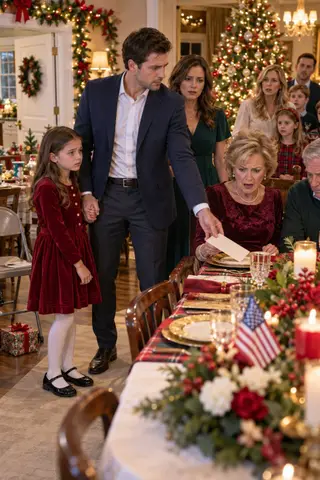
 Confronting toxic family on Christmas: The shocking envelope drop that instantly ended a generational nightmare!
Chapter 21
The Passing of Elizabeth Miller
The telegram of mortality arrived not through a tearful telephone call in the dead of night, but via a dry, formal facsimile sent to Arthur Vance’s legal offices during the first week of February.
Elizabeth Miller had passed away in the palliative care ward of the county hospital at the age of sixty-eight. According to the hospice administrator’s notes attached to the formal notification, she had died in the early hours of a Tuesday morning, surrounded by the sterile beeps of heart monitors and the glare of cheap linoleum floors. There had been no candlelight vigils, no mournful socialite gatherings, and no delegations from the Briarwood Country Club auxiliary. Richard had been asleep in a vinyl armchair by the radiator, and Chloe had reportedly arrived four hours after the attending physician had already signed the certificate of death.
Arthur called me into his office to deliver the document in person. He laid the single sheet of paper onto the walnut desk, keeping his hands flat against the mahogany.
“Her private executor is petitioning the county probate court to close out the remaining debt-settlement schedules, Graham,” Arthur said quietly. “Because your legal renunciation of all filial ties and estate claims was finalized eighteen months ago, you are under zero legal obligation to respond, attend, or acknowledge.”
I took the sheet of paper, scanning the cold, clinical lines. Elizabeth Anne Vance-Miller. Cause of death: End-stage cardiopulmonary failure secondary to renal disease.
I waited for the expected wave of emotion—grief, pity, perhaps even the bitter sting of lingering resentment. But inside my chest, there was only a profound, hollow stillness. It was the same sensation one feels when reading about the demolition of a condemned, derelict warehouse in an unfamiliar city. The woman who had ruled our childhood with an iron fist, who had spent decades measuring human value by pedigree, and who had ordered a nine-year-old child to sit beside a commercial trash can on Christmas Eve, had ceased to exist long before her heart finally stopped beating. She had died the moment she traded her humanity for an empire of gilded paper.
That evening, after dinner at the mountain cabin, Nah and I sat by the roaring stone fireplace while Leah sat at the head of the walnut table, sketching an anatomy study of an eagle’s wing for her middle-school biology portfolio.
I set down my mug and looked across the warm great room. “Leah.”
She looked up from her sketchpad, her pencil pausing mid-stroke, her brown eyes clear and receptive. “Yeah, Dad?”
“Arthur received a notice today,” I said, keeping my voice gentle, honest, and unburdened by manufactured drama. “Your grandmother, Elizabeth, passed away early Tuesday morning in the hospital.”
The room fell quiet, save for the crackle of dry oak logs in the hearth and Barnaby’s rhythmic breathing on the hearth rug. Nah shifted closer to me, resting her hand on my knee, her eyes locked protectively on Leah.
Leah didn't gasp. She didn't drop her pencil. She sat straight in her carved walnut chair, looking out through the tall glass windows toward the dark forest where snow was falling in gentle, silent sheets against the hemlocks.
For nearly a minute, she remained lost in thought, processing the news not with the hysterical grief of an abandoned granddaughter, but with the mature, measured sorrow of an observer witnessing the natural end of a tragedy.
“Is Richard alone now?” she asked softly.
The question caught me off guard. There was no venom in her voice. No spite. Just a child’s instinctive recognition of human isolation.
“He has Chloe, I suppose,” I answered truthfully. “Though from what Arthur tells me, their relationship is mostly arguments over who pays the monthly storage fees for their remaining furniture.”
Leah looked down at the smooth walnut grain of her armrest, her fingers tracing the gold-leaf letters of her own name.
“I hope she found peace, Dad,” Leah said quietly, looking back up at me with an openness that humbled my soul. “It must have been very exhausting to spend an entire life being so angry at everyone who didn't fit into a little box.”
She didn't ask to attend the memorial service. She didn't ask if there was an inheritance. She simply picked up her graphite pencil, adjusted the lighting of her desk lamp, and returned to shading the feathers of the eagle's wing.
The matriarch who had tried to define my daughter’s worth with a metal folding chair had departed this earth, and the only tribute Leah offered was the quiet grace of a life too full of love to make room for bitterness.
The End









