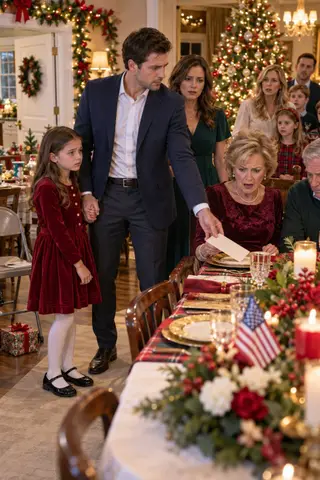
 Confronting toxic family on Christmas: The shocking envelope drop that instantly ended a generational nightmare!
Chapter 16
The Canvas of Belonging
In October, Leah’s elementary school art teacher submitted three student projects to the Tri-County Youth Art Exhibition. One of them belonged to Leah.
When the notification letter arrived in our mailbox, sealed with the official gold crest of the regional arts council, Nah and I sat at the kitchen counter staring at it in stunned disbelief. Leah had won the Juror’s Choice Award for the elementary division—an honor accompanied by a modest youth scholarship and an invitation to exhibit her work at the Grand Metropolitan Gallery in the city center.
“What was the painting, Graham?” Nah asked, her hand trembling slightly as she held the certificate. “Did you see what she worked on in the after-school art club?”
“She kept it wrapped in brown butcher paper,” I replied, shaking my head. “She told me Mr. Henderson said it was a surprise for the gallery opening.”
The night of the exhibition arrived on a cool, rainy Friday.
The Grand Metropolitan Gallery was an imposing, high-ceilinged space of polished concrete, white walls, and track lighting, filled with art patrons, school administrators, and proud parents murmuring politely over glasses of sparkling cider.
Leah wore a simple, elegant dark green dress with flat black dress shoes. Her hair was neatly braided by Nah, but there was no nervous perfectionism in her demeanor. She walked between us with her head held high, holding both of our hands, leading us through the bustling crowd toward the primary exhibit wall designated for the award winners.
When we stopped in front of her piece, the breath completely left my lungs.
The canvas was wide, measuring nearly three feet across, titled simply: Where the Chairs Go.
It was split into two contrasting halves, rendered with a raw, emotional maturity that seemed impossible for a ten-year-old child, yet held the unfiltered clarity that only a child could possess.
The left half of the painting was painted in cold, sterile shades of slate gray, icy silver, and muted burgundy. It depicted an impossibly long, gleaming mahogany dining table, loaded with crystal goblets, towering candelabras, and faceless silhouettes dressed in immaculate evening wear. But at the far, dark edge of that table, tucked beneath the shadow of an open trash receptacle, sat a single, twisted metal folding chair. Beside the chair, lying on the bare floorboards, was a small, perfectly rendered purple square tied with a tiny yellow ribbon—a bar of lavender soap.
The right half of the canvas exploded with vibrant, warm light.
It was painted in rich ambers, deep forest greens, and bright honey yellows. It showed a slightly cluttered, sun-drenched kitchen with mismatched wooden chairs gathered tightly around a sturdy oak table. On the table were slices of messy pizza, mugs painted with crooked stick figures, a goofy golden dog resting its chin on a chair leg, and three distinct figures holding hands. Above the central chair, carved into the wood with thick, bold brushstrokes, was a single word: Daughter.
Beneath the painting, the artist’s statement card read:
“A chair doesn’t make you family. The people who make room for you at the table do. I used to think I had to earn my seat by being quiet. Now I know that real love gives you a chair with your name on it, and it never puts you by the trash.” — Leah, Age 10.
I stood there in the crowded gallery, the chatter of patrons fading into white noise, feeling tears slide down my cheeks without shame. Nah pressed her hand against her mouth, a soft, choked sob escaping her throat as she pulled Leah into a fierce, trembling embrace.
“Oh, baby,” Nah whispered into her hair. “It’s beautiful. You are so, so brilliant.”
Leah looked over Nah’s shoulder, catching my eye. She gave me that quiet, ironclad little nod she had given me on Christmas night beside the folding chair.
She had taken the deepest wound of her young life, transformed it into an undeniable piece of truth, and hung it under the gallery lights for the entire world to see.
The End









