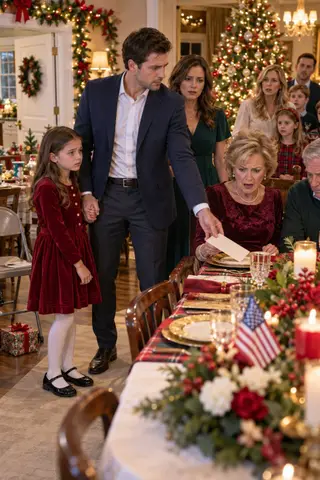
 Confronting toxic family on Christmas: The shocking envelope drop that instantly ended a generational nightmare!
Chapter 23
Middle School Horizons
The transition from elementary school to the sprawling regional middle school in the valley brought a new landscape of challenges and social hierarchies for Leah.
At twelve years old, Leah had grown into a tall, athletic, and thoughtful young woman. Her dark hair was usually tied back in an efficient ponytail, her shoulders were strong from years of softball and mountain hiking, and she moved through the world with an unforced, quiet self-possession that seemed to unnerve people who expected teenage girls to be bundles of anxious conformity.
In a suburban district where status was often signaled by designer sneakers, smartphone models, and family zip codes, Leah was an anomaly. She carried a canvas backpack covered in hand-stitched patches she had embroidered herself, wore durable denim and flannel shirts, and spent her study halls in the art room working on large-scale linocut prints rather than scrolling through social media drama.
The real test came during the second week of October, during the sixth-grade class representative elections.
Leah had been nominated by her homeroom peers to run for the student council board, an honor she had accepted with practical enthusiasm. Her campaign platform wasn't filled with empty promises of longer lunch periods or pizza parties; she proposed turning an abandoned, overgrown courtyard behind the science wing into a community vegetable and flower garden where students could learn composting, grow fresh produce for the local shelter, and have a quiet, green space to decompress during lunch.
On Wednesday afternoon, Nah and I were waiting in the pickup line outside the school when Leah walked out through the double glass doors.
Beside her walked a girl in an expensive suede jacket—the daughter of a prominent local developer whose family had once belonged to the same social circles as my parents. The girl was holding a campaign flyer, speaking in a loud, deliberate tone that carried across the concrete steps where several parents and students were gathered.
“I’m just saying, Leah,” the girl remarked with a patronizing little smirk, her voice dripping with the inherited elitism of her parents, “my mom said people who don't even have real generational family roots in the county shouldn't really be running projects that represent the school’s traditions. I mean, everybody knows what happened with your grandparents. Isn't your family kind of… fractured?”
A dozen kids stopped on the stairs, holding their breath, waiting for the explosion, the tears, or the defensive shouting match that usually followed an insult like that in middle school.
I gripped the steering wheel, my protective instincts flaring hot. Nah placed a calming hand on my forearm, whispering softly, “Watch her, Graham. Look at her.”
Leah didn't flinch. She didn't drop her eyes, and she didn't clench her fists.
She stopped on the second concrete landing, turned calmly toward the girl, and looked at her with a steady, serene curiosity that made the girl’s smirk waver.
“My roots aren't fractured, Sienna,” Leah said, her voice clear, calm, and effortlessly carrying across the quiet courtyard. “My roots were chosen. And when a tree is planted because someone wanted it to grow, instead of just growing by accident, it doesn't blow over when people talk about it.”
She stepped down to the bottom landing, adjusting her canvas backpack over her shoulder.
“Tradition isn't doing what your grandparents did just because they had money,” Leah added with a gentle, disarming smile. “Tradition is deciding what kind of person you want to be tomorrow. If you want to help plant the sunflower seeds in the courtyard next Tuesday, there’s an extra pair of gardening gloves with your name on them.”
She didn't wait for applause or a rebuttal. Leah walked straight down the sidewalk, opened the passenger door of our car, tossed her backpack into the back seat, and slid inside with an easy sigh.
“Hey, Dad. Hey, Nah,” she said, pulling her seatbelt across her chest. “Can we stop at the hardware store on the way home? Caleb said he has some leftover cedar planks from the cabin woodshed that we can use to build raised planter beds for the science wing.”
Nah turned around in the passenger seat, her eyes shining with pure, unfiltered reverence. “You handled that like a queen, sweetie.”
“Queens live in palaces, Nah,” Leah chuckled, pulling a half-eaten apple from her lunch pouch. “I’m a mountain girl. We have dirt to move.”
I put the car in drive and pulled away from the curb, watching the stunned students on the school steps fade into the rearview mirror. My daughter didn't need my armor anymore; she had forged her own, hammered out of truth, grace, and an unshakeable understanding of who she was.
The End









