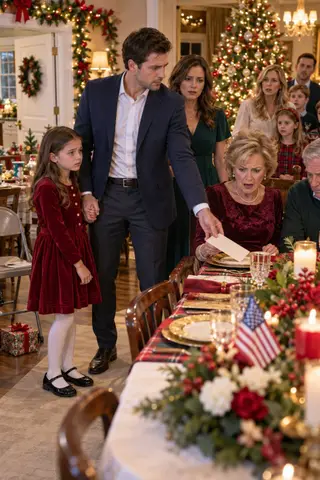
 Confronting toxic family on Christmas: The shocking envelope drop that instantly ended a generational nightmare!
Chapter 27
The Walnut Sapling
In the quiet week following the state symposium, a gentle Indian summer descended upon the mountain valley. The air was warm, smelling of sun-cured grass, falling maple leaves, and the rich, damp loam of the forest floor.
On a quiet Sunday afternoon, Leah and I walked along the lower banks of Sanctuary Creek, where the water carved a winding path through a grove of ancient hardwoods. Barnaby bounded ahead, snuffling through piles of golden beech leaves, chasing invisible chipmunks with joyous, clumsy enthusiasm.
Near the base of a moss-covered granite boulder, thirty yards from where the massive, fallen black walnut tree had rested for half a century before Caleb salvaged it for our table, Leah suddenly stopped.
“Dad, look,” she whispered, dropping to her knees in the soft earth.
I knelt down beside her, brushing aside a thick layer of decomposing hemlock needles.
There, pushing up through the dark, rich mountain soil, was a tiny, vibrant green shoot barely eight inches tall. It had four delicate, serrated leaves that caught the golden afternoon sunlight filtering through the canopy above. At its base, still clinging to the emerging stem, was the split, weathered shell of a fallen black walnut.
“It’s a baby from the table tree,” Leah said, her voice filled with awe.
“It sure is, kiddo,” I said, gently touching one of the tender green leaves. “The parent tree fell during an ice storm six years ago, but before it fell, it dropped this seed into the leaf litter. It waited through three winters in the dark until the conditions were right to push through.”
Leah sat back on her heels, studying the tiny sapling with profound reverence. “It’s growing right where the old one died.”
“That’s how real forests work, Leah,” I said softly. “The old tree falls, but its wood becomes a sanctuary for our family, and its seed starts a whole new generation. Nothing good is ever truly lost if the ground is healthy.”
Leah looked up at me, her eyes shining with sudden inspiration. “Can we move it? Up by the cabin deck, where the morning sun hits the clearing?”
“Go get the spade and the canvas wrap from the shed,” I smiled. “Let’s give it a home.”
For the next hour, we worked side by side in the warm autumn dirt.
With surgical care, I dug a wide, deep circle around the tiny sapling, ensuring that not a single tender taproot was severed from its native soil. We lifted the root ball onto a damp burlap wrap, carried it gently up the winding stone steps, and brought it to the southeastern corner of the cabin plateau, twenty feet from the great room’s picture windows.
Leah dug the new hole herself, her boots covered in dark mountain loam, her face smudged with dirt. She lined the bottom with crushed river stones and rich compost from our summer garden.
Together, we lowered the sapling into the earth. We backfilled the soil with our bare hands, pressing the dark earth firmly around the slender green trunk, anchoring it against the coming winter winds.
When we finished, Leah hauled two buckets of crystal-clear river water from the creek, pouring it slowly around the base until the soil was thoroughly soaked.
She stood back, wiping her muddy hands on her jeans, looking at the tiny walnut tree standing tall against the backdrop of the massive hemlocks.
“How long will it take to grow big, Dad?” she asked.
“Thirty, maybe forty years before it produces its own nuts,” I answered, wrapping my arm around her shoulder. “Long after you’ve gone to college, built your own career, and maybe brought your own kids up to this mountain to run through the creek.”
Leah leaned her head against my chest, her voice quiet, steady, and filled with an ancient, peaceful certainty.
“I’ll take care of it, Dad,” she whispered. “Every year, I’ll check the roots. And when it’s big enough, we’ll put a bench under it so people can sit down and rest when they’re tired.”
I pressed a kiss against the top of her dark hair.
Down in the valley, the names of Richard, Elizabeth, and Chloe Miller had vanished from the public memory, their wealth liquidated, their pride buried in forgotten graves and cheap rental apartments.
Up here on the granite mountain, we were planting trees whose shade we might never sit under, confident that the table we had built would feed generations long after our own hands had returned to dust.
The End









