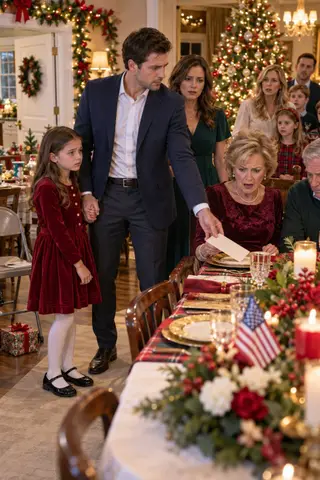
 Confronting toxic family on Christmas: The shocking envelope drop that instantly ended a generational nightmare!
Chapter 26
The Voice of the Unbroken
In late October, Leah received a formal invitation from the State Department of Child and Family Services to serve as the youth keynote speaker at their annual Statewide Adoption and Foster Care Symposium, held in the grand auditorium of the state capital.
The invitation had not arrived through political connections or corporate sponsorships; the committee had read the transcript of her school heritage speech, which had been published in a regional educational quarterly, and had unanimously voted to invite her to address an audience of over eight hundred social workers, family court judges, adoptive parents, and foster youths.
On the morning of the symposium, the capital city was bathed in crisp autumn sunlight.
The auditorium was a breathtaking space of polished brass, velvet theater seating, and towering limestone pillars. Nah sat beside me in the third row, dressed in a sharp navy blazer, while Arthur Vance sat on my other side, wearing the proud, beaming smile of an uncle attending a graduation.
When the state commissioner of family welfare stepped to the podium and announced, “Please welcome our youth keynote speaker, Miss Leah Miller,” the applause was polite, warm, and expectant.
Leah walked onto the wide wooden stage wearing a tailored dark-green pantsuit and simple black leather shoes. At twelve years old, she was the youngest person to ever address the symposium, yet there was not a single tremor in her stride. She adjusted the microphone, looked out across the sea of eight hundred adults, and placed her handwritten index cards flat on the lectern.
She didn't use them.
“When I was nine years old,” Leah began, her voice carrying through the acoustic chamber with a clarity that silenced every rustling paper in the room, “I learned that some people believe a family is an elite club. They believe that if you don't share the same blood, the same pedigree, or the same bank account, you are an outsider who must be taught to be grateful for whatever crumbs fall from their table.”
The auditorium grew impossibly still.
“On my last Christmas with my biological grandparents,” Leah continued, her gaze scanning the silent rows of judges and caseworkers, “there was no chair for me at the twenty-seat mahogany dining table. They placed a single, cold, metal folding chair by an industrial garbage can in the dark corner of the room. They told me they had run out of space. They expected me to sit there, eat with a paper napkin, and smile so I wouldn't ruin their holiday photograph.”
A soft, collective murmur of horror rippled through the front rows of foster parents.
“I was nine,” Leah said, her voice dropping into a register of quiet, devastating power. “And for about sixty seconds, I believed them. I thought that because I was adopted, because my mother had died when I was little, that maybe I was broken. That maybe I was only worth the space next to the trash.”
She paused, lifting her chin, her eyes locking straight onto where Nah and I sat in the third row.
“But then I looked at my dad. And my dad didn't tell me to be patient. He didn't tell me to keep the peace. He didn't ask me to compromise my dignity to protect someone else's comfort. He stood up, he took my hand, he handed them the truth, and he walked out of that house forever.”
Tears welled in Nah’s eyes, spilling over her lashes. Arthur cleared his throat thickly, adjusting his spectacles.
“To every child in this room who has ever felt like an afterthought,” Leah spoke, her words ringing like an iron bell, “I want you to hear me: you are not an intruder in someone else’s life. You are not a guest in your own home. Real love doesn't make you earn your seat through obedience. Real love builds a table where your name is carved into the oak before you even walk through the door.”
She raised her hands, resting them lightly on the podium.
“And to the parents and judges here today: never ask a child to sit at a table where their humanity is treated as a favor. If they don't give you a seat, don't beg for a folding chair. Build your own table. Plant your own forest. Because an unbroken table made of pine and courage will always outlast a palace built on lies.”
When Leah stepped back from the microphone, there was a heartbeat of stunned, breathless silence.
And then, the eight hundred people in that grand auditorium rose to their feet as one single, roaring entity.
Judges in robes, veteran caseworkers, foster teenagers, and adoptive parents clapped their hands until the sound echoed against the high vaulted ceiling like rolling thunder. People were weeping openly, cheering, waving programs in the air.
Leah looked down from the stage, caught my eye, and gave that same, firm, ironclad little nod she had given me on Christmas night beside the folding chair.
I stood in the roaring crowd, tears streaming down my face, my heart expanding so violently it felt like it would burst through my ribs. The girl who had been shoved into the dark corner of a suburban mansion had just turned her wound into a torch, lighting the way for thousands of children who were still searching for their seats in the world.
The End









