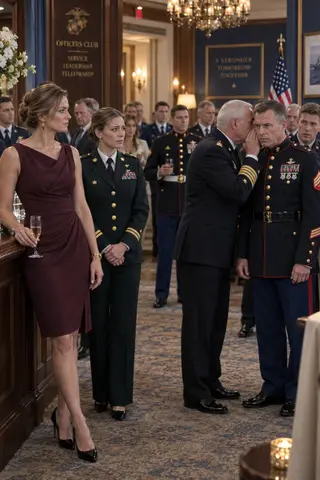
 "She Flies Desks," the Colonel Laughed at the Bar
Chapter 8
The Ready Room Reckoning
For twenty-two minutes, I flew twenty feet above the wave crests.
The storm was a churning monster of salt spray and fog, blinding every optical sensor on the airframe. But the AN/APG-79 radar cut through the clutter like a surgeon’s scalpel. Four miles off our port wing, the infrared pod caught a tiny, pulsing thermal bloom—the heat signature of twelve men huddled together on top of an overturned helicopter fuselage sinking slowly into the Pacific swells.
"Contact," I transmitted to the Ford. "I have eyes on twelve souls in the water. Releasing pods One and Two."
I banked the fighter hard, pulled five Gs through the rain, and toggled the weapons release.
Two cylindrical canisters dropped from the wings, their parachutes blooming orange against the gray storm. They struck the water forty yards upwind of the sinking fuselage, instantly deploying two covered, twenty-man survival rafts equipped with emergency transponders and thermal blankets.
Through the camera feed on my cockpit display, I watched the first three Marines dive off the sinking aluminum hull and swim into the raft opening.
"All survivors entering rafts," I reported. "Vector the Wayne E. Meyer to my beacon."
"Copy, CAG," Keira Lin’s voice came through the radio, crisp, clear, and triumphant. "Destroyer has radar contact on your beacon. Their small boats are in the water now. ETA six minutes."
Forty-five minutes later, I caught the three-wire on the deck of the Gerald R. Ford.
The tailhook grabbed the steel arresting cable with a violent, bone-jarring deceleration that dragged the aircraft from one hundred and forty knots to a dead stop in three hundred feet. The jet shuddered, the engines spooling down from afterburner to idle, and I taxied off the landing area into the parking slot beneath the island.
When I stepped down from the boarding ladder into the drenched, wind-swept catwalk, two dozen flight deck sailors were standing against the bulkheads, banging their heavy wrenches against the steel plating in a deafening salute.
I unzipped my survival vest as I walked through the watertight hatch into Ready Room Seven.
The ready room was packed.
Every pilot from VMFA-314 was there, along with the squadron maintenance chiefs, the ship’s executive officer, and Colonel Derek Marlowe.
Marlowe was standing by the briefing podium. He was holding a clipboard, but his hands were at his sides. He looked at my soaked flight suit, my helmet carried beneath my arm, and the red marks pressed into my forehead from the oxygen mask.
The room went silent.
"All twelve recovered," I announced, setting my helmet on the briefing table. "Two minor cases of hypothermia, one dislocated shoulder. All twelve are currently in the sickbay aboard the Wayne E. Meyer drinking warm soup."
A cheer erupted from the Marine pilots in the back row.
Marlowe didn't cheer. He walked slowly down the center aisle between the leather briefing chairs. He stopped two feet in front of me.
He didn't have his lieutenants with him. He didn't have an audience to impress. He looked like an officer who had finally seen his own reflection without the filter of his own mythology.
"Captain Vance," Marlowe said. His voice was low, rough, and completely stripped of defense. "I’ve spent twenty-five years believing that courage was something you had to shout to prove."
The pilots behind him went completely quiet.
"You saved my men," Marlowe said, looking directly into my eyes without flinching. "You saved them after I questioned your resolve, after I insulted your career, and after I acted like a child in front of junior officers who deserved better from me."
He reached to his chest, unclipped his gold command badge, and laid it on the podium between us.
"If you want my resignation, ma'am, it’s yours. You won't have to convene a board."
I looked at the badge on the wood. Then I looked at Derek Marlowe.
"Pick that up, Colonel," I said.
He blinked. "Captain?"
"I don't need your resignation," I told him, my voice steady enough for every pilot in that room to hear. "The Marine Corps doesn't need another disgraced colonel retiring on a full pension to complain at the golf course about how the military got soft. What the Marine Corps needs is a commander who remembers what it feels like to be wrong."
I pointed toward the back of the room, where Lieutenant Lin had just walked through the hatch.
"That young woman coordinated the radar intercept that kept those boys from drifting into the open ocean while I was in the soup," I said. "You’re going to walk over to her, you’re going to thank her, and then you’re going to spend the rest of this cruise making sure every junior officer in your command gets the credit they earn."
Marlowe stood frozen for three seconds. A single, heavy breath shuddered through his shoulders.
He reached down, picked up his command pin, and fastened it back to his uniform.
Then, for the first time since I had met him, Colonel Derek Marlowe rendered a salute that wasn't born of regulation or fear. It was born of absolute, unvarnished respect.
"Aye, aye, CAG," he whispered.
The End









