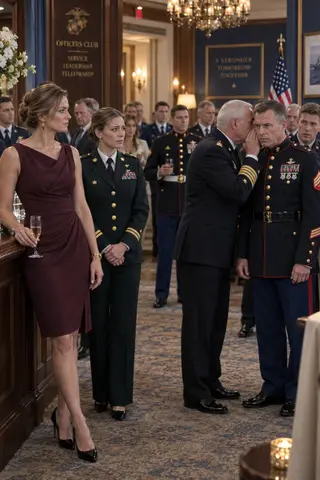
 "She Flies Desks," the Colonel Laughed at the Bar
Chapter 4
The Doctrine Panel
The afternoon session of the symposium was dedicated to the future of joint expeditionary strike warfare.
The stage had been arranged with seven high-backed chairs behind a skirted table. Sitting at the table were three colonels, two Navy captains, an Air Force brigadier general, and Colonel Derek Marlowe.
Marlowe had regained some of his color, bolstered by the familiar comfort of a microphone and an audience of his peers. He had adjusted his tunic, cleared his throat, and was leaning forward over the table, delivering his opening remarks on the integration of Marine air support into carrier strike groups.
"The core issue," Marlowe said, projecting his baritone across the quiet auditorium, "is that naval aviation remains too detached from the reality of the ground scheme of maneuver. Aviators think in terms of sorties and flight hours. Ground commanders think in terms of blood and terrain. When an aviator aborts a strike due to low fuel or weather minimums, they return to an air-conditioned wardroom. My Marines stay in the mud."
A murmur of agreement ran through the Marine officers sitting in the first four rows.
Marlowe smiled—a small, familiar flicker of the arrogance that had dominated the bar the night before. He looked out over the crowd, basking in the sound of his own authority.
"What we need," Marlowe continued, "is less emphasis on high-altitude electronic doctrine and more willingness for aircrews to put their paint in the fire. We have seen a cultural drift toward caution over the past decade. Some communities prefer flying desks and managing spreadsheets to actually pressing the attack when the margins get thin."
He let the phrase flying desks hang in the air for half a second.
It was subtle. To anyone who hadn't been in the bar, it was just another piece of military rhetoric. But to me, to Keira Lin, and to the four lieutenants sitting two rows behind him, the words were an unmistakable echo.
I sat in the front row, directly in the center aisle, in full dress whites.
I raised my hand.
I didn't wave it. I simply lifted my right index finger two inches off my lap.
The moderator, a Navy captain from the Naval War College, spotted the motion instantly. "The chair recognizes Captain Vance."
I stood up.
The auditorium fell into a dead hush. Three hundred chairs stopped shifting. The Air Force general on the stage leaned back, his eyes narrowing with sudden interest.
I didn't look at the other panelists. I looked straight into Colonel Marlowe’s eyes.
"Colonel Marlowe," I said, my voice carrying cleanly to the back wall without the aid of a microphone. "You just stated that naval aviators lack an understanding of the ground scheme of maneuver and prioritize comfort over mission accomplishment."
Marlowe swallowed hard, his throat clicking audibly against his collar. "Captain, I was speaking broadly about doctrine—"
"Let’s speak specifically, Colonel," I interrupted, stepping out into the open space between the first row and the stage. "In your published white paper on expeditionary logistics last November, you proposed eliminating the secondary electronic-warfare screen for carrier-based CAS assets to reduce maintenance overhead. Is that correct?"
"Yes," Marlowe said, trying to square his shoulders. "The cost-to-benefit ratio of dedicated EA-18G support for small-scale engagements is inefficient."
"On March 14, 2017," I said, my tone as cold and steady as a winter morning on the flight deck, "the third platoon of Charlie Company, First Reconnaissance Battalion, was operating in the Shajwah Valley. They were your Marines, Colonel. You were their battalion commander."
Marlowe’s jaw went slack. The papers in his hands began to tremble against the table.
"That platoon walked into an unmapped SA-19 radar perimeter," I continued, pacing two slow steps along the edge of the stage. "The only reason they weren't wiped out by high-explosive fragmentation before the close air support arrived was because an EA-18G Growler sixty miles away was jamming the battery's acquisition frequency. If your logistics paper had been policy that night, seventeen Marines would have come home in aluminum cases."
The room seemed to run out of air.
On the stage, the Air Force general looked at Marlowe, then looked down at his notes, completely separating himself from the colonel.
"Furthermore," I said, stopping directly in front of Marlowe’s microphone, "when the close air support did arrive, the pilot ignored two abort directives from the command cruiser, descended through an eight-hundred-foot overcast into a blind gorge, and delivered two laser-guided munitions fifty yards from friendly lines to break the ambush."
I reached up, my hand brushing the blue ribbon of the Navy Cross hanging over my heart.
"The pilot didn't return to an air-conditioned wardroom, Colonel. She returned to a carrier deck with three hydraulic lines severed, twenty-four shrapnel holes in her starboard wing, and thirty pounds of jet fuel remaining in her feed tanks."
I paused. The silence in the auditorium was heavy enough to crush bone.
"Do you still believe, Colonel Marlowe, that the naval aviation community prefers flying desks?"
Marlowe didn't speak. He couldn't.
His face had turned the deep, mottled crimson of a man experiencing a medical emergency. His mouth opened slightly, closed, and opened again. Not a single sound came out.
"Thank you, Colonel," I said softly, sitting back down in my chair. "I look forward to reviewing your revised doctrine before our deployment."
The End









