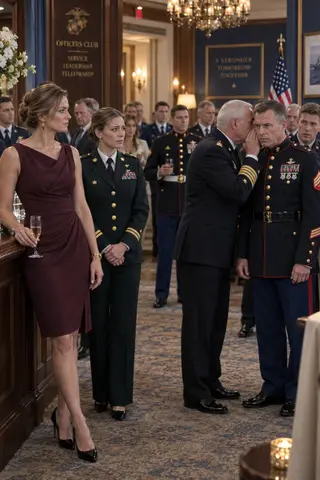
 "She Flies Desks," the Colonel Laughed at the Bar
Chapter 10
Catapult One
One year later, the sunset over the Philippine Sea was a masterpiece of liquid gold and deep violet.
The flight deck of the USS Abraham Lincoln was bathed in the warm, fading light of late afternoon. Flight operations had concluded forty minutes earlier, leaving the four-and-a-half-acre steel deck quiet save for the rhythmic rush of thirty knots of wind over the carrier’s island.
I stood on the starboard catwalk, my hands resting against the cold painted railing.
On the epaulets of my khaki shirt rested the single silver star of a Rear Admiral. As Commander of Carrier Strike Group Three, I was now responsible for nine ships, eighty aircraft, and seven thousand sailors and Marines spread across three thousand square miles of open ocean.
Down on the flight deck, a single F/A-18F Super Hornet was parked on Catapult One.
The jet was painted in the high-visibility colors of the strike group commander, with my name and callsign stenciled in crisp black lettering beneath the canopy rail: RADM MEREDITH "APEX" VANCE.
Standing beside the boarding ladder was Lieutenant Keira Lin, now wearing the golden wings of a naval flight officer, reviewing the pre-flight maintenance log with her plane captain.
Beside her, leaning against the intake of the jet, was Colonel Derek Marlowe, visiting the flagship as the expeditionary strike commander for the upcoming bilateral exercise with the Australian navy. He was laughing with Keira, pointing out an adjustment on the wing root, completely at ease among the grease, the non-skid, and the noise.
He looked up at the catwalk, spotted me standing against the horizon, and raised his coffee mug in a silent, respectful toast across sixty feet of salt air.
I lifted my hand, returning the gesture.
Behind me, the hatch to the island opened. My flag aide, a sharp young lieutenant commander, stepped onto the catwalk holding an encrypted tablet.
"Admiral Vance?"
"Yes, Chris?"
"The Seventh Fleet commander just transmitted the operational schedule for the South China Sea transit," he said, handing me the screen. "Every destroyer in the group is on station. The air wing is at ninety-eight percent readiness."
I looked down at the digital map, then looked back out over the carrier deck.
Below me, Keira Lin climbed into the rear cockpit of the Super Hornet, pulling her helmet on, her visor reflecting the golden rays of the setting sun. On the catwalk below, sailors in green, yellow, and red jerseys moved with the synchronized, effortless ballet of an organization that worked because every single person—from the seaman scrubbing the scullery to the admiral on the bridge—understood their worth.
Twenty-five years earlier, a flight instructor in Pensacola had told me that the Navy wasn't built for women like me. He had said that the sea was too cold, the hours too long, and the culture too hard to survive without bending until you broke.
I took a deep, clean breath of the Pacific air.
The wind smelled of jet fuel, salt water, and absolute freedom.
"Signal the strike group, Chris," I said, handing the tablet back to my aide.
"What’s the signal, Admiral?"
I watched Keira’s jet spool its engines, the low, powerful rumble vibrating through the steel deck beneath my boots.
"Tell them the skies are clear," I said, smiling into the wind. "And we are ready for launch."
The End









