 "She Flies Desks," the Colonel Laughed at the Bar
Chapter 1
The Glass on the Floor
The ice in my water glass had melted into a thin, lukewarm film by the time Colonel Derek Marlowe reached the punchline of his third joke.
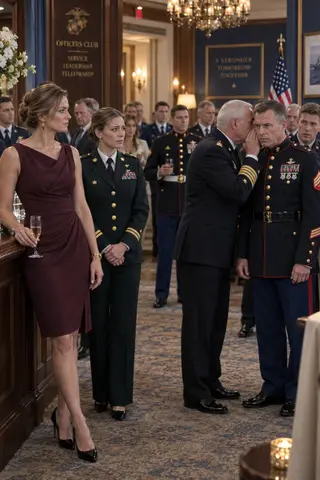
Around him, four junior officers leaned in with the stiff, eager smiles common to men whose careers depended on laughing at the right moments. The officer’s club at Naval Air Station North Island was crowded, noisy, and thick with the heavy humidity of a San Diego heatwave. Overhead, ceiling fans spun lazily against the dark mahogany rafters, pushing around air that tasted of bourbon, fried appetizers, and brass polish.
"She’s not aircrew. Look at her," Marlowe said, waving his heavy crystal tumbler toward me across the four feet of varnished bar separating us. His face was flushed red under a short, high-and-tight haircut, his service khaki collar slightly damp at the neck. "Ladies don’t fly the hard stuff. They fly desks. Supply, logistics, maybe administrative paper-pushing in the basement of the Pentagon. Real flight suits don't come in silk."
His lieutenants grinned on cue. One of them, a fresh-faced Marine first lieutenant who still looked young enough to get carded at a bowling alley, dropped his eyes to the counter, shifting uncomfortably. "Sir, maybe don't..." he whispered.
Marlowe waved him away like a man swatting a fly. "Relax, Miller. It’s an observation. You can tell who’s spent twenty hours in a cockpit and who’s spent twenty hours in a swivel chair just by looking at their posture."
Beside me, Lieutenant Junior Grade Keira Lin went completely rigid. Her knuckles turned white around her club soda. Her eyes darted from Marlowe to me, filled with that panicked, helpless rage that young female officers carry when they watch a superior officer cross a line they are powerless to enforce.
"Ma'am," Keira whispered, her voice trembling. "I can say something. I can get the duty officer—"
"Drink your soda, Lieutenant," I said softly.
My voice didn't rise. It didn't waver. It held the flat, steady cadence I had used for two decades over tactical radio frequencies while coordinating combat air patrols over hostile coastlines.
I was wearing an off-the-rack charcoal shift dress, a delicate silver necklace, and low heels. I had checked my service dress uniform at the hotel front desk three hours earlier after flying in from Washington. There were no golden wings pinned to my left breast. No ribbon rack spanning seven rows. No eagle insignia gleaming on my collar points. To Colonel Derek Marlowe, I was just an unattached civilian woman who had wandered into an aviation symposium reception and had the audacity to use the word Hornets in his presence.
"Don't let it ruin your night," I told Keira, setting my empty glass on the napkin. "Men like that spend their entire careers talking loudly in bars because the aircraft only listen to competence."
I picked up my small leather clutch and prepared to turn toward the double oak doors leading out to the terrace.
Then the room shifted.
It wasn't a sudden explosion or a blaring siren. It was the quiet, immediate drop in atmospheric pressure that happens in any military gathering when senior authority enters a space. Conversations tapered off. Laughs died in throats. Officers unconsciously straightened their spines, adjusted their gig lines, and cleared paths through the crowd.
Walking through the center aisle between the high-top tables was Vice Admiral Thomas Prescott.
Prescott was sixty-one years old, the Commander of Naval Air Forces—the 'Air Boss'—a legend who had logged four thousand hours in tactical jets, survived two ejections, and commanded three carrier strike groups. He carried himself with the quiet, terrifying economy of motion that only comes from decades of holding life-and-death authority. Behind him walked two aides, clutching leather binders and encrypted tablets.
Marlowe saw him coming.
The Marine colonel immediately puffed his chest out, set his feet at shoulder-width, and arranged his face into an expression of rugged, deferential competence. He turned halfway toward the aisle, clearly preparing a greeting to impress the four lieutenants clustered around his shoulder.
"Admiral Prescott, good evening, sir," Marlowe began, lifting his hand toward a salute.
Prescott didn't look at Marlowe’s hand. He didn't break stride. He didn't return the greeting.
He walked straight past Marlowe’s outstretched arm, stopped two inches from the colonel’s shoulder, and leaned in close to his right ear.
Prescott didn't whisper, but his voice was pitched low enough that only Marlowe, his lieutenants, and I could hear the eight words he delivered with the surgical chill of a butcher's knife:
"That’s Captain Eleanor Vance. Apologize or resign tonight."
The silence that followed was absolute.
Colonel Derek Marlowe’s face didn't merely lose its color; it emptied completely, turning the sickening, bloodless gray of wet newspaper. His eyes widened until the whites showed all the way around the pupils. His chest, which had been swollen with barroom swagger two seconds before, caved inward as if every lungful of air had been punched out of him.
His right hand twitched.
His fingers went completely slack.
The heavy cut-crystal tumbler slipped from his grip. It fell through the four feet of empty air, struck the slate floor near my shoe, and shattered into twenty glittering pieces. Amber whiskey and melted ice splashed across the cuffs of Marlowe’s trousers and soaked into the carpet.
Nobody moved to pick it up. The four lieutenants stood frozen like statues carved from salt.
Prescott stepped back, ignoring the puddle on the floor, and turned his steel-gray eyes directly onto me. The coldness in his face vanished, replaced by a warm, familiar smile that crinkled the deep crow’s feet around his eyes.
"Meredith," Prescott said, extending a broad, calloused hand. "I’m sorry to keep you waiting. The SECNAV’s office ran long on the secure video link. We need to go over the air wing deployment schedule before the joint doctrine breakfast tomorrow."
I took his hand. My grip was firm, steady, and unhurried.
"No problem at all, Admiral," I said smoothly. "I was just finishing my drink."
Prescott glanced down at the puddle of liquor, then shifted a single, scorching look toward Marlowe, who was standing trembling in his soaked shoes, incapable of closing his mouth.
"Walk with me, Eleanor," Prescott said. "The Pentagon brief is waiting in my suite."
"Aye, sir," I replied.
I turned to Keira Lin, who was staring at me with her mouth slightly open, her eyes wide as saucers. I gave her a small, conspiratorial wink.
"Get some sleep tonight, Lieutenant Lin," I told her quietly. "Tomorrow morning is going to be very loud."
The End









