 "She Flies Desks," the Colonel Laughed at the Bar
Chapter 2
The Service Dress Whites
The alarm sounded at 0500.
I sat on the edge of the hotel bed, listening to the muffled roar of the Pacific surf breaking against the rocks outside the Coronado shoreline. Through the sliding glass door, the sky was a deep indigo, fading slowly into lavender along the eastern horizon.
I did thirty push-ups on the carpet, drank a glass of water, and began the ritual that had anchored my mornings for twenty-two years.
The uniform hung from the wooden closet door, encased in breathable black cloth. I unzipped the garment bag and pulled it into the morning light: the Navy Service Dress White coat. High collar, stiff shoulders, tailored wool that smelled of dry-cleaning cedar and starch.
I slipped into the trousers, fastened the belt buckle so that the brass tip aligned precisely with the trouser fly seam, and buttoned the tunic.
Then came the hardware.
On the shoulders rested the hard boards bearing the silver eagle of a Navy Captain—O-6. On the left breast, pinned with two-inch brass clutches, sat my golden aviator wings, the anchor fouled with rope, the wings swept back like the tail fins of an F/A-18. Below the wings rested the ribbon rack, dense and heavy against the white wool: the Navy Cross, the Silver Star, the Distinguished Flying Cross with combat 'V', the Bronze Star, the Air Medal with strike numerals, and the Meritorious Service Medal.
I checked my reflection in the full-length mirror. My dark hair was pulled back into a regulation bun, clean and tight against the nape of my neck. My eyes were clear.
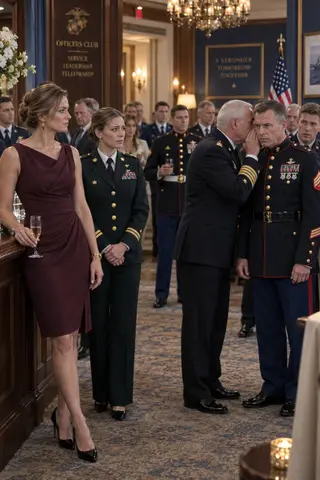
At 0715, the grand ballroom of the Paradise Point Resort was humming with the energy of three hundred senior officers.
The Joint Air-Sea Readiness Symposium was the premier tactical conference of the fiscal year. Every table was occupied by khaki and green uniforms—Naval Aviators, Marine Ground Combat commanders, Air Force strike leads, and civilian defense analysts. Waiters in black aprons weaved between the round tables pouring black coffee from silver carafes.
Near the rear entrance, Colonel Derek Marlowe stood with his back to the wall, holding a paper coffee cup with both hands as if using the heat to stop his fingers from shaking.
He looked like a man who had spent the night staring at his ceiling fan. The redness in his face had been replaced by dark, bruised circles beneath his eyes. His service uniform was immaculate, but the way he kept his shoulders hunched showed that every ounce of his barroom bravado had evaporated.
Beside him stood the same three lieutenants from the night before, speaking in hushed, anxious whispers.
"Sir, are you sure it was her?" the young lieutenant, Miller, muttered. "I mean... Captain Eleanor Vance? The one from the Shajwah ridge engagement?"
"Shut your mouth, Miller," Marlowe hissed, though his voice lacked any bite. He raised the cup to his lips, his hand visibly unsteady. "I checked the conference register at three in the morning. It’s her. She’s the incoming Commander of Carrier Air Wing Seven."
"The CAG?" another captain whispered in horror. "Sir... our Marine strike fighter squadron is assigned to Air Wing Seven for the Western Pacific deployment."
Marlowe closed his eyes. A muscle in his jaw jumped once, twice, like a trapped insect.
Before he could answer, the double mahogany doors at the front of the ballroom opened.
A master-at-arms stepped forward, his voice cutting through the clatter of silverware and conversation:
"Attention on deck! Admiral Prescott arriving with the incoming Carrier Air Wing Commander."
The entire room snapped to its feet with the synchronized scrape of three hundred chairs. Heels clicked together on the carpet. Shoulders went back. Chins rose.
Admiral Prescott strode down the central carpet, his four-star shoulder boards gleaming under the recessed lighting. And walking half a step to his left, her pace matched to his, was me.
As I passed the middle tables, I felt the eyes of every aviator in the room lock onto my uniform. To the younger pilots, the medals on my chest were historical artifacts—decorations from engagements they had studied at TOPGUN or read about in declassified after-action reports. To the older commanders, I was simply 'Apex,' the callsign that had led the night strikes into the contested river valleys when the air defenses were still fully active.
My eyes swept across the back row.
I found Colonel Marlowe.
He was standing at attention, his chin tucked so hard into his chest that the veins in his neck were pulsing. His eyes were wide, tracking my face as I walked past his table.
I didn't glare at him. I didn't smirk. I didn't pause.
I held my gaze on him for two seconds—just long enough for him to see the golden wings pinned over my heart, the silver eagle on my collar, and the blue ribbon of the Navy Cross. Then I looked forward toward the podium, stepping onto the raised stage beside the Air Boss.
"Take your seats, ladies and gentlemen," Admiral Prescott said into the microphone.
Three hundred officers sat down in unison.
Marlowe sank into his chair as if his knees had turned to wet rope. Across the table, Lieutenant Junior Grade Keira Lin looked up at the stage, caught my eye, and sat taller than anyone else in the room.
The End









