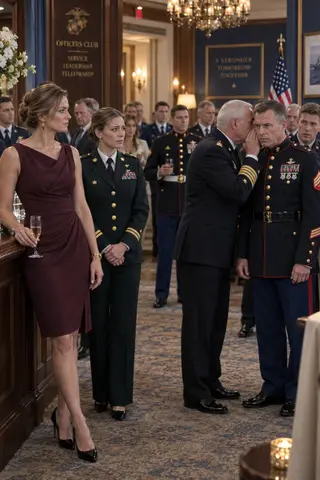
 "She Flies Desks," the Colonel Laughed at the Bar
Chapter 3
Night Over the Valley
The medal on my chest had a date attached to it: March 14, 2017.
Every officer in that room knew the story of Shajwah Ridge, but none of them knew how cold the cockpit gets when your second generator fails at twenty-two thousand feet.
We had launched off the deck of the USS Harry S. Truman at 0130 under a sky so dark you couldn't tell the horizon from the black belly of the Persian Gulf. I was leading a two-ship element of Super Hornets from VFA-103. Our mission was routine close air support—boring, predictable racetrack patterns over an empty sector while special operations forces conducted reconnaissance eighty miles inland.
Then the radio net went wild.
“Mayday, Mayday, all airborne assets, this is Hammer Three-Actual! We are taking heavy fire from the tree line! Three casualties down, RPG fire on the extraction LZ! We need immediate ordnance on coordinates Delta-Niner-Four!”
Hammer Three was a twenty-man Marine reconnaissance platoon. They had walked into a fortified ambush in a dried riverbed hemmed in by sheer limestone cliffs.
The tactical air controller aboard the command cruiser ordered us to hold our altitude. A mobile surface-to-air missile battery had lit up its radar forty miles north, and the cloud deck had descended to eight hundred feet above the jagged mountain peaks. High-altitude drops were impossible through the overcast, and flying beneath the clouds meant threading a fifty-million-dollar fighter jet through a blind canyon filled with heavy anti-aircraft fire.
"Hold current orbit, Dash One," the cruiser’s controller repeated. "Surface threats are unlocated. Do not penetrate the deck."
I looked at my heads-up display. The fuel readout showed forty-five minutes of gas before we hit bingo status.
Through my auxiliary radio, I could hear the Marine lieutenant's voice breaking. In the background, the rapid, rhythmic thump-thump-thump of a Russian-made DShK heavy machine gun was chewing through the rocks protecting his wounded men.
“They’re flanking our left side! We are out of smoke! If you don't drop now, we’re gone!”
I didn't ask for permission. In combat, permission is often just a committee's way of avoiding responsibility for dead men.
"Dash Two, hold orbit at angels twenty," I transmitted to my wingman. "Keep the radar active to paint that SAM battery. I’m going down."
"Lead, you can't see the canyon floor!" my wingman called back, his voice tight with panic. "The peaks are eight thousand feet!"
"I have the terrain database," I said. "Watch my transponder."
I pulled the throttles back to idle, shoved the flight stick forward, and dropped like a stone into the gray soup.
The transition from clear starlight into the suffocating blind of the cloud deck was instantaneous. The heads-up display flashed green against my visor as the radar altimeter began its frantic countdown: Ten thousand... nine thousand... eight thousand...
At seven hundred feet above ground level, the clouds tore open.
The valley below was a cauldron of fire. Tracers—glowing strings of green and orange light—were crisscrossing the canyon floor. Through my night vision goggles, I could see the thermal bloom of the pinned-down Marines huddled behind a collapsed stone wall. Less than two hundred yards away, two pickup trucks mounted with heavy guns were advancing up the wash.
BEEP-BEEP-BEEP-BEEP.
The threat warning receiver screamed in my ears. The radar-guided SAM on the ridge had locked onto my heat signature.
I didn't pull up. If I climbed back into the clouds, the laser-guided bomb wouldn't track, and the Marines would be overrun in ninety seconds.
"Hammer Three, keep your heads down," I said over the net, my voice level enough to sound like I was ordering lunch. "Ordnance away."
I released two five-hundred-pound GBU-12 laser-guided bombs.
At eight hundred knots, fifty feet above the canyon floor, I guided the weapons through the crosshairs with my right thumb while dumping bundles of flares with my left. The twin detonations obliterated the advancing trucks in a wall of white-hot pressure that rocked my wings like an ocean wave.
A missile corkscrewed past my canopy, close enough that the rocket wash blistered the paint on my starboard intake.
I pulled twelve Gs out of the canyon, blacking out at the edges of my vision as the aircraft strained against the physical limits of its titanium airframe, breaking out of the top of the clouds just as my fuel warning began to chime yellow.
The Marines survived. All seventeen of them.
When the platoon returned to Camp Lejeune three months later, their battalion commander was a rising, ambitious lieutenant colonel who accepted the Navy Unit Commendation on their behalf at a formal parade. He shook hands with senators, took photographs with the press, and never once asked the name of the pilot who had dove into that canyon to pull his boys out of the dirt.
That battalion commander was Derek Marlowe.
The End









