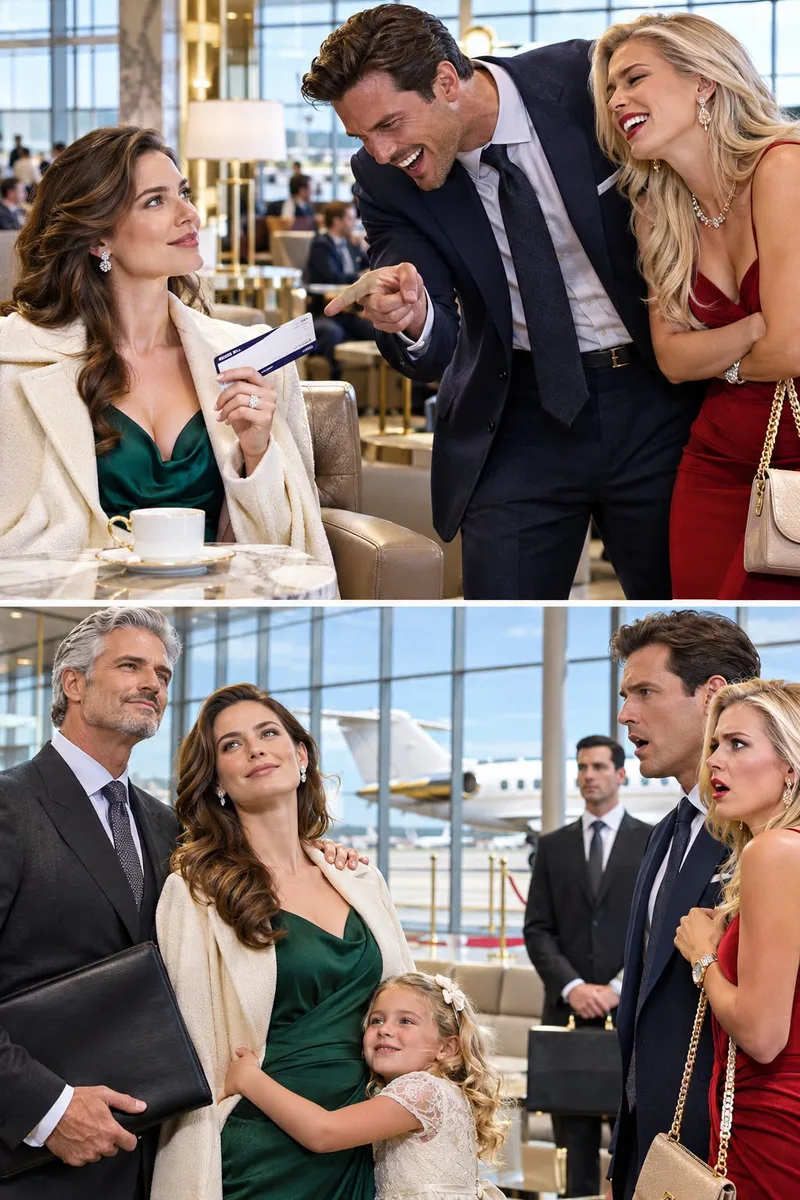
 Five Years After My Ex-Husband Left Me Broke, He Mocked My Airport Ticket
Chapter 8
An Offer With Conditions
The acquisition committee's decision reached the public markets before I heard anything from Alexander. Sterling Capital had announced that it would not proceed on the original hundred-million-dollar terms. The independent directors were evaluating a narrower asset purchase, contingent on updated liabilities, certain customer contracts, and labor arrangements.
The announcement did not say that Richard had lied or that his company was worthless. It said the numbers under review did not support the original structure. That was less theatrical than a canceled signing, and more consequential for the people trying to plan their futures.
Richard's photograph appeared beside the news again. I closed the article and called Mara for a status update on our shipments. She confirmed that Caldwell's operations remained normal and that our contract was being performed. We agreed not to speculate to customers. Aster had enough to manage without writing commentary on a pending transaction. I knew Richard might believe Alexander had engineered the change to punish him. I could not control what Richard believed. I could keep records showing our decisions had been made independently.
At home Alexander looked tired. He had spent the day responding to questions about his recusal, making sure investors understood that the committee was carrying out the review. "Some people assume I wanted to protect Richard," he said. "Others assume I wanted to hurt him. Neither group seems interested in a process that doesn't revolve around me."
I poured tea into two cups. "Now you know how it feels to be someone's explanation for everything," I said. He laughed softly. We sat by the window, watching rain collect on the garden stones.
I asked whether his recusal had left him frustrated. "A little," he admitted. "But I hired people to be better at questions I can't answer alone. If I interfere every time something matters personally, their independence is a performance." He turned his cup in his hands.
I remembered Richard insisting that a powerful man should always be able to get what he wanted. Alexander's answer was different. It didn't make him flawless; we had argued over family time and risk more than once. It made me willing to trust the limits he accepted.
A few days later Naomi called again. Caldwell management had finally held a staff meeting. Workers had been told the sale might change form and that certain contracts would undergo review. No one promised every job was safe. "At least they admitted they don't know," she said.
She also told me Luis had been offered a place in an advanced training program. Aster's contract renewal gave the facility enough predictable work to support his schedule, though Naomi was careful not to promise more. I congratulated her. We both knew a young technician's education should not depend on whether a wealthy man signed a particular deal.
Delia advised me that the financial settlement was proceeding according to its written terms. One payment remained, and she would monitor it without involving me in repeated conversations. I authorized her to do so. The process no longer occupied my mornings. I still thought about the years I had doubted myself, especially when I heard a familiar phrase or caught sight of the old divorce folder. But those memories were beginning to feel like weather that passed through a house rather than the foundation beneath it.
I attended the training foundation's committee meeting to discuss the scholarship. We agreed that applicants would demonstrate financial need, commitment to safety, and progress toward an aviation trade or operations certification. The selection group would be independent, and my family would not choose winners. The first awards would be modest. I could have announced a larger sum and invited cameras. Instead we funded a sustainable program and arranged to review its impact after a year. I imagined my mother, who always liked a well-organized ledger, approving of the decision.
Richard sent no more personal messages for a while. I learned through Delia that he had complied with the first payment and continued to dispute any allegation of wrongdoing. That was his right under the agreement. I had not acquired the power to make him adopt my interpretation of our marriage. I had gained the ability to state my own. Sometimes the distinction still angered me. I wanted moral certainty with the clean edges of an accounting figure. Human history rarely supplied it.
At Aster, a junior manager named Theo made an error on a shipping quote that would reduce our margin on a small contract. He entered my office visibly pale, expecting an angry lecture. I asked him to explain what happened, what the customer had been promised, and how he intended to prevent the mistake.
We corrected the quote where possible and absorbed the part that was our responsibility. Afterward he thanked me for not shouting. I told him that accountability worked better when people could tell the truth early. As he left, I thought of how afraid I had once been to ask Richard a simple financial question.
Lily's school held its first autumn concert. Alexander arrived late after a meeting and slipped into the seat beside me while the children were lining up. He whispered an apology and held out the program he'd picked up at the entrance. We watched Lily sing with more confidence than accurate pitch.
At the end, she searched the audience until she found us together. She waved so hard that her teacher gently lowered her arm. I waved back. My daughter did not need to know which adult in the room controlled which investment firm. She needed us to show up.
After the concert, a parent asked whether Aster might sponsor a classroom project on transportation and geography. I invited the teacher to send a proposal. Alexander offered to help with a visit to a local museum, but Lily interrupted to say she wanted to see a train, not another plane. "Our lives have enough airplanes," she announced.
We agreed on the train. I enjoyed the way she could refuse something our world treated as impressive and ask for what she actually wanted. It reminded me of the child I'd been before money became a measure other people imposed.
That night I took my mother's brass compass from the file box and placed it on the shelf near Lily's drawings. I had spent years keeping it out of sight because it reminded me of what I'd lost. Now it could remind me of what I was choosing.
The pending acquisition might change Richard's business, but it would not provide the last sentence of my story. I was already writing that sentence in classrooms, hangars, kitchens, and conference rooms where the people around me were allowed to tell the truth.
The End









