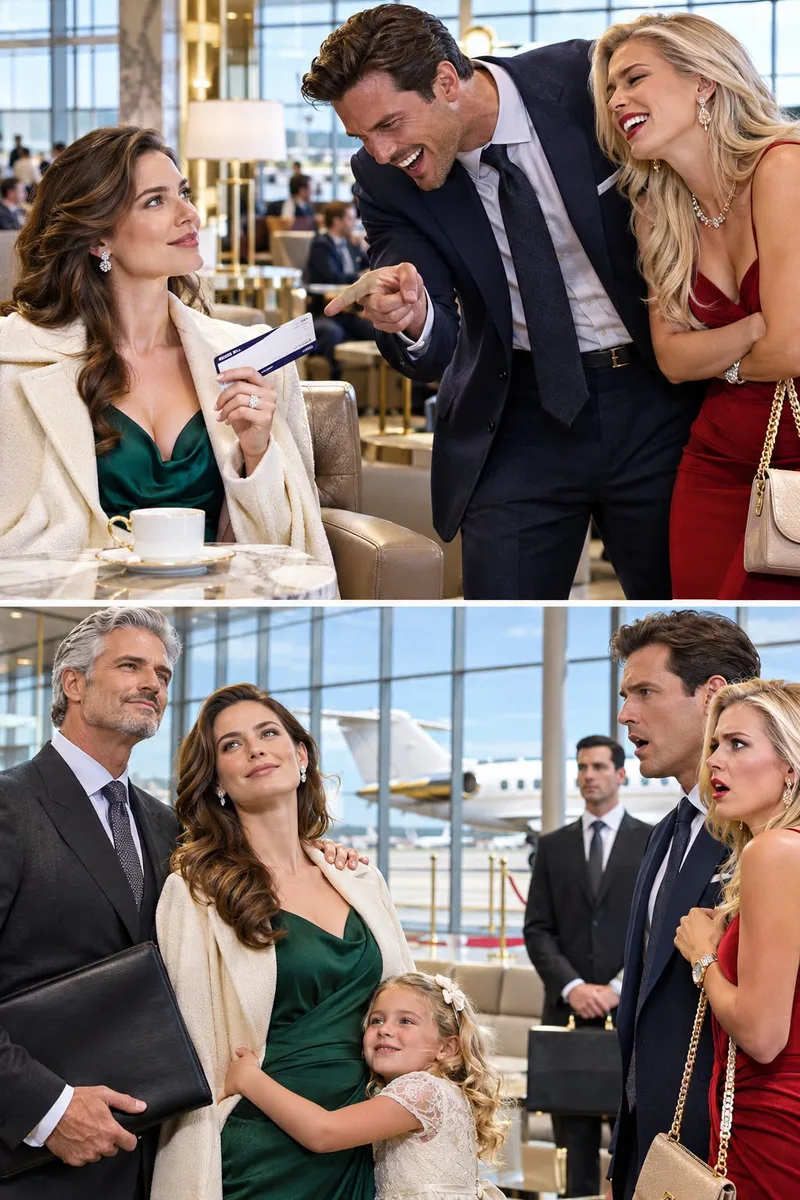
 Five Years After My Ex-Husband Left Me Broke, He Mocked My Airport Ticket
Chapter 5
The Room With Two Doors
The mediation office occupied the twelfth floor of a building with no view worth describing. Its waiting room contained two chairs, a water dispenser, and a stack of magazines several years out of date. I appreciated the lack of grandeur. Richard had always preferred rooms designed to make someone feel small.
Here the tables were identical and the mediator, a woman named Judith Lane, asked each of us to agree to the same ground rules. Our lawyers sat beside us. There were no company officers, no representatives of Sterling Capital, and no discussion of the pending acquisition.
Richard arrived early. He stood when I entered, then seemed unsure whether he was supposed to offer his hand. I chose a chair across from him. He looked older than he had at JFK. I noticed a line between his eyes and remembered how he used to rub that place after long meetings. For an instant, the memory made me ache for a marriage that hadn't survived. I let it ache. Being glad to be free did not require me to deny that I had loved him.
Judith explained that mediation was voluntary and that she could not decide whether a crime or civil wrong had occurred. The purpose was to see whether the parties could reach an informed agreement about a disputed transfer. Delia presented a limited bundle of bank records. The accountant's reconstruction showed money moving from the account created by my mother's estate into Richard's brokerage account. The instructions for that movement remained disputed. I knew better than to say the records told us everything. They showed enough to demand an answer.
Richard looked at the transfer date. "That was when we were paying the house expenses," he said. Delia asked what specific expenses he meant. He named the mortgage and improvements to the property. The amount was substantially larger than those charges.
His lawyer interrupted to say that records were incomplete and Richard disputed the characterization of the transfer. Judith asked us to keep to facts we could identify. Richard folded his hands and looked toward the door. I watched him reach for the same old strategy: speak confidently until the other person was tired of questioning.
"My mother left that account to me," I said. "I asked you what happened to it and you said I had misunderstood. I trusted you to manage the statements. I want to know what instructions you believed you had." Richard's expression changed slightly. He did not apologize.
He said he believed we had agreed to use the funds for our household. "Then show us the agreement," I answered. Silence spread across the room. It was not proof that he was lying. It was the first time I could remember when my question remained on the table instead of being turned back against me.
We broke for a private meeting with our lawyers. Delia pointed out that the statute of limitations and the divorce settlement could complicate any lawsuit, depending on what the documents established. She did not recommend pressing a claim she couldn't justify.
I admitted that part of me wanted Richard to feel the vulnerability I'd felt. "That would be understandable," she said. "But our job is to keep you from buying a moment of satisfaction at a cost you regret." I drank water and thought of my employees, whose paychecks depended on my ability to make decisions without acting on every painful impulse.
When we returned, Richard asked to speak without legal arguments. Judith allowed him to make a statement. "I didn't know you were going to build Aster," he began. I almost laughed. He looked bewildered by my expression. "That's what you wanted to say?" I asked.
He corrected himself awkwardly. He said that at the airport he had been surprised, and Vanessa had been surprised, and that the situation had been uncomfortable. It was a string of descriptions that avoided responsibility so efficiently I could hardly tell where one excuse ended and another began.
"You laughed at me," I said. "You did that while I was sitting quietly in a public lounge. You didn't know whether I was wealthy or poor, and you decided I deserved it anyway." He looked at his lawyer. Judith waited. Richard finally said, "I shouldn't have spoken like that." The sentence was smaller than an apology and more honest than anything else he'd offered. I accepted it as a statement of fact. It could not reverse what happened, and I didn't need it to.
Judith asked whether we wanted to explore a financial resolution. Richard's lawyer proposed an amount to close the dispute without admission. Delia requested a recess so we could review the figures and the proposed release. I resisted the temptation to attach my signature immediately.
Years ago, forty-three thousand dollars had felt like the last possible answer I could afford. Now I could take a document home, ask careful questions, and decline it if the terms were wrong. That freedom had more substance than the size of the number on the page.
During the break Richard approached the water dispenser. He stood a few feet away, hands empty. "Are you happy?" he asked. I looked at him. He seemed to mean the question genuinely. "Most days," I said. "Sometimes I'm exhausted. Lily lost her rabbit yesterday and we had the entire household searching under couches. My business had a terrible quarter once. I worry about ordinary things. Yes, I'm happy." He looked down. "I didn't think you wanted that kind of life." I wondered whether he'd ever asked. I didn't say it. We had spoken enough.
We ended without signing. Delia and I agreed to evaluate the offer after receiving supporting statements, with no waiver of rights until an attorney explained the precise consequences. Richard left by the other door, an arrangement Judith made without ceremony. On the street, the sunlight was sharp and the traffic impossibly loud.
I called Mara, who told me the hospital shipment had arrived and the next contract renewal was ready for review. She didn't ask about mediation. I thanked her for the update and stood still for a moment, remembering my mother's handwriting on that brass compass receipt.
That evening Alexander met me in the garden after Lily went upstairs. I told him what I could without sharing privileged negotiation details. "There may be a resolution," I said. "I don't know yet." He asked whether I regretted attending. "No. I asked a question and nobody made me feel foolish for asking it."
He slipped his hand into mine. I had gone into the meeting wanting proof that Richard could no longer control the narrative of my life. I came out realizing I did not need to control his either. I needed a record, a fair decision, and the courage to accept whichever answer the evidence supported.
The End









