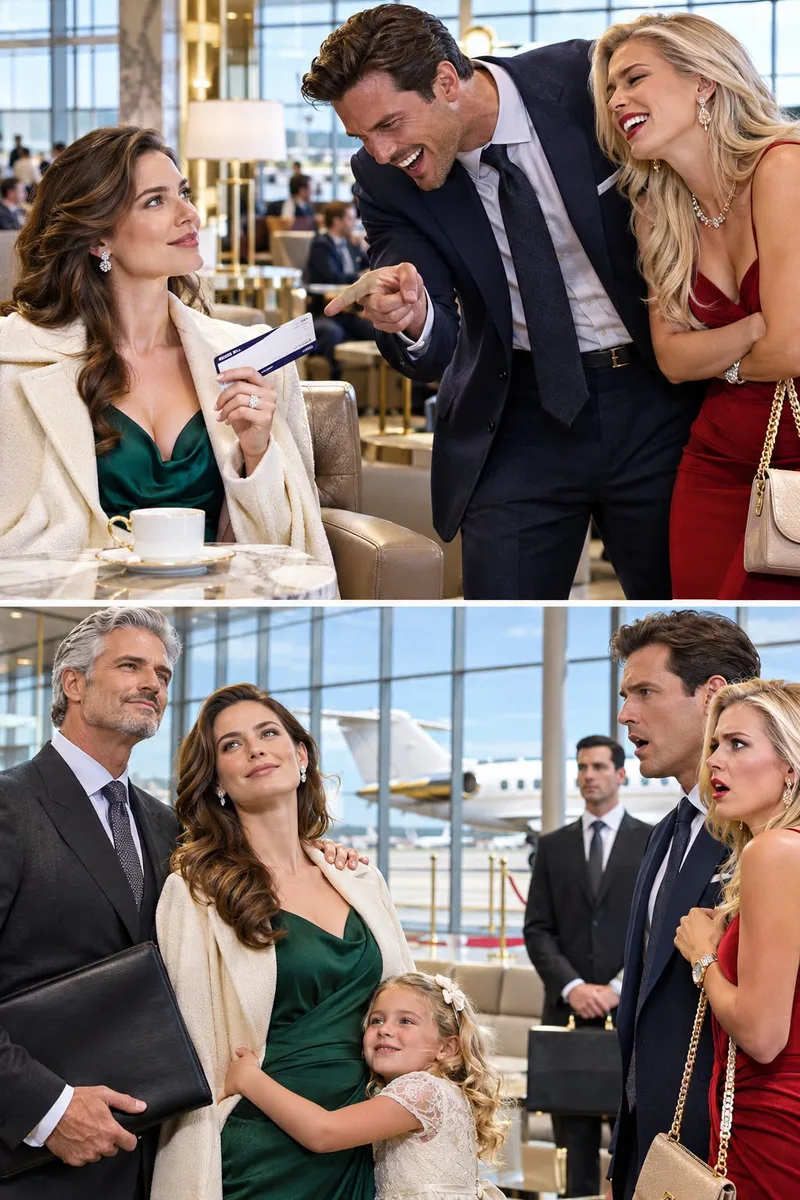
 Five Years After My Ex-Husband Left Me Broke, He Mocked My Airport Ticket
Chapter 1
Beyond the Glass Doors
The private terminal smelled faintly of coffee and rain-soaked pavement. Lily was explaining to Alexander why a cloud shaped like a dog probably needed a name, and I was still hearing Richard call after me in the lounge. He had once possessed an extraordinary talent for making me stay. A raised eyebrow, a quiet threat about money, a reminder that I had nowhere better to go. Five years later, my feet kept moving without permission from anyone.
"Mommy, you're walking fast," Lily said. Her sneakers squeaked against the polished floor. Alexander slowed, settling her against his hip, and waited for me beside a display of weather maps. Beyond the windows stood the white aircraft bearing the small compass emblem of the company I had built. It was ours in the most practical and unromantic sense: an asset with insurance, maintenance schedules, and a debt-free title. Lily considered it a place where the snacks were better.
"I ran into someone I used to know," I told her. "He was unkind. I'm all right now." She examined my face with the disconcerting seriousness of a five-year-old. Then she offered me her stuffed rabbit, whose left ear had been repaired twice. I accepted him for the length of the corridor. Alexander did not ask for an account while she was listening. That small act of restraint was one of the reasons I trusted him.
At the aircraft steps, our operations director, Mara Ortega, waited with a tablet. She greeted Lily first, as she always did, and then lowered her voice. "There's a message from Sterling Capital's deal team. Caldwell Aviation wants to move the signing meeting forward. They say the seller's president spoke with the chairman this morning." She glanced at Alexander. "Apparently he also spoke with you in the lounge."
Alexander's mouth tightened. "I said hello and nothing about the transaction." Mara nodded but did not look reassured. I knew why. Richard had recognized Alexander as the chairman whose signature he wanted, then discovered we were married.
Even a brief encounter could become a story told differently in a boardroom. The deal was supposed to acquire airport servicing contracts and several regional maintenance facilities for approximately a hundred million dollars. It was not a personal favor Alexander could grant or withdraw because he disliked somebody's manners.
"Make a record of the encounter," I said. "Time, place, who was present, and exactly what was said about the deal." Alexander regarded me for a second. "You're right," he said.
He called his general counsel before boarding, told her that he had encountered Caldwell unexpectedly, and disclosed that Caldwell’s president had once been married to me. The last description sounded ridiculous when spoken aloud. It was also accurate. I watched him send the note and felt the first portion of my anxiety loosen.
On board, Lily settled by the window with her rabbit and a picture book. I walked to the galley to speak privately with Alexander. "Did you know Richard owned the company before this morning?" I asked. "I knew the name," he said. "I didn't connect it to your marriage. You never used his surname professionally, and the acquisition team presented the business, not his divorce history." He looked plainly uncomfortable. "I should have recognized it."
"I didn't tell you every detail because I didn't want our marriage to become an investigation into my first one." My words came out sharper than I intended. Alexander nodded. He knew about the two suitcases, about the forty-three thousand dollars I left with, and about the inheritance I had never recovered.
I had told him how Richard had called my mother's money his to manage and dared me to challenge him. I had not shown Alexander every account or every humiliating email. They belonged to a part of my life I thought was finished.
"You don't owe me an inventory of your pain," Alexander said. "But if this deal creates a conflict, our counsel should hear what could matter. I can step aside from the approval decision."
I looked toward Lily, who was pressing her nose to the window and narrating the movement of the fuel truck. "Do that," I said. "And don't decide whether Richard deserves this acquisition by remembering what he said to me. His employees deserve better than that." Alexander gave a tired smile. "So do you."
The cabin crew confirmed that the route was clear. I buckled beside Lily as we began to taxi. She asked whether Richard was the man who had laughed about my ticket. I was surprised she had noticed. "Yes," I answered. "Why did he laugh?"
There was no age-appropriate way to explain an old humiliation completely. "He thought he knew something about me that wasn't true," I said. "Sometimes adults make that mistake." She considered this. "He should ask next time." I kissed the top of her head. She returned to her book, satisfied that she'd solved it.
When the plane leveled off, Mara brought me another message. Richard had sent an email to my corporate address, a contact he must have found through a search. The subject was EMILY—IMPORTANT. He wanted to meet before the signing.
He said there had been misunderstandings at JFK and that neither of us should let an old marriage interfere with a major transaction. There was no apology for laughing at me. There was also no explanation of why the man who had refused to speak about my inheritance now wanted a private conversation.
I forwarded it to my personal attorney, Delia Ross, with a short note: Please advise whether I should respond at all. Then I asked Mara to send Sterling Capital's counsel the facts of the airport encounter. I had spent years working too hard to keep my business separate from my husband's investment decisions to give Richard an opening to argue that I was interfering. The distinction mattered even if no one else saw it. I wanted to protect it for myself.
That evening, after Lily fell asleep at home, Alexander found me at the kitchen table with an old folder. Inside was the final divorce agreement, its corners softened by years of moving. At the back sat the statement showing the balance in my mother's account before Richard took control of it. "I thought I had left all this behind," I said.
Alexander pulled out a chair but waited until I invited him to sit. I turned one page and found the note I'd written at the time: Money can be replaced. Trust cannot. I had believed it was the last sentence of that story. Now someone else wanted to reopen it, and I intended to choose how.
The End









