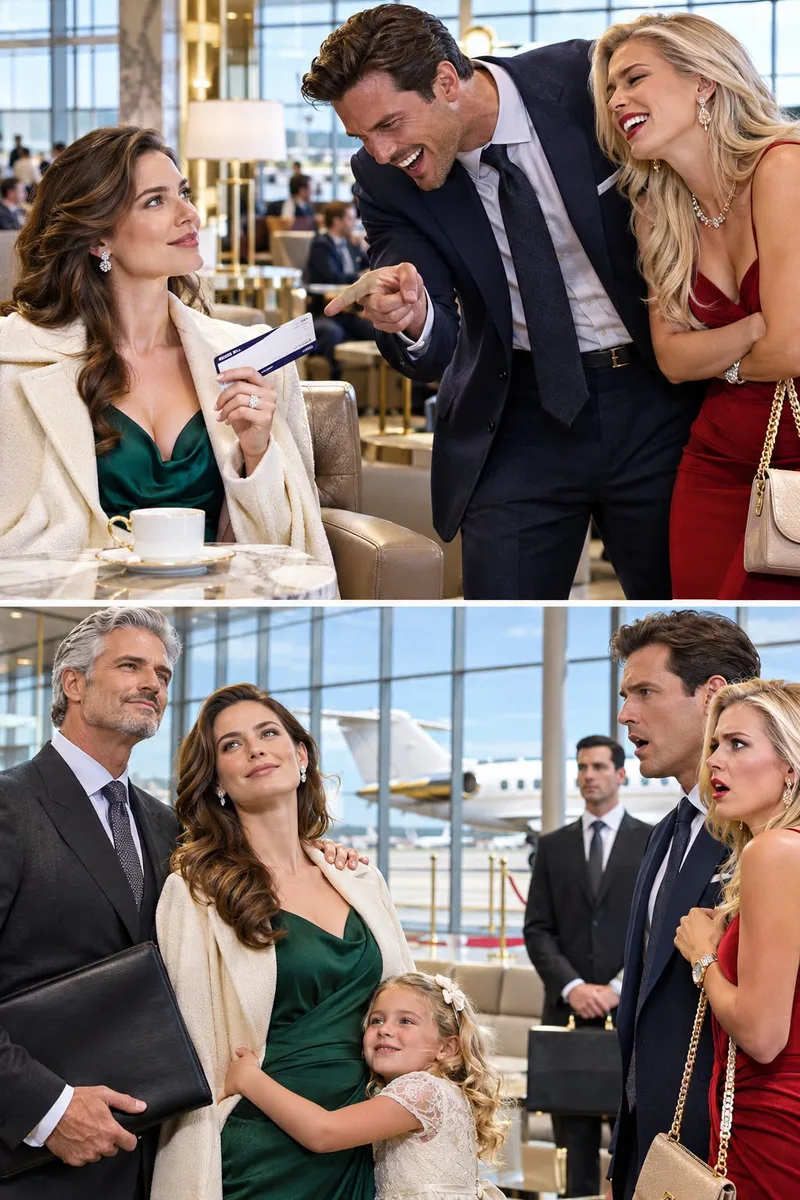
 Five Years After My Ex-Husband Left Me Broke, He Mocked My Airport Ticket
Chapter 2
The Part That Was Mine
Delia called at eight the next morning, when Lily was deciding whether oatmeal counted as breakfast if she ate only the berries. I stepped into the study and closed the door halfway. "I read the email," Delia said. "Do not meet Richard privately. Your husband's company has a pending deal with his. Anything you say about that transaction could be distorted. If you want to revisit the old financial records, that's a separate question." The separation was precisely what I needed to hear. One man had betrayed my trust. A roomful of employees and investors had not.
I opened the metal file box I had carried from apartment to apartment after the divorce. I had never thrown out its contents, though I rarely looked inside. There were statements from my mother's estate, records of a joint investment account, canceled checks, and several letters I wrote but never mailed.
The sum I had taken away—forty-three thousand dollars—had paid for a small office, software subscriptions, and the first months of rent. It had been enough to begin, not enough to erase what Richard had taken. I wanted the difference acknowledged, but I would not pretend that wanting it guaranteed a legal remedy.
Delia reviewed the index while I read out account dates. "Some claims may be barred by time or affected by your settlement," she said. "I'd need the original documents and jurisdiction details before advising you. Don't let the acquisition tempt you to trade your silence for a payout."
The suggestion made my stomach turn. I had done enough work in procurement to understand the damage of attaching a personal demand to a corporate decision. "I won't," I said. "I want to know whether the record tells the truth, even if that's all it can do."
After our call I went to the office of Aster Logistics, the aviation business Richard had mocked without recognizing. We operated freight planning, customs coordination, and time-critical cargo routing. The private aircraft was a relatively recent addition, used for executive travel and occasional specialist missions; it was not the source of our success.
Our margins depended on finding reliable routes at hours when other systems failed. I had learned the business from customers who could not afford a shipment to be late. The early invoices still mattered to me more than the photograph of our aircraft on the website.
Mara met me in the conference room with a problem unrelated to Richard. A hospital network needed equipment delivered before a scheduled procedure, and a carrier had lost its overnight slot. We spread the route maps across the table. For half an hour, I thought about customs windows, ground crews, and whether a backup aircraft could make the deadline.
We found a solution that cost us part of the fee but protected the customer's schedule. I authorized it and watched Mara coordinate the calls. No one mentioned Caldwell Aviation. The work reminded me that my life was not a footnote in a man's acquisition.
Near lunch my financial controller, Priya Shah, stopped by. She had been with Aster since our first employee could barely fit a desk between stacked shipping boxes. "You looked worried at the briefing," she said. I explained that a former spouse was connected to a company Sterling Capital was evaluating and that legal teams were managing a conflict.
Priya did not ask for gossip. She asked whether any current Aster contracts touched Caldwell's facilities. She already had a report prepared. Two service agreements did, both signed through open bids before the acquisition was announced. We logged the relationships and offered the documents to our compliance counsel.
"Would you rather be somewhere else today?" Priya asked. I thought about the version of me who had taken those first contracts in secondhand shoes, pretending I understood everything. Richard had told me I lacked the instincts to build a company. Priya had believed in me when I still needed to call a mechanic to understand an aircraft part. "No," I said. "This is exactly where I'd like to be." She smiled and took the report away. It was a modest exchange, and it steadied me more than any declaration of triumph.
Richard called my personal number in the afternoon. I let it ring, then heard his voicemail. His voice had changed since the lounge: less amusement, more urgency. He said he hoped we could behave like adults and he didn't understand why I was making a scene after five years.
I saved the message for Delia. Five years earlier, he'd told me to prove the inheritance was mine; now he wanted me to explain why I was not helping him. I could see a pattern without allowing it to decide my next action.
At home Lily was making a paper airport with Alexander. Every gate had a different animal assigned to it, and the rabbit was apparently in charge of customs. I sat on the floor to help fold a bridge.
Lily asked why my hands smelled like copier paper. "I found old letters," I told her. "Were they sad?" she asked. "Some were." She placed a blue paper airplane in my palm. "You can have a new one." I looked at the crooked wings. She had no idea how accurately she'd named the gift of the last five years.
Later Alexander told me he'd formally recused himself from the immediate acquisition recommendation. Sterling's independent investment committee would review the matter, and a different authorized director would manage any approval if the documents permitted it.
He would still have to disclose what he knew and comply with governance rules. "I don't want Richard thinking I can pull a lever for you," he said. "I don't want him thinking I can pull one against him, either," I replied. Alexander understood. He had married me when I was already building something difficult; respecting its independence had been part of loving me.
That night I found a receipt clipped to my mother's statements. It was for a small brass compass she had given me when I first talked about aviation. I'd thought it lost. On the back she had written, You don't have to follow anyone else's route.
I held the paper a long time, then sent Delia a photograph of the account records and asked what verification would require. I did not know whether the money could ever be recovered. I did know the documents would no longer remain in a box because I was ashamed of having trusted someone.
The End









