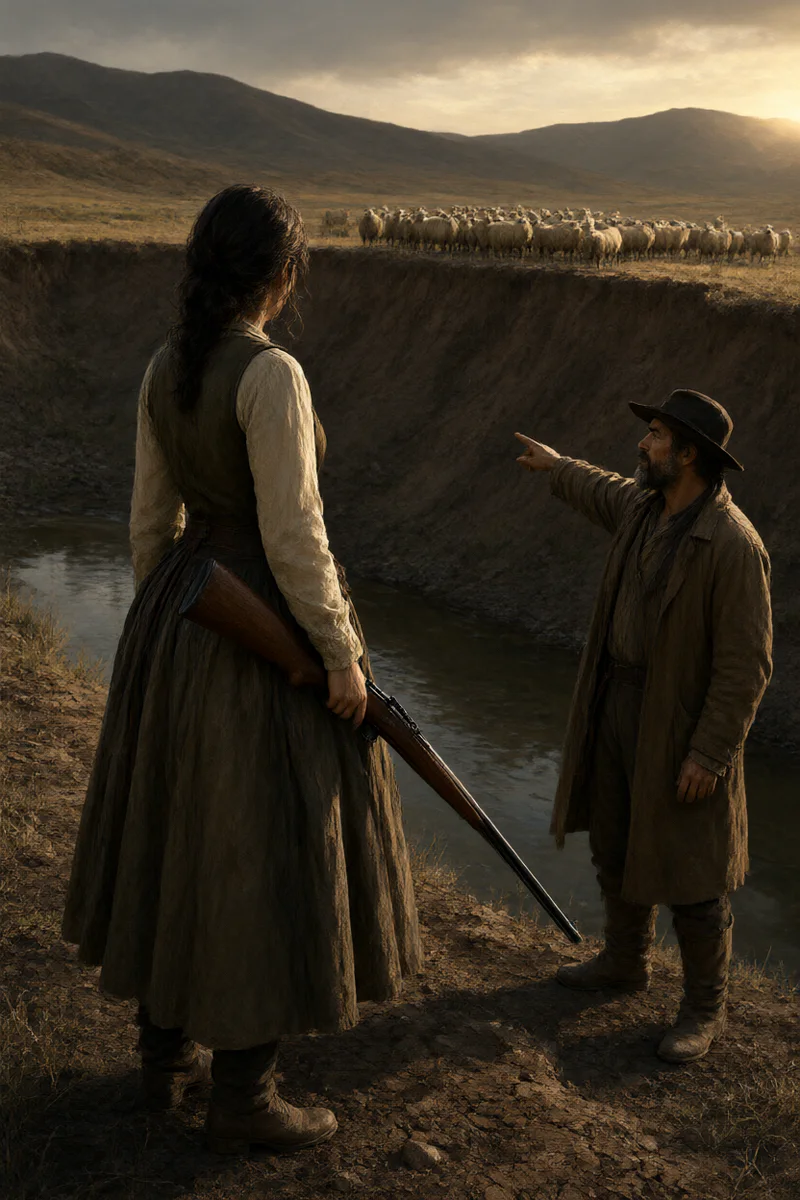
 The Ditch on Piñon Creek
Chapter 5
The Twenty-Eighth of March
Lavinia did not look at the lawyer. She looked at the date on the quitclaim.
March 28. She had been carrying it in her head for more than a week as the day Royal could not have signed. She had not once asked herself where she had been.
She remembered snow. A late storm, wet and heavy, and Royal grumbling that she should wait a week. She remembered a long cold ride, and a stove, and a clerk with a cough who had kept apologizing for it.
“Your Honor,” she said. “Under the act of 1879, every owner of a ditch in this district had to file a statement of claim with this court before the hearing. Is that so?”
Haskell put his spectacles back on. “It is.”
“Would you look for the statement filed for the Ashcombe ditch? I filed it in this building, in a snowstorm. I believe the clerk witnessed my signature and wrote the date beside it.”
The clerk was sent for. He still had the cough. He came back with a long folded paper and gave it to the referee, and Haskell read it, and then he read it again, the way Lavinia read a bill of sale.
“Statement of claim, Ashcombe water right,” he said. “Signed Royal Ashcombe, by L. Ashcombe, his wife. Witnessed in this office at two in the afternoon on the twenty-eighth day of March, 1881.” He looked up. “Mr. Stroud. How far is Pueblo from Walsenburg?”
Stroud did not answer. One of the Silver Crown lawyers answered for him, faintly. Fifty miles.
“Fifty miles,” Haskell agreed. “In a spring storm. She'd have had to be in two places at once, and only one of them keeps a register.”
After that it went quickly, the way a dam goes once the first trickle finds the soft place. Stroud withdrew his demand before he left the building, because the security had never been sold. Haskell ordered the Silver Crown gate opened to every right older than the company's, which was all of them. The notary from Pueblo, recalled the following week, discovered he had no entry in his book for March 28 and a great desire to speak to a lawyer of his own, and the quitclaim was set aside. The bank had a new president by Christmas.
The water came down Piñon Creek on the morning of September 20. Lavinia heard it before she saw it, a low, steady sound in the dry ditch like someone talking in the next room. The cattle heard it too. They went down the fence line all at once, bawling, and stood in it to their knees.
Dunbar rode in an hour later. She was standing at the headgate with her skirt wet to the shin.
“Your half's going right past my meadow,” he said. “I thought I'd see where it ended up.”
“It ended up here.” She held out a paper. “I wrote this last night. It's a partnership. Ashcombe and Dunbar. Cattle on the bottoms and sheep on the benches. The neighbors will have fits.”
He read it. He read it slowly, down to the foot of the page, where she had already signed.
“Lavinia Ashcombe,” he read. “Not Royal.”
“It's the first paper on this ranch with my own name on it.” She found she was smiling, and that she did not mind his seeing it. “I've been signing for other people long enough. The line above is yours. And there's room under it, Fergus Dunbar, if there is anything else you'd care to ask me.”
He took the pen from her and signed. Then he stood a while with it in his hand, looking at the room she had left. “I'd as soon ask that one out loud,” he said, and did.
The End









