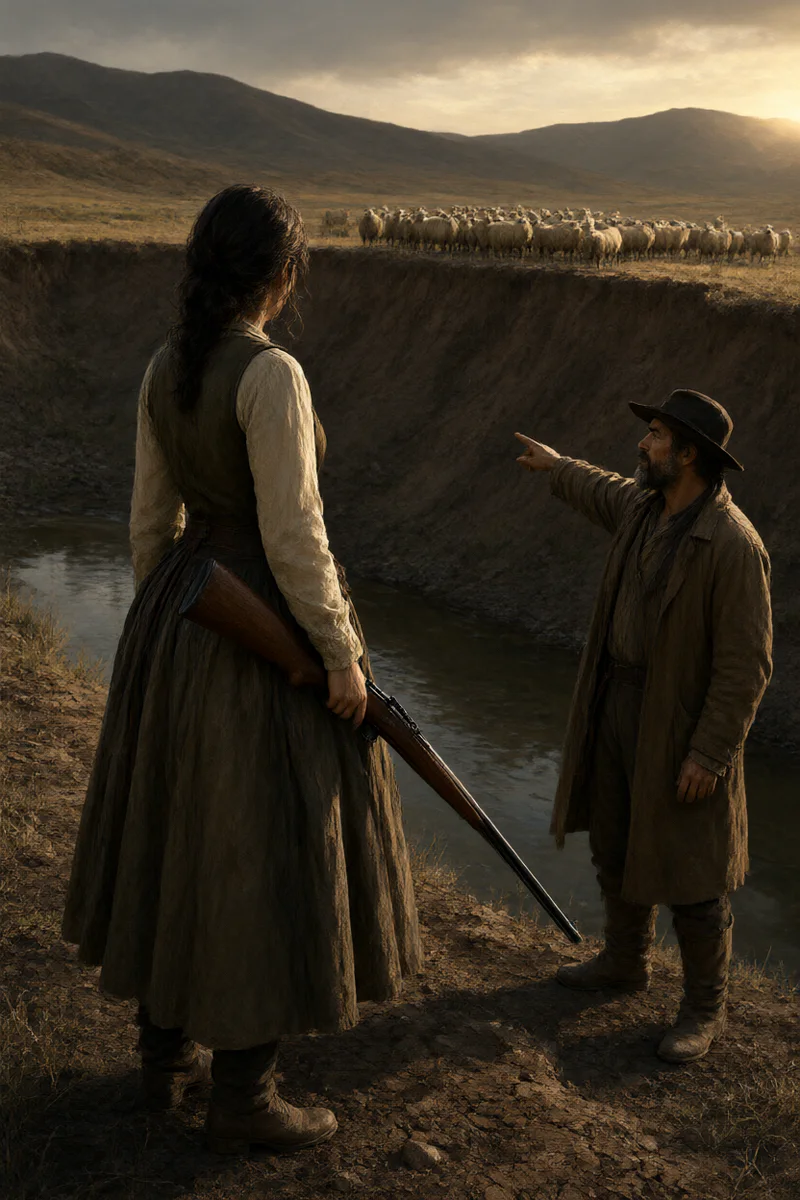
 The Ditch on Piñon Creek
Chapter 4
Walsenburg
That night they sat on her porch and did arithmetic, which turned out to be easier to do side by side than across a table.
Her cattle, sold in a drought, in September, would bring perhaps eleven dollars a head. Three hundred head made thirty-three hundred dollars if she could find a buyer in ten days, which she could not. Dunbar's wool clip had brought him nineteen hundred. With the six hundred he had already paid her, she was three hundred short.
“I'll not take a loan from you,” she said.
“I wasn't going to offer one.” He was quiet a while. “I was going to offer to buy in. Half the ranch, the way the ditch was meant to be in 1872. Cattle on the bottoms, sheep on the benches. Every man on Piñon Creek will say we've both lost our minds.”
“They already say so.”
“Then we'd be no worse off.”
She did not answer him. She found she did not want to answer too fast and have it mean only money.
The water hearing fell on the eighth of Stroud's ten days. It was held in the Walsenburg courthouse before a referee named Haskell, a sharp, thin man who wiped his spectacles whenever a lawyer said heretofore. Silver Crown had two lawyers. Mabry sat between them like a man at a play.
Dunbar testified first, about 1872, the mule, the two shovels, the Ashcombe and Dunbar filing. Haskell nodded and made notes. Then Lavinia was called.
She told the truth. She told it to a room full of men who had known Royal and liked him, and she watched it land on them. Royal Ashcombe could not write. His wife had signed for him for nine years. He had learned, at the very end, in secret, from a sheepman.
She laid the copybook on the referee's table, open to April 3. Then she took a pen and, on a sheet of the court's paper, wrote Royal Ashcombe in her own hand, the way she had on the mortgage. She laid the quitclaim beside it.
Haskell looked from one to the other. He took off his spectacles and wiped them, though no one had said heretofore.
“Mr. Mabry,” he said. “Do you have anything to say to that?”
Mabry's senior lawyer rose. “We do, Your Honor. We do not dispute that the signature is in Mrs. Ashcombe's hand. We have a witness who will tell the court how it got there.”
The witness was Stroud. He took the oath with the ease of a man who took many oaths.
“Mrs. Ashcombe came to my bank on the twenty-eighth of March,” he said. “She told me her husband was ill and wished to sell his water right to pay down the note. She signed the quitclaim in his name, as she signed everything. I saw her do it. The notary saw her do it. The two thousand dollars was paid to her in gold.”
Every face in the courtroom turned to Lavinia.
“And where is that gold now, Mrs. Ashcombe?” the lawyer asked pleasantly. “Your note was never paid down. Did you sell your husband's water behind his back, and keep the money, and then come here to call it a forgery?”
The End









