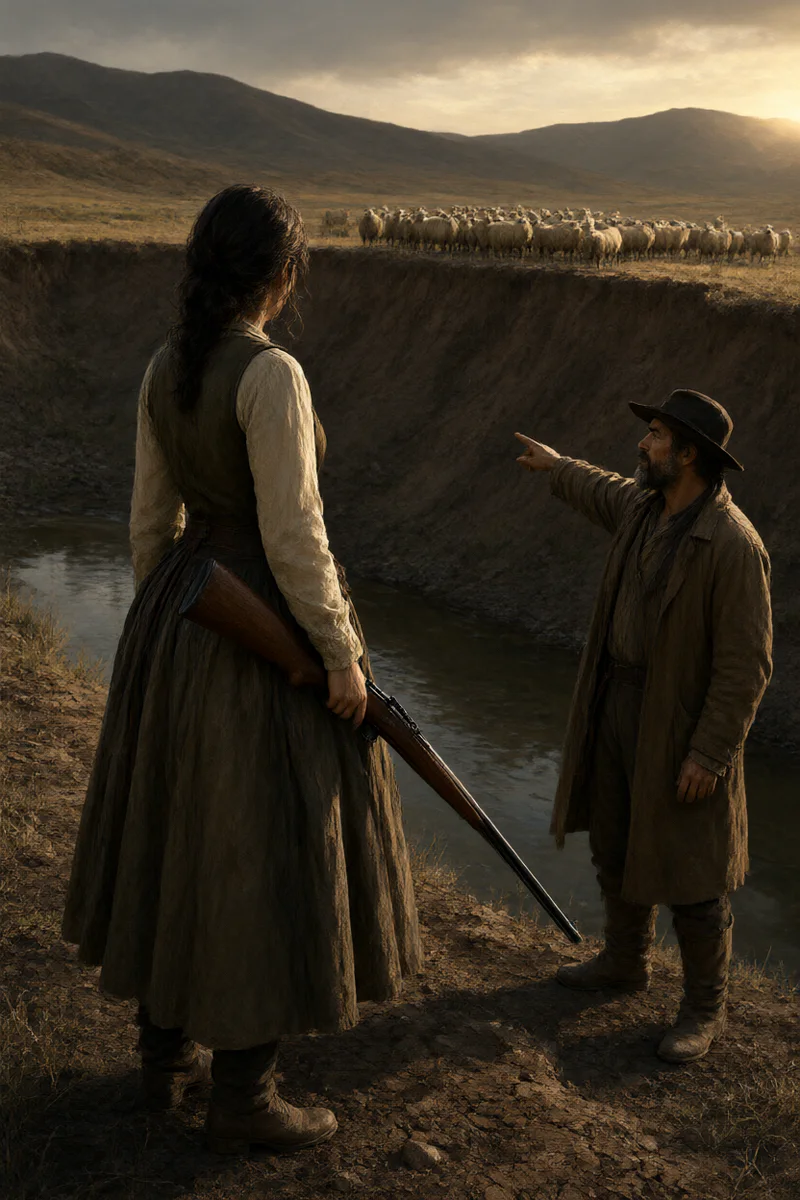
 The Ditch on Piñon Creek
Chapter 2
Ashcombe and Dunbar
Mabry laughed, as if she had told a pleasant joke at a church supper. He said that grief did strange things to the memory. He said the company's lawyers would be happy to explain the matter at the water hearing in Walsenburg on the twelfth of September, and that until then the gate would stay shut.
She rode down the creek without speaking. Dunbar rode beside her and let her not speak.
At her own gate she said, “You didn't look surprised.”
“About the signature? No.”
“Nobody knew. Not his foreman. Not the bank. I signed every paper on this ranch for nine years. In March I rode to Walsenburg through a snowstorm to file his statement of claim, because he would not go anywhere a clerk might hand him a pen. He'd stand over me and say his name was his own business.”
“I knew,” Dunbar said. “I wrote out the claim on Piñon Creek water in 1872. He made his mark on it. So did I, though I could have signed. It seemed only fair.”
She stared at him. “You and Royal?”
“We came in together. Dug that ditch together, with one mule and two shovels and a great deal of language. It's filed as the Ashcombe and Dunbar Ditch. Half the 1872 right is mine, Mrs. Ashcombe. It always was. He never told you.”
He said it without any satisfaction at all.
She made coffee, because it was something to do. He sat at Royal's table in Royal's chair and explained it, and he explained it well. In Colorado the first man to put water to use owned it first. The company's right dated from 1880. Even if Royal's half were sold, Dunbar's half was older than any dam, and the court would have to make Silver Crown let it pass.
“So you get your water back,” she said.
“My half comes down the same ditch as yours. It can go to my meadow or it can go past it to you.” He turned his cup. “I've two thousand sheep and no winter grass. You've a thousand acres of stubble and a note you can't pay. I'll give you six hundred dollars to winter my flock on your lower range, and run my water to your cattle till the court sorts out the rest.”
“Sheep on Ashcombe land. Royal would come up out of the ground.”
“He might,” said Dunbar. “He'd have a drink first, though. We'd do that.”
She agreed before she could argue herself out of it. The word went up and down the creek within a day. Two neighbors stopped speaking to her at the store. The Hollister boy, who had worked her fences since he was twelve, quit without asking for his pay.
Nine days before Walsenburg she went through Royal's tin box for the 1872 papers. Under the deeds was a bundle she had never seen, wrapped in a flour sack.
It was a child's copybook. The kind sold at the store for a nickel, ruled in blue.
Every page was filled. The first pages held crooked capital letters, each one copied below a model in a different, neater hand. Then words. Cow. Creek. Lavinia. Then, on the last dozen pages, over and over, cramped and careful and growing steadier line by line, a name.
Royal Ashcombe. Royal Ashcombe. Royal Ashcombe.
Her husband had learned to write.
The End









