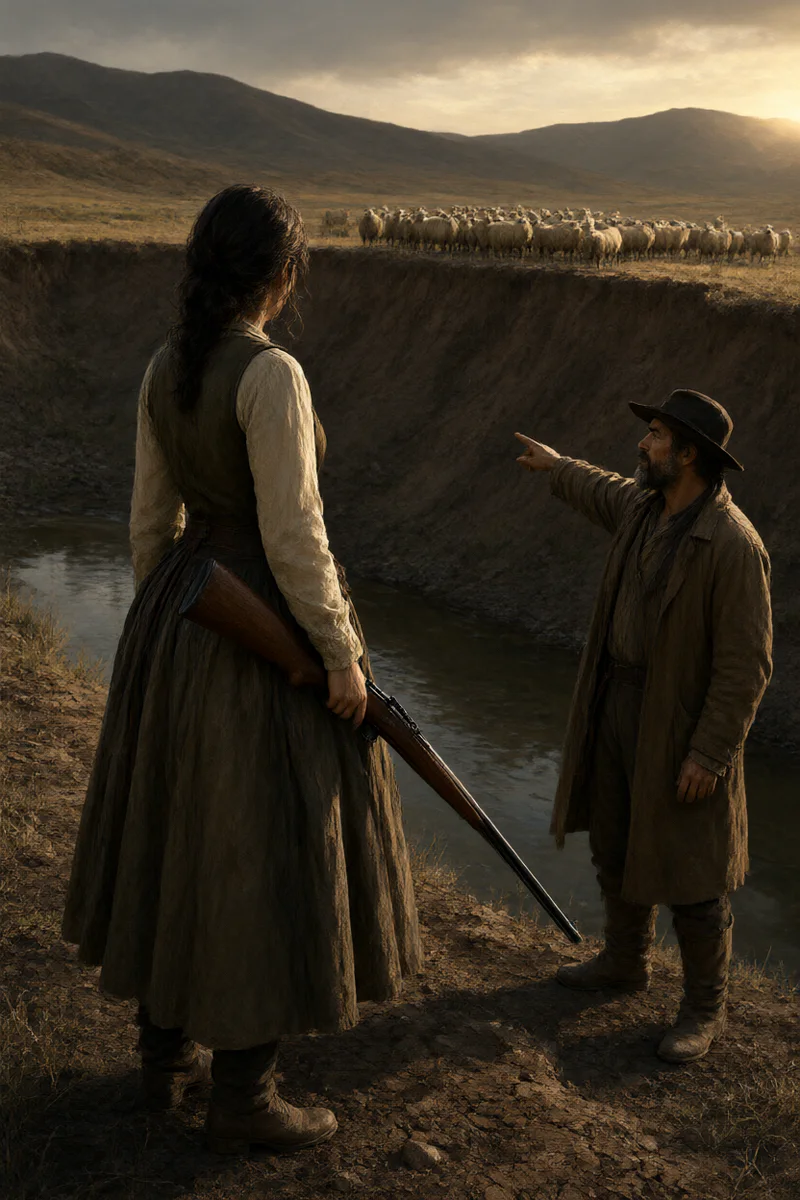
 The Ditch on Piñon Creek
Chapter 3
Sundays
She rode to Dunbar's camp at first light with the copybook inside her coat. He was at the sheep wagon frying bacon, and he saw her face and took the pan off the fire.
“The model letters are yours,” she said. “I've seen your hand on the ditch filing.”
“They are.”
“Every Sunday last winter he rode off after breakfast and came home after dark. I thought he was at the saloon in Badito. I thought he was angry with me. Once I thought there was a woman.” Her voice cracked and she let it. “He was here.”
Dunbar sat down on the wagon tongue. “He came in November. Stood over there by the dog for an hour before he said a word. Then he said his wife wrote every letter and signed every note and kept every book, and he'd be damned if he'd die without writing her name once himself.” He looked at the ground. “We fell out in '73 because I offered to teach him in front of other men. He came back because I was the only one who already knew.”
“Why didn't you tell me? After?”
“He made me promise it'd be a surprise. And then he was thrown at the river crossing, and the surprise was gone, and I thought you'd as soon not hear from the Scotchman how your own husband spent his Sundays.”
She sat down on the other end of the wagon tongue. For a while neither of them said anything. The sheep moved over the hill behind them with a sound like rain that never arrived.
Then she opened the copybook to its last page. At the bottom, in pencil, Royal had written a date in his laborious hand. April 3. A week before he died.
The name above it leaned in three directions at once. The R was enormous. The b had been gone over twice.
“That's the best he ever did,” Dunbar said quietly. “He was proud of it.”
Lavinia took Mabry's copy of the quitclaim from her pocket. The company had sent it down with the hearing notice. March 28. Smooth, quick, the capital R looping into the o without a lift of the pen.
“He couldn't have written this,” she said. “Not on the twenty-eighth of March. Not on the twenty-eighth of next year.”
Then she looked again, and the hair rose on her arms.
She knew that R. She knew the way the A of Ashcombe began with a little hook, the way the final e trailed off into nothing. She had made those strokes ten thousand times.
“Fergus,” she said. It was the first time she had used his name. “That isn't his hand. It's mine. Someone copied my writing of his name. From a paper I signed for him.”
“What paper?”
“There's only one place in the territory with a long Royal Ashcombe in my hand on it. The mortgage. At the Pueblo bank.”
Dunbar stood up slowly. He was looking past her, down the creek road, where a buggy was coming fast in a cloud of white dust with a horseman riding alongside.
The buggy belonged to Mr. Stroud, president of the Pueblo bank. The horseman was the county sheriff.
Stroud did not get down. He held out an envelope.
“Mrs. Ashcombe. Your mortgage pledged the Ashcombe water right as security. That right has been sold. Under the terms of your note, the whole sum is now due. You have ten days.”
The End









