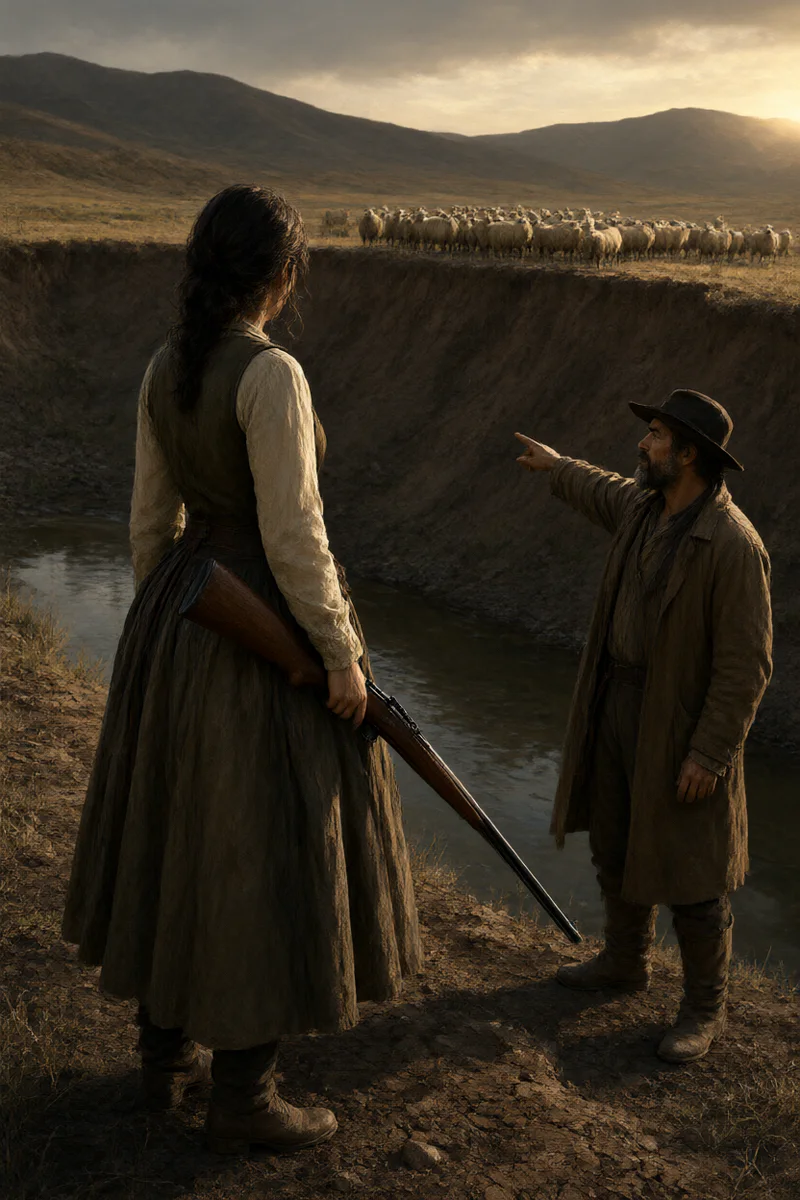
 The Ditch on Piñon Creek
Chapter 1
Dry Ditch
By the second week of August the Ashcombe ditch held nothing but cracked mud and the small, flat skeletons of frogs, and Lavinia Ashcombe took her husband's rifle down from the pegs over the door.
Royal had been dead four months. The note at the Pueblo bank, two thousand eight hundred dollars, came due on the first of October. Three hundred head of cattle stood along the fence by the dry ditch and bawled at her every morning as if she were the one who had stopped the creek.
Everyone on Piñon Creek knew who had stopped it. Fergus Dunbar ran two thousand sheep on the benches above her, and he had a ditch of his own, and Royal had said for eight years that the Scotchman would steal the paint off a church if the church stood downhill.
She rode up the creek bed in the early light. It was strange to ride where water should be. Her mare's hooves rang on stones that had never been dry in her memory.
Dunbar was at his headgate when she came around the bend. He was a big man going gray at the beard, in a canvas coat too heavy for August, and he was standing in an empty ditch exactly like hers.
He looked at the rifle across her saddle and then at her face.
“Mrs. Ashcombe,” he said. “If you've come to shoot me for the water, I'd be grateful if you'd tell me where it's gone first. I've been wondering myself.”
She had prepared a speech. She found it no longer applied.
“You're dry,” she said.
“Since the twenty-ninth of July. Lost forty ewes to it already.” He climbed out of the ditch. “I rode up yesterday. I was coming down to tell you this morning, and then I thought, she'll not believe a word out of me. So I've been standing here working out how to say it so you might.”
“Say it plain, Mr. Dunbar.”
“Plain, then. There's a dam across Piñon Creek six miles up. Silver Crown Mining. They want a reservoir for the stamp mill they mean to build next year, and they've shut the whole creek off to fill it.”
“They can't. Royal filed on our water in 1872. Every right on this creek is older than a mining company.”
Something passed over his face she could not read. “Aye. That's the law. Come and tell them so.”
They rode together, which she would not have believed a day before. The dam was raw yellow earth packed across the narrows, with a wide brown pond already backing up behind it and a dozen men with scrapers and mules. A man in a city collar came out of a tent to meet them.
“Carver Mabry, superintendent,” he said, and shook Dunbar's hand as if he owned it. Then he heard her name, and he smiled.
“Mrs. Ashcombe. We were sorry to hear about your husband. Very sorry. Fine man to do business with.”
“My husband never did business with you.”
Mabry went into the tent and came out with a folded paper. It was a quitclaim deed. For the sum of two thousand dollars, Royal Ashcombe conveyed all his right, title and interest in the waters of Piñon Creek to the Silver Crown Mining Company. Notarized at Pueblo. Dated March 28, 1881. Two weeks before he died.
At the bottom, in a firm, flowing, practiced hand, someone had written Royal Ashcombe.
Lavinia looked at it for a long time. Then she handed it back.
“That's very fine penmanship,” she said. “My husband could not write his name.”
The End









