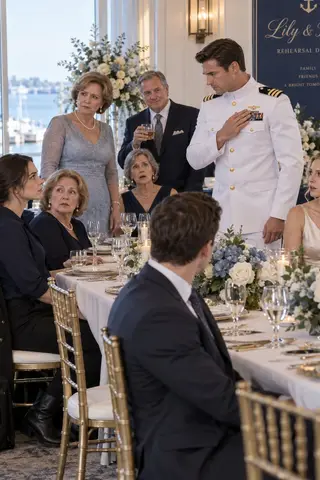
 Scorned by his family for wearing an old military uniform, the naval officer groom snapped to attention and saluted me with a "Yes, Commander!" the moment he saw me
Chapter 28
Crisis in the Aegean
Two weeks later, the Aegean Sea was gripped by a sudden, volatile Mediterranean storm known as a Medicane—a tropical-like cyclonic tempest that unleashed sixty-knot sustained winds and blinding sheets of rain across the Greek archipelago.
At 0330 hours, the tactical command speaker above my stateroom bunk squawked with emergency priority: "Chief of Staff to the Flag Command Center. Immediate operational crisis."
I was through the hatch within forty-five seconds, buttoning my working fleece as I took the stairs two at a time down to the command deck. The room was bathed in the harsh red glow of combat alert lighting. Admiral Harrison stood over the search-and-rescue tactical console, surrounded by the wing commander and the surface warfare director.
"Report," I commanded, stepping into the circle of officers.
"Captain, international maritime distress broadcast intercepted from the southern Aegean," the communications coordinator announced, handing me a decoded message sheet. "A commercial passenger ferry, the Aegean Star, carrying two hundred and forty civilian passengers and thirty crew members between Rhodes and Crete, suffered complete propulsion failure after taking a rogue wave over the bow. Her main engine compartment is flooded. She is dead in the water, rolling forty degrees, and drifting rapidly toward the razor-sharp reefs off the uninhabited island of Karpathos."
"Where are the regional civilian coast guard cutters?" Admiral Harrison demanded.
"Pinned down in port at Heraklion, sir!" the officer replied. "The civilian rescue boats cannot clear the harbor breakwater in thirty-five-foot seas. The nearest NATO surface vessel is the Ford strike group, eighty miles northwest."
"What's our flight deck status?" I asked, looking up at the air operations monitor.
"Flight deck is officially fouled, Captain," the air wing commander answered grimly. "Wind sheer is exceeding launch safety margins by fifteen knots. The arresting wires are slick with seawater. If we launch our MH-60S Knighthawk rescue helicopters into this storm envelope, recovery aboard this carrier will be an extreme hazard."
The room grew dead silent. Military doctrine explicitly stated that peacetime humanitarian rescues could be aborted if weather conditions threatened the safety of capital naval assets. But two hundred and seventy innocent civilians were drifting toward jagged rocks in the freezing darkness.
I stepped directly up to the navigational plotting chart, my mind processing wind vector algorithms, fuel reserves, and carrier stability envelopes at blinding speed.
"We don't launch from the carrier deck into the wind," I stated with absolute, unshakable authority. "We alter the strike group formation immediately."
Admiral Harrison turned to me, his eyes sharp. "Explain, Captain Hayes."
"Admiral, order the USS Normandy and USS Mason to steam flank speed ahead of the carrier, forming a wedge formation three miles upwind of the distressed ferry," I ordered, tracing the coordinates on the screen. "We bring the Ford around to heading one-eight-zero, using the carrier's massive one-thousand-foot hull as a literal sea-wall to create a lee—a calm pocket of flat water on our sheltered port side. That drops the effective wave height in the immediate extraction zone from thirty feet to eight feet."
The air wing commander’s eyes widened as the tactical brilliance of the plan sank in. "A moving harbor..."
"Exactly," I continued, unblinking. "Our helicopters launch downwind from the carrier's stern, fly low under the cloud base within our radar umbrella, and conduct hoist extractions directly to our flight deck. Those who cannot be hoisted immediately will be secured by our search-and-rescue swimmers dropping into the lee pocket. We have two hours before that ferry breaks against the reef. We are not leaving those people to drown."
Admiral Harrison did not hesitate for even a heartbeat. He looked at the flag watch supervisor and gave a decisive, resolute nod. "You heard the Chief of Staff! Execute the Hayes Maneuver! All ships to flank speed! Launch the rescue package!"
For the next four hours, the Aegean Sea witnessed the raw, breathtaking power of American naval coordination. In the teeth of a howling tempest, three massive warships positioned themselves with microscopic precision around the floundering ferry. Working within the sheltered pocket of calm water created by the Ford’s colossal hull, our helicopter crews conducted eighty-four individual hoist runs, pulling terrified mothers, crying children, and elderly travelers out of the raging foam and depositing them safely onto the warm, illuminated expanse of our carrier’s hangar bay.
When the Greek maritime authorities finally managed to tow the empty, battered hull of the ferry into calm water at sunrise, all two hundred and seventy passengers and crew were aboard the Ford, drinking hot broth wrapped in navy wool blankets, weeping with relief.
As I walked through the crowded hangar bay, a Greek grandmother clutching a shivering toddler looked up at me. Seeing the silver eagles on my collar, she reached out with trembling, weathered hands, grasping my sleeve, tears streaming down her face as she murmured heartfelt blessings in broken English.
"Thank you... Commander... God bless you..." she wept.
I knelt down, gently covering her hands with my own, smiling warmly into her tired eyes. "You're safe now, ma'am. You're on American steel."
Standing twenty feet away, Admiral Harrison watched the interaction, an expression of profound, unreserved pride written across his battle-hardened face.
The End









