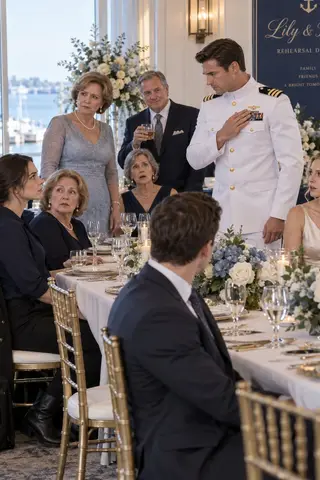
 Scorned by his family for wearing an old military uniform, the naval officer groom snapped to attention and saluted me with a "Yes, Commander!" the moment he saw me
Chapter 26
The Gibraltar Passage
The monolithic limestone pillar of the Rock of Gibraltar rose against the horizon like an ancient sentinel emerging from the morning sea mist.
Aboard the USS Gerald R. Ford, the transit from the wide swells of the Atlantic into the narrow, congested waters of the Mediterranean Sea demanded the vigilance of an entire battle fleet. The Strait of Gibraltar was one of the most heavily trafficked maritime choke points on earth—dozens of commercial tankers, container freighters, and regional fishing trawlers packed into an eight-mile-wide funnel, surrounded by international airspace and shadowed by unseen foreign submarines lurking along the thermal layers beneath the surface.
Inside the Tactical Flag Command Center, I stood behind the primary tactical console in clean working khakis, an unspilled mug of bitter black roast cradled in my palm. The tactical watch was operating under Condition Three modified—crews at ready stations, phased-array radars operating at high-resolution surface sweep, and two MH-60R Seahawk helicopters patrolling five nautical miles ahead of the strike group's bow.
"Surface watch reports clear channel through the southern separation zone, Captain," Lieutenant Commander Marcus Reed reported, pointing a digital stylus at the real-time shipping tracks on the main display. "Commercial traffic is heavy off Tarifa, but the escort destroyers Normandy and Mason have formed a moving buffer. Transit window looks clear."
I leaned forward, studying the digital track of a three-hundred-meter bulk freighter named the Caspian Glory, flying a flag of convenience and registered out of Monrovia. While the other commercial vessels in the channel were maintaining steady twelve-knot courses along the designated lanes, the Caspian Glory was drifting erratically toward the boundary of our carrier’s restricted standoff envelope.
"Marcus, bring up the historical AIS transponder data on that freighter," I said, my operational instincts prickling.
"The Caspian Glory?" Marcus asked, tapping the terminal keys. "She’s logged as carrying agricultural fertilizer from Alexandria to Rotterdam."
"Look at her waterline displacement telemetry from the port authority cameras in Ceuta," I pointed out, tapping the high-resolution optical feed on the secondary monitor. "Her draft is sitting three meters too high for a fully loaded fertilizer carrier. And her automated steering is showing micro-corrections consistent with human helm override, not autonomous transit navigation."
Before Marcus could reply, the sonar supervisor at the anti-submarine desk stiffened. "Ma'am! Passive acoustic intercept from dipping sonar buoy four! We have faint, low-frequency diesel-electric cavitation signatures masked directly underneath the freighter’s acoustic shadow. Range six miles off our starboard bow!"
A chill passed through the command deck. Someone was using the commercial freighter’s massive engine noise as acoustic cover to stalk our strike group into the Mediterranean.
Admiral Harrison stepped out of his briefing nook, his jaw tightening. "Subsurface contact? In foreign territorial waters during a civilian transit?"
"It’s an intelligence collection submarine, Admiral," I said with absolute calm, stepping up to the tactical board. "They’re trying to bait us into lighting up our fire-control active sonars so they can record our acoustic frequency libraries. If we ping them, they win the intelligence fight. If we ignore them, they compromise our flank."
"Recommendations, Captain Hayes?" Harrison asked, crossing his arms, deferring entirely to my operational maneuvering.
"Order our lead Seahawk to execute non-lethal acoustic redirection," I commanded crisply. "Deploy active active dipping sonar directly into the acoustic shadow—not on a combat search band, but transmitting the international standard distress frequency. At the same time, signal the Caspian Glory on VHF Channel 16 that she is drifting into an active navigational hazard zone and request an immediate thirty-degree course correction north."
Within ninety seconds, the plan unfolded with textbook naval precision. The airborne Seahawk dropped its active sonar transducer into the water, flooding the acoustic mask with jarring, unmistakable pings. Caught naked without the shield of commercial noise, the unidentified diesel submarine realized its deception was blown. Sonar telemetry showed the contact banking sharply south toward the international deep-water trench, breaking contact without a single shot fired.
Admiral Harrison let out a low chuckle, looking at the retreating contact track. "Clean, quiet, and surgical. You stripped their cover without giving them a shred of operational data to take home."
I looked out through the command CCTV monitor at the dark waters of the Mediterranean stretching before our bow. "This sea has a long memory, Admiral. You just have to know how to listen to the currents."
The End









