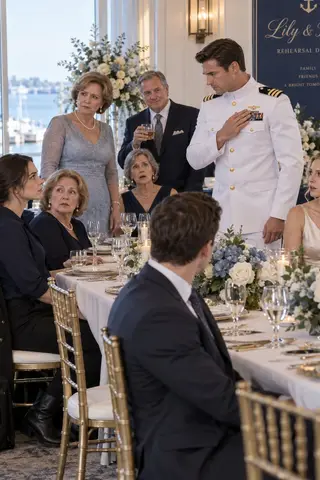
 Scorned by his family for wearing an old military uniform, the naval officer groom snapped to attention and saluted me with a "Yes, Commander!" the moment he saw me
Chapter 14
Command in the Tempest
Twenty-four hours later, personal family drama was obliterated by the harsh, unrelenting reality of naval operations.
A sudden, violent late-season cyclonic depression roared out of the North Atlantic, colliding with the Azores high-pressure front and generating sea state eight—waves towering over forty feet, sustained winds exceeding sixty-five knots, and blinding squalls that cut visibility to zero.
At 0200 hours, a red alert siren sounded in the fleet operations bunker. I was out of my rack and on the operations deck within four minutes, wearing working khaki trousers, a dark blue tactical fleece, and steel-toed flight deck boots.
"Commander on deck!" the watch supervisor called out.
"Report," I commanded, stepping up to the central tactical display board where a massive radar map pulsed with angry red storm bands.
"Ma'am, the auxiliary cargo vessel USNS Kanawha, carrying emergency fuel and vital munitions for the escort strike package, lost starboard propulsion fifty miles northwest of the storm's core," Marcus Reed reported, his face pale under the harsh tactical lighting. "She’s rolling thirty degrees in heavy swells. Her hull is taking heavy strain, and she has fifty-eight civilian mariners and navy personnel on board. The destroyer USS Mason is within fifty nautical miles, but if we order the Mason into the storm's eyewall to secure a tow line, the destroyer risks structural damage and running out of fuel before reaching the Azores."
The room was dead silent. A junior communications officer looked back at me with wide, panicked eyes. Every watchstander held their breath. In naval operations, this was the crucible: a single wrong decision would either send fifty-eight mariners to the bottom of the icy Atlantic or risk an entire billion-dollar guided-missile destroyer.
I stepped up to the terminal, studying the barometric pressure gradients, wave buoy telemetry, and engine output reports. My mind cleared instantly, shedding all fatigue. This was the work I was born to do.
"Marcus, bring up the auxiliary ballast pump logs on the Kanawha," I ordered, my voice steady, sharp, and commanding. "Have their chief engineer flood the aft ballast tanks by twelve percent to lower their center of gravity and stabilize the roll period. That buys them three hours before hull breach thresholds."
"Yes, ma'am!" Marcus began typing furiously.
"Communications," I snapped toward the radio console. "Patch me through to the commanding officer of the USS Mason via secure SATCOM right now."
A headset was handed to me. Static hissed through the line, followed by the distant roar of hurricane-force wind and crashing waves.
"Commander Hayes, this is Commander Miller, USS Mason," a tense voice crackled over the speaker. "Conditions are deteriorating rapidly, ma'am. Swells are topping thirty-eight feet. What are your orders?"
"Miller, listen to my voice," I said, my tone an unshakable anchor in the midst of the chaos. "You will not engage a surface tow in sea state eight. It will snap your hawsers and breach your stern. Instead, you will execute tactical maneuver Bravo-Three: take your vessel thirty degrees off the wind to shadow the Kanawha’s windward flank. You will create a rolling sea-break with your hull to shield her starboard quarter from direct wave impact."
Miller hesitated for a second over the static. "Ma'am, shadowing that close in zero visibility—"
"I have your radar tracks synced to my tactical satellite array right here, Miller," I interrupted firmly, leaving no room for doubt. "I will walk you into position coordinate by coordinate. Trust your instruments, trust your crew, and trust me. We are bringing both ships home tonight."
For the next four grueling hours, I stood over the glowing tactical display, calling out speed adjustments, heading corrections, and wave crest timings. While my feet remained planted on the concrete floor of a bunker in Virginia, my mind was out in the black, freezing fury of the North Atlantic, holding two massive warships apart by mere yards through sheer operational calculation and iron nerve.
At 0615 hours, as the first gray light of dawn crept across the horizon, the satellite telemetry shifted. The Kanawha’s engineers successfully restarted the secondary drive turbine. Sheltered behind the Mason’s rolling hull, the cargo ship stabilized her list and swung into a safe recovery vector, clearing the southern perimeter of the tempest.
"Both vessels report all personnel accounted for, Commander," Marcus announced, letting out a massive breath that seemed to carry the weight of the entire room. "Zero casualties. Engines holding. They are proceeding to Rota for inspection."
A spontaneous cheer erupted from the tactical watchstanders. Junior sailors clapped each other on the back, grinning through exhaustion.
I removed my headset, wiped a stray lock of hair from my forehead, and offered Marcus a small, tired nod. "Good work, everyone. Log the event, update the admiral’s morning brief, and let’s get fresh coffee brewing."
As the watch changed and the morning sunlight filtered into the bunker, I looked at my reflection in the dark monitor screen. My uniform was rumpled, my eyes were heavy with fatigue, but my heart was completely steady. This was what leadership meant. Not toasts, not silk gowns, not country club handshakes—just the quiet, sacred duty of keeping people alive when the world turned into a storm.
The End









