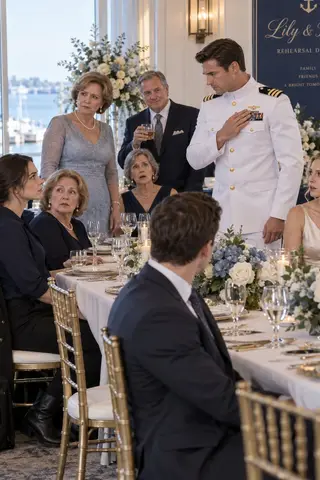
 Scorned by his family for wearing an old military uniform, the naval officer groom snapped to attention and saluted me with a "Yes, Commander!" the moment he saw me
Chapter 15
The Unvarnished Truth
By Sunday morning, forty-eight hours after the North Atlantic storm was conquered, quiet returned to the coastal town of Virginia Beach.
I had slept for twelve uninterrupted hours, waking up to the sound of seagulls wheeling over the dunes and the gentle surf crashing against the sandy shore a block from my cottage. I made a pot of strong black coffee, pulled on a thick wool cardigan and worn jeans, and sat out on the front wooden porch, letting the cool salt air fill my lungs.
My phone buzzed on the armrest of the Adirondack chair. It was an international message from Ryan Walker, sent from an airfield in southern Italy where his carrier wing was rotating through on transit:
“Commander—word just hit the Sixth Fleet grapevine about the Kanawha rescue. Incredible tactical routing, ma'am. The admiral himself mentioned it in the morning dispatch. Lily and I just landed in Naples on our way back stateside. She saw the news ticker and couldn't stop bragging to the flight attendants that the Commander running the Atlantic Strike Group is her big sister. See you soon. Respectfully, Ryan.”
I smiled warmly, setting the phone down. To know that Lily was finally seeing past the shallow illusions of our upbringing and feeling genuine pride in something real was worth more than any medal pinned to my chest.
A soft crunch of gravel at the base of the driveway broke my thoughts.
A modest rental sedan—not Alan’s ostentatious luxury vehicle—pulled up to the curb. The engine shut off. The driver’s side door opened slowly, and a woman stepped out onto the driveway.
It was Diane.
She wasn't wearing her tailored designer suits, her expensive pearl chokers, or the rigid, painted makeup she used as armor against the world. She wore simple slacks, flat walking shoes, and a light beige trench coat pulled tightly around her against the coastal breeze. Her hair was pulled back into a simple clip, revealing the deep lines of grief, worry, and age etched around her eyes.
She looked up at the porch, hesitant, looking like an intruder on unfamiliar ground.
I didn't stand up, but I didn't turn away either. "There’s hot coffee inside, Mom. Help yourself to a mug."
Diane’s shoulders dropped slightly in relief. She walked up the wooden porch steps with slow, careful footsteps, disappearing into the kitchen for a moment before returning with a steaming ceramic mug. She pulled up the matching wooden chair beside mine, sitting down with a quiet, weary sigh.
For several long minutes, neither of us said a word. We simply watched the white waves roll onto the gray sand, listening to the rhythmic roar of the Atlantic ocean.
"I left him, Nora," Diane said softly, her voice barely louder than the wind.
I turned my head, studying her unpainted, vulnerable profile. "You left Alan?"
"I packed two suitcases and drove down yesterday morning," she nodded, staring into the dark surface of her coffee. "When he lost the defense contracts, he completely unraveled. He spent three days screaming at me, blaming me, blaming Lily, blaming your dead father... saying our family brought bad luck into his pristine life. And as I sat there watching him break our furniture, I suddenly realized something that made me sick to my stomach."
Diane paused, turning her head to meet my eyes. For the first time since I was a ten-year-old girl standing by my father’s grave, my mother looked at me without a mask.
"I realized," Diane whispered, tears finally slipping silently down her hollow cheeks, "that for seventeen years, I spent every single day trying to appease a coward. I was so terrified of being poor again after your father died that I traded away everything that mattered—including my relationship with my own daughter—just so a wealthy man wouldn't leave me."
The pain in her voice was raw, unvarnished, and completely real. The anger that had lived in my chest for nearly two decades—the bitter coldness that had built a wall between us—suddenly melted away, leaving behind only the quiet sorrow of wasted years.
I reached out across the wooden armrest, sliding my hand over her trembling, cold fingers.
"You don't have to be afraid anymore, Mom," I said gently. "You don't need Alan’s money, and you don't need a country club to have a home."
Diane broke down then, burying her face in her hands, her shoulders shaking with silent, cathartic tears that washed away twelve years of artificial posturing. I leaned over, wrapping my arm around her, holding her tightly as the ocean breeze whipped across the porch.
The past could not be undone. The wounds were deep, and the road to rebuilding what was shattered would take months, perhaps years. But as the morning sun finally broke through the coastal mist, painting the wide open horizon in shades of brilliant gold and blue, I knew the foundation was finally real. We were no longer living in a house of lies. We were standing on solid ground.
The End









